
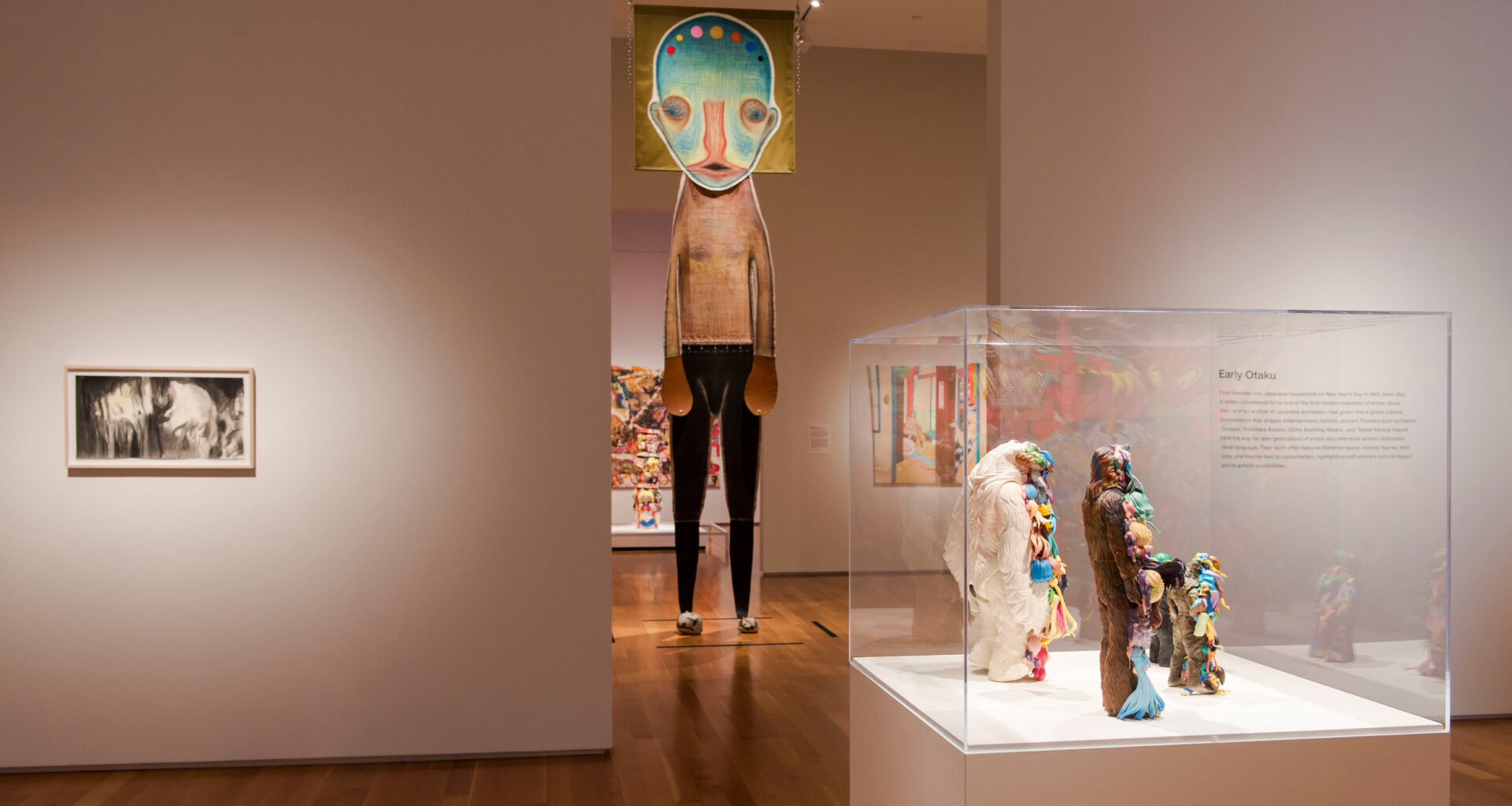
The House of Pikachu: Art, Anime, and Pop Culture
Asia Society Texas
October 17, 2025–March 15, 2026
Houston, TX
The House of Pikachu: Art, Anime, and Pop Culture, presented by the Asia Society Texas, explores the manifold associations of not only Pikachu but the scope of anime at large. Taking a sweeping view of its influence, most of the artists assembled by Owen Duffy, Nancy C. Allen Curator and Director of Exhibitions, like him grew up in a world in thrall with this aesthetic and its evolution, experiencing the aftereffects of its dispersal. Animation and comics—anime and manga—reside in the realm of the infinite; as pure visuals, they can propel their narratives regardless of their language of origin, yielding meaning where other modes of expression fail. Anime can wear its heritage lightly, speaking not only to a moment of creation, but also to the economies from which it emerges. Although globalization tends to flatten history and context, amid this leveling of difference, anime has proven to be perennially popular, thriving in our ever more interconnected world, with the style not just becoming substance, but subsuming it.
Seen through Duffy’s selection, the global influence of anime is deeply intertwined with its sweeping fandom. The evolution of anime from niche interest to global phenomenon, enabled by an ever expanding marketability, has resulted in a singular aesthetic confluence, surpassing all limitations of origin and becoming an international style all its own. The House of Pikachu surveys the broader implications of the intense enthusiasm of an ever expanding anime fanbase and an idiosyncratic blend of art and commerce that has undeniably altered visual culture at large. Such love is not born in a vacuum; even in more market driven works, the worlds of anime series often reward attention paid with rich world building and multidimensional characters. While produced with equal commercial calculation, Disney animation frequently offers a circumscribed world of predictable outcomes, possibility appended for storytelling efficiency, while the realms seen onscreen in a Hayao Miyazaki film appear to be awash in potentiality, the golden light of a new day seemingly always raking across the characters. These are complicated stories with morality that is rarely binary, few clear resolutions, and lessons learned perhaps only partially or not at all. For a generation, Pikachu was undoubtedly an entry point into the world of Japanese animation and comics and their multi-platform fandom. Through this admittedly kid-friendly aperture, it was possible to catch a glimpse of a different world, a domain of sophisticated mature storytelling, but above all, for those whose attention was grabbed, it served as an entry into an intimate world of fandom. Although ostensibly built upon a Pokémon-centered framework, Duffy’s curation does not ignore the larger evolution of anime and its reception in the 1990s, as well as it attaining a global reach in its selection. Like the inspiring source material, the scope is vast.
The 1990s—formative years for many of the featured artists—while marking the beginnings of the nascent growth of anime and Japanese culture as a world-spanning force, were a turbulent time in Japan. Although the decade would begin with the costumed romantic fantasia of Sailor Moon and the triumphal looping story arcs of muscular heroics in Dragon Ball Z, after the collapse of the real estate driven economy, to be swiftly followed by the 1995 Kobe earthquake and the Aum Shinrikyo cult’s Tokyo subway sarin gas attacks, a darker interiority could be glimpsed in some of the most popular anime being produced at the time. While not explicit responses to these events, Hideaki Anno’s 1995 Neon Genesis Evangelion chronicled the esoteric battles of a war-weary populace, and Masamune Shirow’s series Ghost in the Shell, explored the pains of digitally-defined existence. Both achieved explosive success, striking a nerve at a moment when Japanese society was enmeshed in upheaval. This febrile atmosphere also saw the rise of the original video animation (or OVA), enabled by the expanding world of home video, a new path toward monetization that allowed for increasingly lavish projects to be produced as well as the ability to make extensive back catalogues more easily available in foreign markets. For the budding anime fan, it was a golden era of discovery, if it was at times hampered by poor quality translations and hapless dubbing. In the sheer abundance suddenly available was an ecstatic newness, seemingly foretelling a world of greater permeability and cultural exchange through a medium that was able to speak in so many voices to so many people.
Julien Ceccaldi draws upon this profusion in his gallery-spanning A Collection of Little Memories (2025). In this near life-size composition, five figures stand on a gantry overlooking industrial ruin, extended into the space of sculpture with the addition of a steel staircase, paying homage to a towering reclining creature. One of the figures leans down to kiss the creature’s massive outstretched finger while another, sharply dressed, tosses an apple core toward it. Is this a pageant of desire or obligation? Are the offerings witnessed made out of devotion or terror? The figures in Ceccaldi’s tableau of lucid dread seem resigned to their own specific roles, while amid the creature’s rippling flesh, a limpid sexuality courses through the scene. Ceccaldi’s work, rife with scenes of collusive eroticism, makes use of many period-specific anime tropes, including the lanky battle-hardened bodies of Buronson’s Fist of the North Star and the spasmodic violence of Katsuhiro Ôtomo’s Akira, creating an insular iconography, both familiar and jarring. The monstrous figure, mostly seen as a swollen balding head pockmarked with veiny growths, stares out, his arresting gaze directed toward the viewer, eyes ringed with stylized specular highlights. Participation with the work is reordered with the sculptural appendage, complicating the sexualized doomscape further while questioning the inherent tensions of gallery spectatorship.