
“When communities understand that a single arrest, even one resolved in court, can trigger a handoff to ICE, trust collapses. Survivors of domestic violence hesitate to seek support. Parents avoid schools and hospitals. Public safety suffers.”
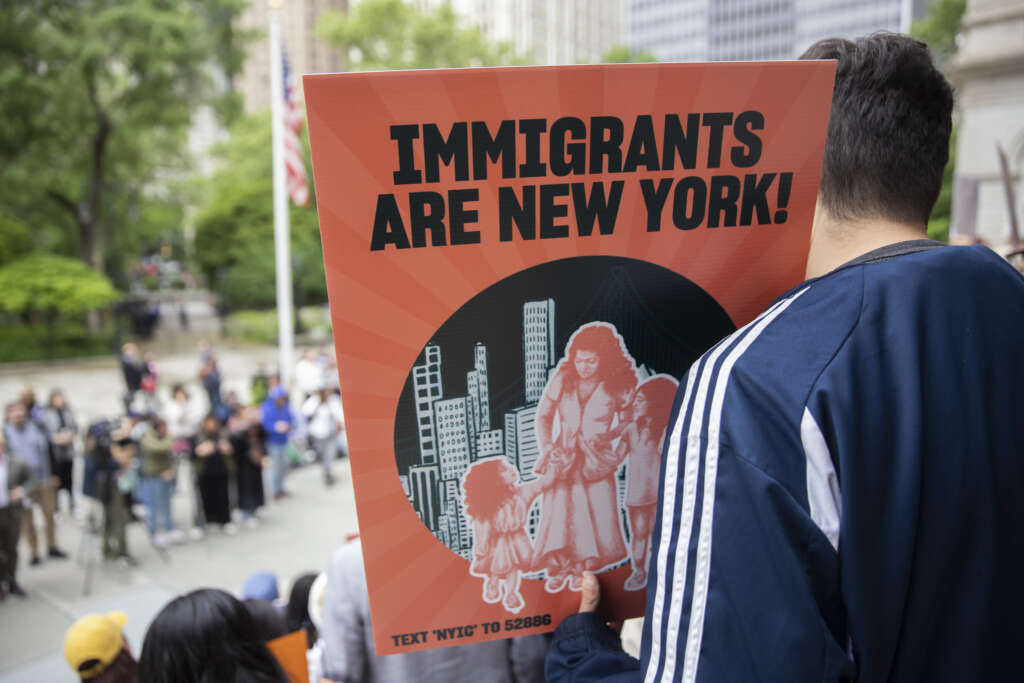 A 2024 rally outside New York City Hall. (John McCarten/NYC Council Media Unit)

When Gov. Kathy Hochul stood before New Yorkers earlier this month and denounced the Trump administration’s mass deportation agenda, she was right to do so. She proposed banning formal 287(g) agreements and temporarily ending contracts that allow U.S. Immigration and Customs Enforcement to detain people in local jails. It was an important acknowledgment that local entanglement with federal immigration enforcement causes severe harm.
Many elected officials and policy experts have already pointed out what is missing from the governor’s proposal. But there is a deeper issue beneath the policy details—a belief about how immigration enforcement can and should work.
The governor has suggested that immigration enforcement is not fundamentally flawed, only that it must be more targeted. Implicit in that view is the idea that we can separate immigrants into categories—those who deserve protection and those who do not—because at bottom we can trust our immigration system to deliver fair results.
After over a decade defending New Yorkers in immigration court, I can tell you: that premise does not hold up in real life.
I represented a young man I will call Adam. He came to the United States at 11 to reunite with his mother. As a teenager, he was arrested for robbery and sentenced as a youthful offender to a juvenile facility. While incarcerated, he did exactly what we say we want young people to do. He left gang involvement behind. He excelled in school. He rebuilt his relationship with his mother. He made plans for college.
New York invested in his rehabilitation—and it worked.
But the day he was released at 18, instead of walking into community programs lined up to support him, Adam was transferred directly to ICE custody—in a local county jail no less—because there was nothing in state law preventing that handoff.
He applied for humanitarian relief. He had viable legal claims. But because of the stigma attached to a criminal charge, he was denied bond and detained. Unable to withstand prolonged detention in Orange County Jail, Adam withdrew his appeal and was deported. He was stripped of the chance to pursue the future the state’s rehabilitation and tax dollars had made possible.
And here is the hard truth: nothing in the governor’s proposal would have stopped that transfer.
Adam was not swept up through a formal 287(g) agreement. He was handed directly from state custody to ICE because state law allowed that cooperation to happen. Even if 287(g) agreements are banned, and even if certain jail contracts expire, local officials can still share information and transfer custody absent a clear prohibition. If the state allows cooperation in certain categories of cases based on charges or convictions alone, then young people like Adam remain exposed.
That is what happens when policy rests on the idea that some people can be safely funneled into federal immigration enforcement.
But a charge or conviction is not proof that someone no longer deserves a chance to remain in the United States. It does not capture a person’s trauma, growth, or transformation. Yet proposals that preserve space for cooperation assume we can decide who is worthy of protection. We cannot.
And when communities understand that a single arrest, even one resolved in court, can trigger a handoff to ICE, trust collapses. Survivors of domestic violence hesitate to seek support. Parents avoid schools and hospitals. Public safety suffers because people can see that our legal system is based on arbitrary judgements, not evidence or fairness.
If the governor’s goals are to restore faith in state and local institutions and cease enabling our federal immigration system’s injustices, then the solution must be clear and consistent. The New York For All Act provides that clarity. It would prohibit officials from sharing information or transferring custody to ICE absent a judicial warrant signed by a judge.
That bright line matters. It means due process is not contingent on a charge or conviction alone. Without automatic cooperation, Adam would not have gone straight from juvenile detention to ICE custody. He would have had a real opportunity to pursue his legal claims and continue his rehabilitation in the community. Something every New Yorker has the right to pursue, just like people living in Illinois, Washington, and other places that have passed laws without making these false distinctions based on involvement in the criminal legal system.
This moment calls for a deeper uprooting of the causes of mass deportation. It requires us to reject the false belief that immigration enforcement can be humane if we simply target the “right” people.
After more than a decade standing beside New Yorkers in immigration court, I have seen teenagers mature. I have seen parents change. I have seen families rebuild. I have also seen how quickly progress unravels when local systems open the door to federal detention. Experience has taught me that the only way to protect due process, public safety, and the integrity of our institutions is to draw a clear line that preserves those principles.
New York can lead. But it must do so with clear eyes about what actually happens when we leave the door even slightly open. Pass the New York For All Act, and close it for good.
Karla Ostolaza is the managing director of the Immigration Defense Practice at The Bronx Defenders.
We want to hear from you!
Take a short anonymous survey to help us deliver content to empower our community.