
states of becoming
The Bruce Museum
November 28, 2025–May 10, 2026
Greenwich, CT
Visitors to the Barclays Center in Brooklyn may be familiar with the large, dark, tornado-shaped sculpture looming beneath the oculus. The monumental piece anchors the space, balancing conflicting feelings of timelessness, and unease. Titled Ona (2013), which translates from Polish as “she,” the work is by Ursula von Rydingsvard and is one of her largest bronze sculptures to date. Born in 1942 to a Polish mother and a Ukrainian father, von Rydingsvard spent several childhood years in a series of German refugee camps after World War II. She immigrated with her family to the United States in 1950 and now maintains a large studio in Brooklyn. At age eighty-three, after more than five decades of sustained work, she shows no sign of slowing down.
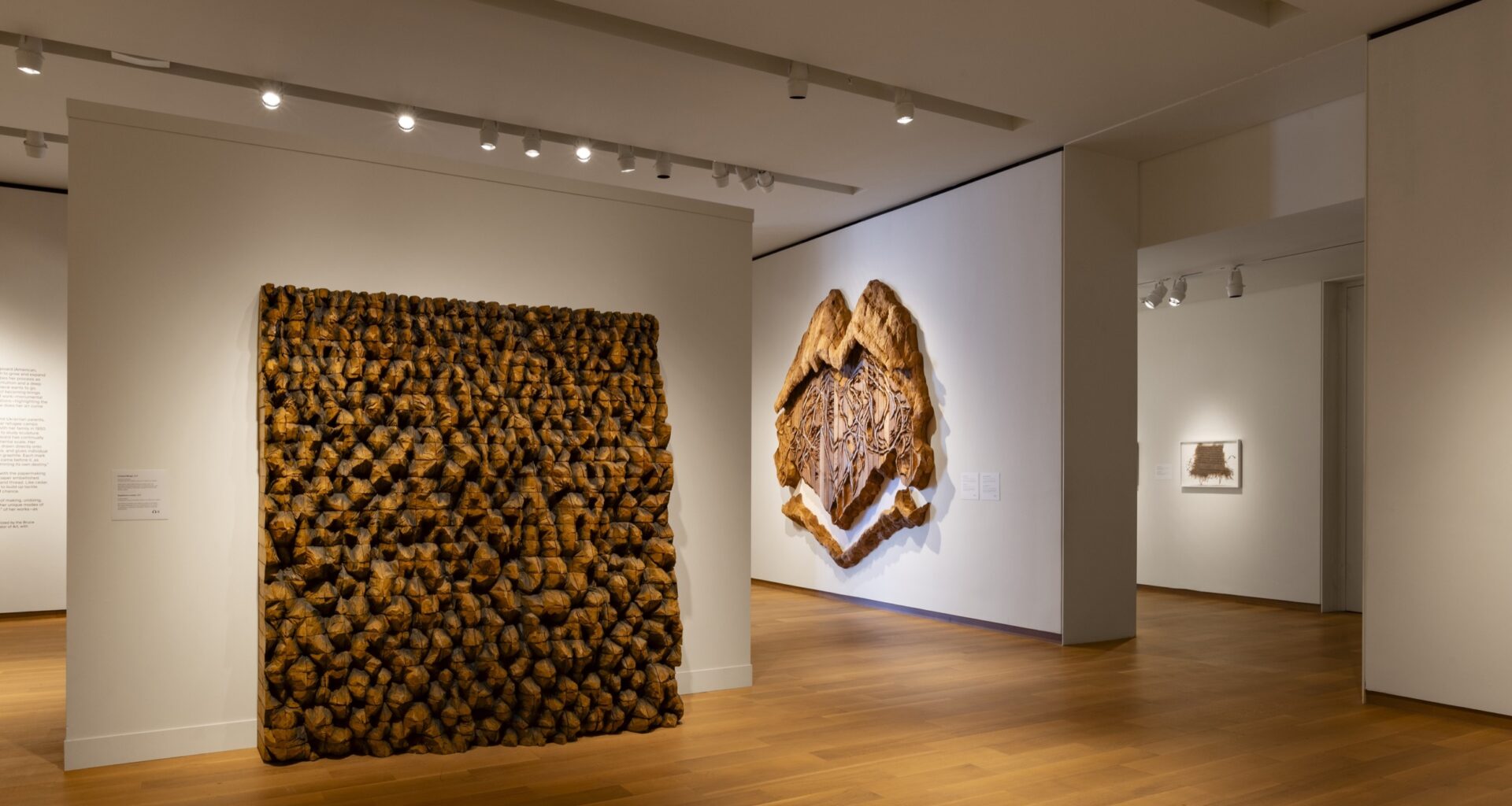
At the Bruce Museum exhibition, Ursula von Rydingsvard: states of becoming, her work feels less ominous and more attuned to the human scale, in contrast with Ona as well as her two monumental wooden sculptures at Storm King Art Center, whose forms echo the scale and drama of canyons or rock cliffs. For Paul (1990–92/2001), the large black sculpture at Storm King, addresses the loss of her husband. That sense of loss permeates much of the work in states of becoming, though it is expressed on a more intimate scale.
The exhibition reflects careful attention to spatial relationships. The placement of the works demonstrates thoughtful curatorial decisions by Margarita Karasoulas, allowing each sculpture room to breathe while reinforcing the emotional and thematic connections between them. At the entrance to states of becoming stands her sculpture Book with No Words (2017). As the title suggests, it takes the form of a large book, its pages made from thin cedar boards and left entirely blank, without words or images. The sculpture functions as a quiet prologue, inviting viewers to imagine, reflect, and construct meaning as they move through the exhibition. Early in her career, von Rydingsvard often left works untitled, allowing for open interpretation. More recently, she has favored single-word titles in Polish, which, with some effort on the part of the viewer, offer subtle conceptual cues rather than a fixed reading. The exhibition features several of the large, monolithic wooden sculptures for which she is best known, their forms evocative of stalagmites. These are complemented by freestanding and wall-hung works that reveal unexpected surprises. Interspersed throughout are pieces created in collaboration with the papermaking studio Dieu Donné in Brooklyn.
Among the most striking departures are the sculptures ZGINEŁA (2017–19) and Estrella (2012). Both reference bodily forms, marking a shift from von Rydingsvard’s predominantly abstract body of work. ZGINEŁA, which translates from Polish as “she died,” is a large sculpture positioned at the threshold between floor and wall. Made using her familiar cut-and-stacked wood technique, it features leg-like appendages emerging from what can be read as a reclining figure. The sculpture was completed the year her husband died, and the shifted gender of the title remains enigmatic. Estrella, a wall-hung work, resembles a disemboweled stomach, echoing Kiki Smith’s explorations of the digestive system from the 1980s.