
Sculpture
The Chinati Foundation
October 11, 2025–June 2026
Marfa, TX
It is about as easy to put the work of Fred Sandback into words as it is to capture it in a picture. Using acrylic yarn stretched taut to create various shapes and arrangements between the walls, floor, and ceiling of a given room, Sandback’s “sculptures,” as he terms them—despite their obviation of any physically quantifiable volume—become nearly indistinguishable from the spaces they occupy.
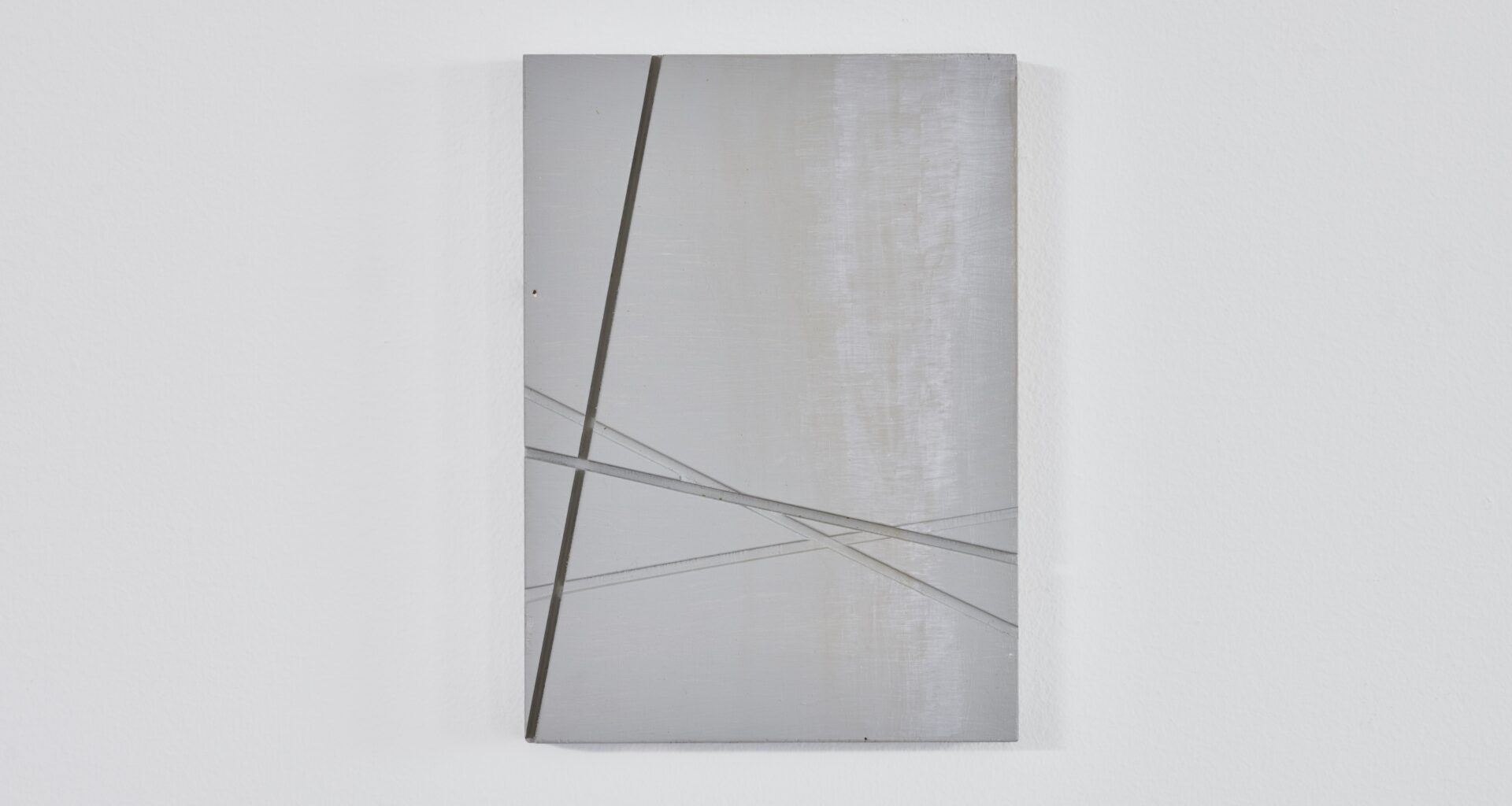
Each composition, which lives on paper as a diagram or certificate until its realization in three dimensions, is distinct in color and form, but invariably responsive to the site in which it is installed. This attunement to subtle shifts—and its sheer irreproducibility—is clear in the artist’s current exhibition, Fred Sandback: Sculpture, which comprises six sculptures and three small wooden low-relief wall works at the Chinati Foundation in Marfa, Texas. Although these works were first installed in 2001 by Sandback himself, in the exact same arrangement and the very same U-shaped barracks, it is nonetheless reasonable to assume that he would believe the current manifestation, however identical, to be unique, beholden to the time and space in which it exists.
In the seminal essay “Art and Objecthood,” Michael Fried refers to the work of Sandback’s peers—Donald Judd, Robert Morris, Frank Stella, and others—not as Minimal art, but as literalism or theater. Despite the negative connotations of performativity that the latter term holds for Fried, his characterization touches on an unassailable quality of the work in question. He quotes Tony Smith’s account of driving down the unfinished New Jersey Turnpike at night, and remarks, “The experience is clearly regarded by Smith as wholly accessible to everyone, not just in principle but in fact.” In such circumstances, the socially constructed, context-dependent nature of art falls away and all that’s left is experience.
Specific objects: basic shapes and colors in largely unvarnished, recognizable materials push and pull the viewer along a path that they might not otherwise have taken throughout a given space. The gestalt of these gestures—the ability to understand them readily and extrapolate from a particular vantage what shape or arrangement the parts that remain unseen likely take—creates an encounter that is immediate, embodied, and to some degree predictable. This signifies a departure from orthodox modernism, which demanded a distanced, disembodied vantage—a pair of floating eyes that see without the inconvenient obtrusion of their physical support, their orientation in the present moment, their liveness.
A yellow triangle leaning against the wall at an odd angle, for example, welcomes visitors upon entering the exhibition at Chinati. But the triangle is a phantom, conjured with three lines of yarn. By outlining a shape, it creates the illusion of a volume that slows your approach and bars your access—not literally, of course, only psychologically. And that right there is the point. As literal as Fried would have you believe all Minimal art to be, it still traffics in that ineffable quality that makes something art. Sandback himself has said, “illusions are real and reality is allusive.” We would do well to listen to him, as his work, despite its extensive intellectual superstructure, does not live in the mind but rather the body—and the body knows far more than we’d like to admit. What I’m speaking of here is not a formal or psychoanalytical reading of Minimalism, but a transcendental one.
So despite Fried’s insistence that art transport your eyes—but not your body—into another space, perhaps another time, within the frame, I have not had an experience of art that does this more tangibly than Sandback’s. As Andrea Fraser explains in her essay “Why Does Fred Sandback’s Work Make Me Cry?”, we are all products of socialization, which has, in my case and hers, enabled us to recognize specific objects and experiences as art. All I have is my own vantage. So in rereading Fraser’s essay anew I was struck by her description of the Freudian concept of “object loss”—the loss of a significant person or thing that results in profound grief—as a principal source of the emotional experiences art provokes. Now I find myself searching for the “lost object” that I mourn in my return to Sandback.