
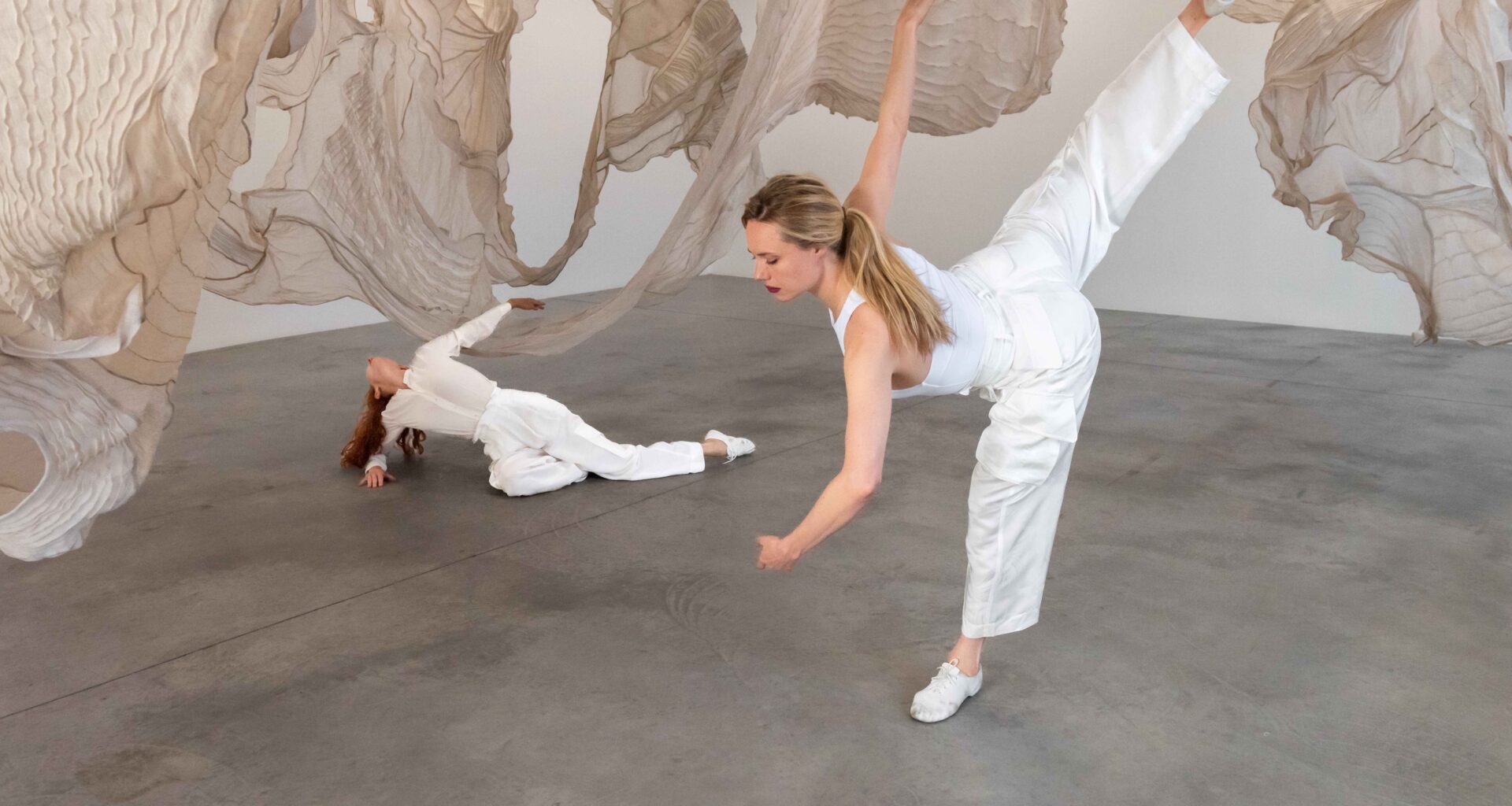
Superbloom (Dancing Into Choreographic Forms)
92nd Street Y
March 27–28, 2026
New York
Jodi Melnick and Sara Mearns return to 92nd Street Y in March to present the world premiere of Superbloom (Dancing Into Choreographic Forms). The performance is part of Women Move the World, 92NY’s 2025/26 Harkness Mainstage Series devoted entirely to works curated and created by women. The new evening-length piece for five dancers is inspired by female choreographers who have shaped the American modern and postmodern dance scene, as well as 92NY’s own storied history.
Melnick and Mearns come from very different worlds. Melnick’s choreography is rooted in postmodern dance, drawing from over thirty years performing with downtown luminaries like Twyla Tharp, Sara Rudner, and Trisha Brown. Mearns has been a principal dancer with New York City Ballet since 2008, performing George Balanchine’s neoclassical repertory and originating roles for contemporary ballet superstars like Justin Peck, Alexei Ratmansky, and Christopher Wheeldon. But since meeting a decade ago, the two women have formed a strong artistic bond and created many innovative works together.
Melnick and Mearns spoke with the Brooklyn Rail about their newest collaboration, their unexpected partnership, and the body as an archive.
Caedra Scott-Flaherty (Rail): How did you two find each other?
Sara Mearns: We first worked together at Danspace Project. We were in a group for Platform 2015, with Rashaun Mitchell and Sterling Hyltin. She was paired with Sterling, and I was paired with Rashaun. But when we got to St. Mark’s Church, we were all working as one. And that’s how the universe put us together. How we “found each other.”
Jodi Melnick: It was, like, a Judson postmodern person and a Merce Cunningham person and two Balanchine New York City Ballet dancers. And we were all matched.
Rail: So fun!
Mearns: Jodi did not think it was fun, at first.
Melnick: I did not think it was fun. I was like “No, no, no, no, no.” I really didn’t know ballet. I was not interested in it. And then we all met, and something happened that week with Sara and me. Rashaun and I had to work really fast; we had these postmodern experimental ideas and I was surprised that Sara was basically cutting her veins open for us, like, “Give it to me, give it to me, give it to me!” So, we kept going. I remember I gave a very leggy dance that I would normally not do for myself, but I gave it to her, and I said, “Sara, you have a three-minute solo, and these are your sixteen counts.” And at first, she was like, “What? Are you kidding me?” And then twenty seconds later, she was like, “Okay.” She connected to that idea. Something opened up, a possibility to insert herself into another way of making work that she maybe did not know existed.
Also, I think she connected to me as a female choreographer. Coming from where she came from, she saw that I had a certain kind of agency, a certain way of working that was more… nice. [Laughter]
Mearns: Yeah. I had worked with only two female choreographers before. One was Susan Stroman, and then Melissa Barak at City Ballet. But it wasn’t extensive like this. So, Jodi’s correct. Working with women is… It’s just a different energy. It’s a different way of speaking to each other. And it’s a different level of respect as well.
After that, I was offered a residency at Jacob’s Pillow by Executive and Artistic Director Ella Baff, and when she asked what choreographer I wanted to work with, I didn’t even flinch. I knew I wanted to work with Jodi.
So that’s how it all started. And here we are, ten years later.
Rail: How many pieces have you two made together since then?
Mearns: Official things? About five. But then we’ve done small things, too. And residencies. It’s ever flowing, never stopping.
Rail: Jodi, how has working with Sara affected your choreography?
Melnick: My choreography depends on what goes through my body. That’s what I’m interested in. But there was a very clear switch about twenty days into our first residency when I was like, “Oh, I could make other stuff that maybe I’m not interested in for my own body.” But with what my body knows how to do, and with Sara’s capability, it could really push me. The information in her body has moved my choreographic process into, not a new direction, but, like, a tangent—which has been really surprising and exciting for me. It makes me consider different things—rhythm, time, space. It makes me reify the things that are important to me, like the spectacular in subtlety and nothingness.
Rail: And Sara, how has working with Jodi affected your dancing?
Mearns: For me, it was some of the things that she said in that first residency. As ballet dancers, we’re always very presentational. We go out on stage and automatically, probably without even thinking about it, dance bigger than we are. Like there’s something on top of what we’re doing. And I remember her stripping that away and saying, “You don’t have to comment on your movement. Respond to it, but don’t comment on top of it.” And, “When you walk out on stage, you don’t have to be bigger than who you are. Just walk out and that’s enough.” And, “When you lift your arm, don’t make it a big thing. Just lift your arm.” It was the simplicity of understanding that our bodies are enough.