
The Endless Garment: Atlantic Basin
Pioneer Works
January 24–April 12, 2026
Brooklyn
Red Hook, the neighborhood in Brooklyn’s southwestern edge, boasts a rich maritime history: it was one of New York’s most active transcontinental ports through the 1940s, a century after the Atlantic Basin inlet was dredged and established as a key terminal for cargo from Asia. While this commercial landscape later shifted with the onset of containerization, the area’s industrial evolution—which brought ethnically diverse dockworkers to settle in Red Hook—remains an important thread in the fabric of New York City’s immigrant history. The Endless Garment: Atlantic Basin positions itself in this specific context of commerce and migration, presenting a transnational group exhibition exploring the labor, production, and representation of Asian fashion. Curated by Jeppe Ugelvig, this is the third iteration of an ambitious research project, which previously culminated in two exhibitions in Beijing (2021 and 2022) showcasing artists and designers from China and Southeast Asia. Compared to the dozens of participants in earlier shows, Atlantic Basin presents a more focused group of nine, within the fitting space of Red Hook’s Pioneer Works, a former iron factory turned nonprofit cultural center.
Spanning two floors, the exhibition begins subtly on the stairwell with Serena Chang’s Inventory (2025), showcasing three identical photographic prints of a cardboard surface with yellow strapping and handwritten import/export text reading “NEW YORK” and “MADE IN TAIWAN.” The inventory note was written by the artist’s father, who founded a hosiery manufacturing company in Queens upon emigrating from Taiwan, revealing a layered personal history within a global textiles network. Framed in steel and displayed against concrete brick below the handrails, Inventory alludes to the international movement of cargo within industrial containers, or products shipped and stored in warehouses. A cluster of intricate sculptures made from repurposed hosiery, collectively titled Sweet Water (2024–25), tower outside the first gallery. These nude, skeletal frames of sugarcane plants cast shadows against the wall, doubling their form into a forest. Chang’s practice often speaks to the inherited labor of the family business established in 1992, after her father learnt the trade at a warehouse in Red Hook—an autobiographical detail omitted in the wall text that nonetheless underpins the artist’s relationship to Brooklyn.
Garments dominate the first gallery, with intimate works that further examine personal relationships and histories to textiles labor. Echoing the vertical forms of Serena Chang’s sugarcanes, which also occupy this room, are suspended wooden racks draping Chang Yuchen’s vast archive of delicate handmade clothing, composed of an assortment of fabrics stitched together. Many of them resemble aprons, with distinct straps and open backs, perhaps a nod to the often unrecognized labor of domesticity and artwork fabrication. Created over the last decade in an ongoing project titled Use Value (2016– ), Chang Yuchen prices each item transparently, based on the varying monetary value of her labor, determined by the range of jobs she’s undertaken in the US, from hospitality to academia. The ranging hourly rates are displayed on the beams in meticulous, handwritten notes, revealing the fluctuating costs of her employment across industries, while reflecting on broader questions of value and commodity.
A row of uniform, denim shirts hang at the opposite end of the gallery, displaying Huang Po-Chih’s Production Line – Made in China & Made in Taiwan (2014). Huang enlisted his mother and her former textile worker colleagues to make the shirts after they became unemployed due to the industry’s incremental offshoring from Taiwan to Shenzhen, China. Each tagged in bold with “Phase 2; TB14; Taipei Biennial 2014,” the shirts were presented at the Taipei Biennial exhibition with a makeshift live production of the shirts, following its “Phase 1” debut at the 2014 Shenzhen Sculpture Biennale where the shirts were first live manufactured. This contextual background is curiously absent, forgoing the nuanced narrative of ongoing socioeconomic exchange, and the artist’s framing of the evolving, global industry within an institutional setting of an art museum.
The presentation of Huang’s work focuses tenderly on his mother’s experience as a seamstress, with large, black-and-white portraits alongside testimonies. Blue Elephant—Mother, “Wanting falls around me. Heavy garment, but I can be a floating elephant in my dream.” (2018) is a poignant image, with his mother’s head tucked into her left shoulder, right hand pinching her nose, and left arm stretched out. I recognize the playful imitation of an elephant, whose legs the mother likened to those of her own swollen ones in a testimony describing the physical strain of the work that she and others endured.
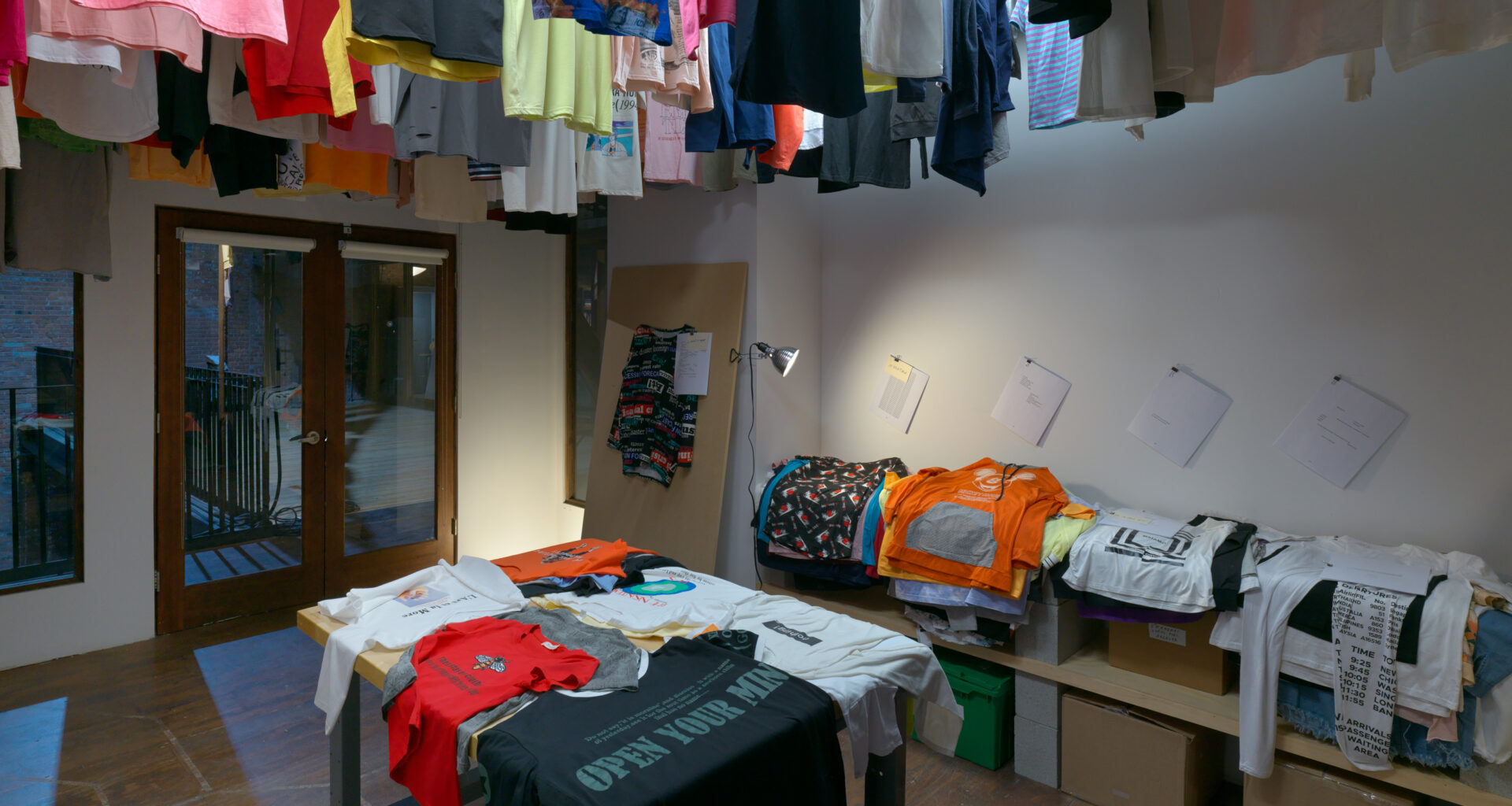
Two artist collectives, Shanzhai Lyric and CFGNY (Concept Foreign Garments New York), were previously exhibited in the 2022 Endless Garment Beijing exhibition. As a current resident artist at Pioneer Works, the self-described “poetic research unit” of Shanzhai Lyric’s inclusion appears coincidental but less intentional. Established in 2015 by Ming Lin and Alex Tatarsky, the group has been prolific, via the fictional office entity Canal Street Research Association, in advocating for the lyricism of bootleg products, examining the creative potential of mistranslated, counterfeit language. For Atlantic Basin, their archived clothes are piled up on a table and hung on clotheslines overhead, mimicking the apparent disorganized nature of the informal economy. While some texts are isolated and printed on paper, the display does not allow for a lyrical or clear reading of the words that exist on the knockoff clothing central to their research.