
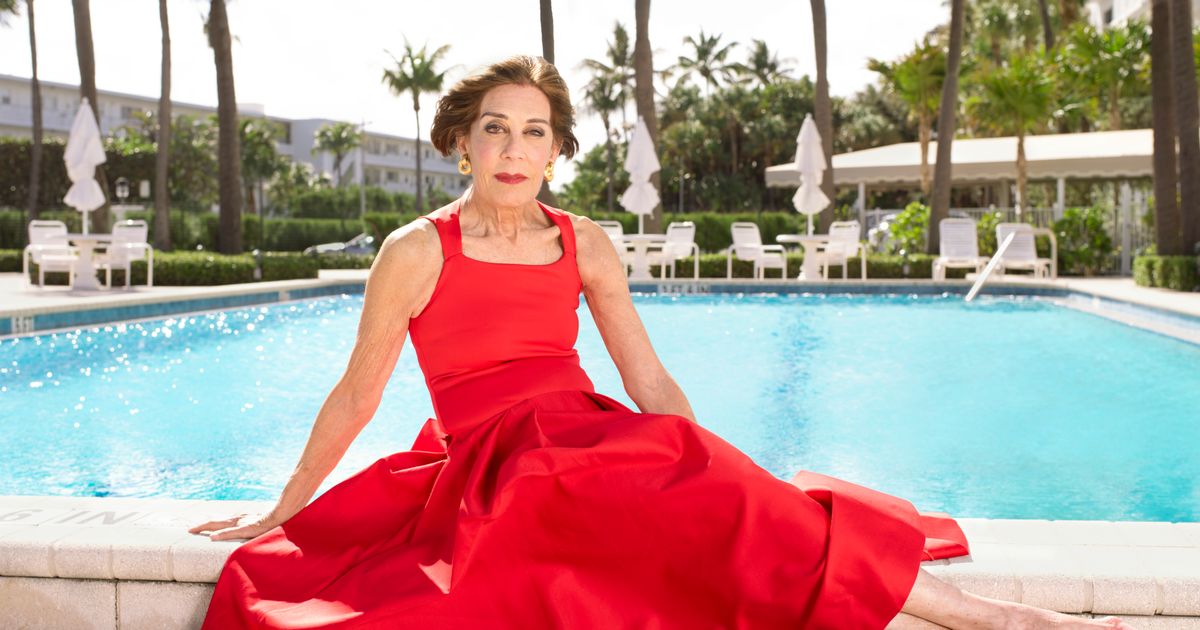

“It was like the devil had heard it in my voice. He’d in some way figured out the worst thing he could ask me.”
Peggy Siegal, the once omnipresent New York publicist, is describing her first conversation with Jeffrey Epstein. It was a phone call — she believes in 2006 or 2007, sometime before his first criminal conviction. She says she’s never before discussed it.
Siegal, now 78, was once the film world’s most coveted publicity power broker. For four decades, beginning in the 1980s, she was the woman studio heads relied on to stir up Oscars buzz by hosting exclusive screenings and clubby dinners. She’d worked for everyone in Hollywood — Steven Spielberg, Harvey Weinstein, Barry Levinson — and specialized in bringing together charming, influential people from disparate social worlds and especially the cultured classes of L.A. and New York. She was as known for her brash, bulldozing style as she was for her “golden rolodex” — a catalogue of more than 30,000 VIPs, organized by industry and importance, how many houses they owned, and whether they were voting members of the Academy.
At the height of her power, Siegal’s defenses seemed inviolable. She was confident and casually rude, inviting herself anywhere she wanted to go. She critiqued her own flaws before others could, once writing and sending out a booklet called How to Look Like Me at 60, which detailed every bit of cosmetic work she’d had done and was passed from hand to hand up Park Avenue and into Beverly Hills. Siegal often said that because she’d had the fat sucked out of her butt and injected into her face, anyone who was kissing her cheek was also kissing her ass. She was eternally single but swatted down pity by joking that she’d give a Mercedes station wagon to anyone who found her a husband. She made it known that in reality she was wedded to her work.
But Epstein, the devil on the phone whom she’d never once met, seemed to see through her. He had sent a “very expensive” Cartier travel clock to her Upper East Side apartment — “It just appeared,” she says — earlier the same day. “I remember opening it up and saying, ‘Who the hell is this guy?’ And then he called, like he was my best friend … How am I? He proceeded to name-drop all these people we both knew, friends in common. He made it clear that he had numerous houses and a jet and that he was a player and should be on my screening list.” Then he asked her, “Have you ever been married?”
“I instantly knew,” she says, “that he collected information to use against you. I instantly knew that’s what he did.” She had not been married. “It was something I was very sensitive to. He wanted to find out some weakness in my makeup or my life. There was a sense of danger. It was like a warning bell.”
That alarm was unsteady — it seems to have swelled and faded as they spoke. In nearly the same moments, Siegal says, Epstein “was charming and funny.” Yet she “knew from the beginning he was a creep.” In the months and years that followed, he flattered her “constantly.”
“He thought I was terrific. He adored me,” she says. “He couldn’t get enough of me. He thought I was funny. He thought I knew everybody. That is sort of hypnotic.”
She stops to make sure she’s been understood: She means that Epstein was the one who was hypnotized — by her.
Siegal’s career, and position in high society, were destroyed in 2019, when it was reported that she’d been among, in the words of the New York Times, the “social guarantors” who greased Epstein’s return to elite circles after his first stint in jail. Now, in a recent cache of files released by the Department of Justice, more than 5,000 emails between Siegal and Epstein have been made public. Over a series of phone calls in late February and early March, Siegal told her version of events and described her relationship with Epstein. She was eager to defend herself, proud, and frequently panicked by the prospect of returning to this particular spotlight — of renewing her humiliation and her exile.
When the Times story broke, Siegal did not dispute that she’d ushered Epstein into screenings and events and hosted a now-infamous dinner at his Upper East Side mansion with Andrew Mountbatten-Windsor — then Prince Andrew — as the guest of honor. She told the press she’d never formally represented Epstein as a publicist and initially said their relationship had not involved money. (Epstein was repped, for a time, by the late Howard Rubenstein, who also worked for Rupert Murdoch and Donald Trump; he later worked with Michael Sitrick, who represented R. Kelly and Harvey Weinstein.)
Within days of her first statements, Siegal revised her story, acknowledging that she’d accepted funds from Epstein for travel but said that this arrangement had ended in 2010. She maintained she knew nothing of his crimes and that, because his 2008 sentence had seemed so lenient, she had not believed the charges against him “were very serious.” (It was true that his penalty had been remarkably lax. For soliciting prostitution and “procurement of minors to engage in prostitution,” Epstein had served only 13 months in a private wing of the Palm Beach County jail and a year of house arrest, during which he’d been allowed freedom to travel, including to his property in the U.S. Virgin Islands. Siegal, however, had known of accusations against him as early as 2007, when she spoke to this magazine for an article that detailed allegations of molesting a 14-year-old girl.) Siegal insisted her relationship with Epstein had been distant: “I mean, I knew him,” she told Vanity Fair in 2020, “but I didn’t know much about him. I was never privy to his private life.”
The latter may have been true, at least when it came to the worst of his secrets. But in the published emails, the two are shown to have remained in regular contact from April 2009 (around the time that Epstein’s now public “jeevacation@gmail.com” account was created) until April 2019, exchanging money and access until three months before Epstein was arrested for the final time on federal sex-trafficking charges — almost a decade longer than Siegal had previously admitted. The two in fact seem to have lived, for a time, interdependent lives: Siegal relying on Epstein for large sums of money as well as legal assistance and financial advice, all of which allowed her to maintain a lifestyle that enabled her career; Epstein leaning on Siegal for far more than party invitations, depending especially on her skills in social maneuvering. The relationship reads as close, admiring — two famously cutthroat people privately paying each other a warm and strangely genteel attention.
Siegal was a locked box, friends and associates say. Personal details about her life escaped between the lines of self-effacing jokes: that she grew up in an upper-middle-class Jewish family in New Jersey with a father who invented varieties of lightbulbs; that she had a mother who once told her she couldn’t have her portrait painted, and hung alongside her brother’s above the mantle, until she was prettier.
Though there were hundreds of people Siegal called friends — associates say everyone was a dear one if it helped her social status — people who know her say she made no pretense of loyalty to anyone but herself. She was a member of the Harpies, an Upper East Side lunch club that once included Nora Ephron and Tina Brown, and the Tennis Girls of Southampton, who played together for 20 years and included Renee Rockefeller and Tory Burch. Siegal regularly broke the group’s rule barring unkind gossip. She could be deeply cruel — as one friend put it, “Always looking over your head for the next best conquest.”
Yet in communication with Epstein, she appears unguarded, voluble, and faithful. In return, Epstein, who seems to have held enormous power over countless people to whom he never expresses any warmth at all, devotes significant time and care to her concerns. Siegal confides her anxieties and seeks his approval: “How about this!” she writes, forwarding an email in which a redacted sender compliments her writing. She rants about her work, and the two discuss how she can “out maneuver” her professional nemesis, another film publicist, whom she calls “a nasty fag.” Epstein advises her to be careful (“as the fags stick together”) and to hold onto her perch in “classic hollywood and leave the fadish trash” to her rival. Siegal details a painful rift between her and her niece, whom she adores — “It broke my heart to see her cry and cry,” she writes — and Epstein advises her not to send the niece any more money until the two are speaking again. When Siegal battles her brother, her mother’s favorite child, for her inheritance, Epstein attempts to win the fight for her, bringing in his lawyers and overseeing a protracted, three-year negotiation. “Once again,” Siegal writes, “you have saved my life.”
By 2010, at least a dozen women had filed civil suits against Epstein, claiming he molested them when they were underage. The next February, Siegal was emailing him as her 87-year-old mother was dying of breast cancer. In a message titled “Mother Siegal — Still Breathing,” she writes, “Yesterday at the nursing home … mother was half dead. It was beyond ghoulish to sit there and watch her take her last breaths. Is this what loving relatives do? They watch their parents die. I have seen enough of this suffering … Did you sit there till the very end?”
Epstein had previously recommended an oncologist for her mother — the doctor was “the best,” he wrote. He would later advise her on how to pay for the funeral and recommend she hire an assessor for her mother’s estate, and the two discussed establishing Siegal’s living trust. As to the question of staying by her mother’s deathbed, he said, “I suggested you no longer go. Those last images, like the ending of a movie, stick with you, you need no more unpleasantness.” A few days later, Siegal requests his advice on a draft of a message announcing the death; it’s “perfect” he tells her. “I’m here if you want to talk.”
When asked if this relationship was a friendship, Siegal says, “I don’t know what the definition of a real friendship is. It was transactional.” And there is no question that improbable gifts were exchanged. But this was not a simple trade of favors and cash.
“Everything you do for me makes me feel there is a guardian angel watching over me,” Siegal writes in late July 2018, less than a year before he entered a federal detention center in Manhattan. “It is beyond comforting to know you always have my back.”
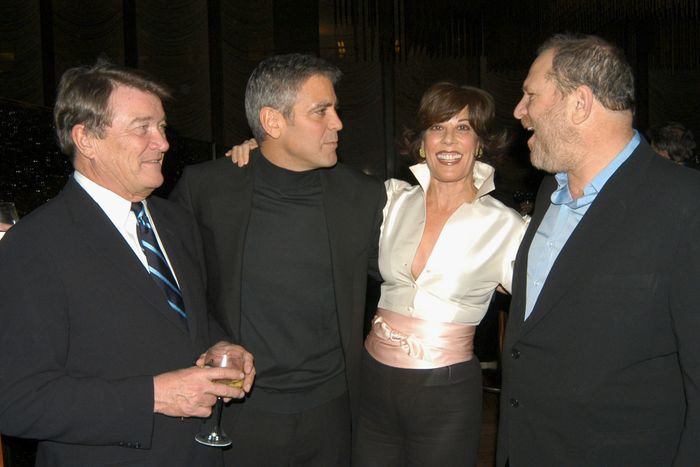
Steve Kroft, George Clooney, Peggy Siegal, and Harvey Weinstein at the Four Seasons in New York City, in 2006.
Photo: Nick Papananias/Patrick McMullan/Getty Images
According to Siegal, Epstein wanted to know everything about Hollywood and New York parties and all other happenings about town. She was already in the habit of sending — to a vast list of friends and acquaintances — lengthy, dishy dispatches (her “diaries,” as she called them), detailing and assessing various social scenes. Occasionally, she published editions of these notes in Avenue and Hamptons, society magazines. Following the advent of the BlackBerry, she often tapped them out late at night from the back seat of a Town Car on her way home from events in a stream of consciousness, full of typos.
As she traveled the city and the world, Siegal sent Epstein private missives of a similar style, providing him with precise knowledge of enclaves she knew far more intimately than he did. “He wanted to know what was going on,” Siegal says, “and I could not write these emails fast enough.” The earliest of these messages, in the DoJ files, is sent in April 2009, while Epstein is still in the Palm Beach County jail.
From downtown Manhattan, Siegal writes, “Saw Eva and Glen Dubin” — Epstein’s former girlfriend and her billionaire husband — “and her cute teen daughter. We spoke about how much we love you, miss you and are devoted to you. We are all counting the days you get out.”
From the Hamptons, in August 2009, shortly after Epstein’s release:
“Lame outdoor screening … of ‘Every Little Step’ in Sagaponack for Film Society of Lincoln Center … stopped by for business … only with, Philip Seymour Hoffman.”
From Capri, a month later:
“Harry Benson, the photographer who was standing right next to Bobby Kennedy when he was shot and got those world famous shots of him bleeding to death on the hotel kitchen floor is on the boat too. His is the most annoying human being I ever met.”
From midtown the following February:
“Martha Stewart hostel [hosted] a dinner … for us for ‘Food Inc’ documentary and then came to my dinner for Lord and Lady Astor both at Monkey bar … Will send all social/business info tomorrow on way to DR …”
The messages were in part a show of gratitude, Siegal says, in a form she loved. “I had become obsessed with expressing myself in email, and if he would send me to Cannes or a film festival, a simple thank-you note was not in my vocabulary.” The files show that Epstein paid for an equestrian safari in Kenya with her niece before their estrangement and for trips to Cannes multiple times (the cost in 2010 was $37,644 — Siegal sent him the budget). Though it’s unclear if Epstein paid, she asked him to foot the bill for hotels at the Venice Film Festival in 2010 and a twin-engine charter flight to East Hampton in 2012. (“It costs $1,136. Would you be a doll and help me out?”)
Siegal had wanted to be a writer; Nora Ephron was her idol. “At my mother’s funeral,” Siegal says, “I wrote a eulogy that brought the house down. And Nora Ephron turned to Barbara Walters and said, ‘She really has a voice.’” At one point, according to Siegal, she asked Ephron if she could publish her diaries under the title Notes to Nora. Ephron said “no” — that Siegal needed to write her own story. In crafting the emails, Siegal says, “I was teaching myself how.”
“I can never ever thank you enough for giving me these fabulous, fun, smart and sunny days in Europe,” she writes to Epstein from one trip to France, where she spent time on Paul Allen’s “414 foot boat, Octopus, that … is beyond anything I have ever been on … I see everyone in the industry … wear my chicest clothes and always have a funny story … and seem to get great feedback on my antics. My presense translates into jobs.”
While Siegal took pains, repeatedly, in our conversations to emphasize that her relationship with Epstein was not romantic, not even “platonically romantic” — “The idea that I had any affection for him is ludicrous,” she says — she was unconcerned that his money appeared to enable her career. That was simply a fact. “He didn’t buy me jewelry,” she says. “He bought me plane tickets to go get work.”
Epstein had come into Siegal’s life at a time when film studios — her main source of business — were contracting and helped her to project the same high-class lifestyle as her clients. For Siegal’s 70th birthday in 2017, Epstein gave her $100,000. In an email, she writes that she planned to spend $30,000 of it on a lavish party for herself in Southampton with 70 guests and a lunch overlooking the ocean. Fifteen-thousand dollars would be donated to Elton John’s AIDS Foundation, she writes, “enabling me to attend a party at his house in June.” Another portion would go to her apartment renovation; she needed a temporary floor covering while she waited for “an amazing brown and beige leopard rug that is wall to wall carpeting for my whole apartment and being made in France.” It would take four months to arrive. “When the apartment gets done,” she writes to Epstein, “you’re my first visitor.”
Siegal says now, “I had no problem taking his money. He had lots of it.”
“You have to put in,” she says — meaning into this story — “that in 2007, we all had BlackBerrys. We never knew the power of this gizmo. No one ever imagined that what we were saying on a little typing machine had the ability to go global in 2026.”
Later, in the same conversation, she cuts in: “Wait, I want to say something about the emails. I was known for my wit. And when I started to write my wit down in these emails, I had no filter. I had no filter because I wanted to amuse people.” It was something for her to do when she got home at night. “I’d be living alone and had no one to talk to, so I’d write an email to somebody. I can write a thank-you note that can make you weep with laughter and cry with joy,” she says. “I was famous for these emails. I’m still famous for them.”
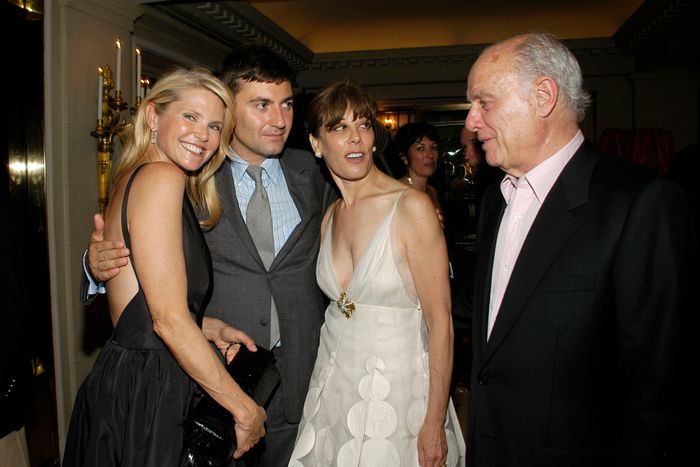
Christie Brinkley, Euan Rellie, Peggy Siegal, Marshall Rose, and in the background, Ghislaine Maxwell, at Siegal’s 60th birthday party at Hôtel Plaza Athénée in 2007.
Photo: Patrick McMullan/Patrick McMullan/Getty Images
Maybe it was only a transaction when Epstein wrote to Siegal in the summer of 2011, telling her not to worry about the accountant he recommended to help in her legal dispute with her brother. “You shmooze and find me a baby mama,” he says. Siegal, in Southampton at Tory Burch’s, writes back: “A baby Mama … if I wasn’t 102 I would take that job in a nano second.” Epstein replies: “I need great genes. smart pretty , funny if you were fifty years younger , whoops „forty.”
Maybe it was only work when Siegal took his request seriously, writing: I am thinking this is a position for a European who understands the mistress (in this case baby mama) mentality. You need someone young without much of a career. Maybe a professional student … someone who is kept and can just keep going to school. Also, who doesn’t have much of a family herself. A wanna be socialite is NOT the way to go. Looking and looking. xoxo Peg.
Maybe all of it is playing at intimacy — another way to keep each other hooked in their mutually beneficial arrangement. But their correspondence, taken as a whole, also reads like a reciprocal fantasy: for Siegal, a strong and steady man, a provider, who guarded against her antagonists. For Epstein, the affection of a woman of appropriate age (his senior in fact), a truer respectability than he could buy, a decorous life.
Siegal’s description of the relationship is not so different. “Jeffrey Epstein was … I don’t want to use the word infatuated,” she says. He saw her as she saw herself.
“Jeffrey Epstein actually knew exactly who I was,” she says. “Being a poor Jewish boy from Sea Gate” — the southernmost reach of Brooklyn — “whose father swept up the parks and whose mother was a housemaker.” Siegal had grown up in Englewood Cliffs, an affluent suburb on the western bank of the Hudson; her best friend was Claudia Cohen, who became the editor of “Page Six”; nearby was Ellen Levine, who became second-in-command at Hearst Magazines.
Epstein’s family, she said, was “really poor. They were not middle class. So he invented himself. And when he came upon me — that yes, my grandfather came over from Warsaw, Poland, in 1905 as a stowaway on a boat and went to work for Thomas Edison, who was a huge antisemite, and that when he died, he owned the fourth largest lightbulb company in America — Jeffrey loved that story. He loved that the daughter in the family was the go-getter. I was obsessed with success, as was he.”
Siegal likened herself as a young woman to Brenda Patimkin, the headstrong, beautiful daughter of assimilated nouveau riche Jews in Philip Roth’s Goodbye, Columbus, played by Ali MacGraw in the film adaptation from 1969. “I was very much Brenda,” she says, whose father doted on her, whose mother was “chic, domineering, and demanding.” She had the same jewelry, the same fur coats. “My father made lightbulbs,” she says, “and I lit up the room when I came in.” (In a later text, she called herself “the Light Bulb Princess of Englewood Cliffs.”) Siegal also “identified a little bit with Marjorie Morningstar” — the ambitious, “sort of lovesick, sort of gorgeous” daughter of an Upper West Side Jewish family, played by Natalie Wood in the film of the same name from 1958.
“Jeffrey knew about Marjorie Morningstar,” Siegal says. “And Brenda Patimkin. He knew because he was a poor Jew.”
Epstein looked after her. “He was my protector,” Siegal says. “If someone owed me money, he was the first one to go after them.” His team would track down her unpaid invoices, sometimes without her knowing. “He loved to go after people. A female publicist — any female, single woman in a business — the men try to take advantage of you. And Jeffrey was very aware of that with me, and he tried to help me,” she says. “And as he was helping me, he was destroying my life, destroying my credibility.”
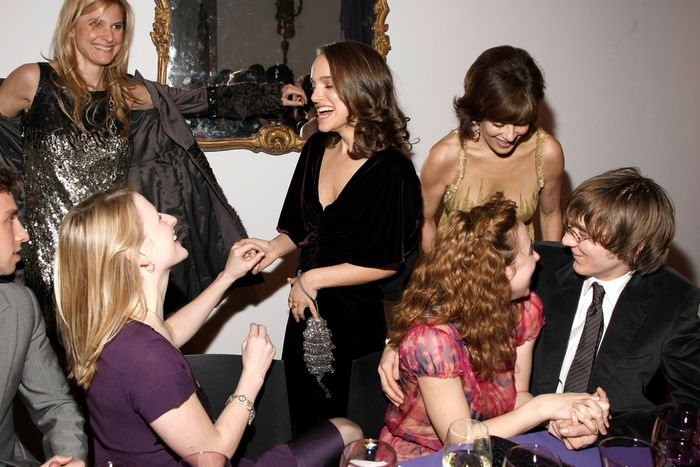
Mamie Gummer, Natalie Portman, Zoe Kazan, Peggy Siegal, and Paul Dano, at a dinner party at Christies in 2008.
Photo: Jemal Countess/WireImage/Getty Images
Siegal contends that she and Epstein spent little time together during the roughly 12 years they were in contact. She never went to his island, she never flew on his plane, and, she says, she was at his house exactly twice — once for the dinner for then-Prince Andrew, once for breaking the fast on Yom Kippur. But there is no question that following his time in jail, she undertook a type of social engineering on his behalf. One former close associate said that she became “the linchpin” in the wheel of Epstein’s public life. According to the emails, Siegal secured his invitation to the Met Gala in 2013, to the New York Observer’s 25th-anniversary party at The Four Seasons that same year, and she ensured he was on the list for exclusive dinners alongside names such as Martha Stewart, Lorne Michaels, and Google CEO Eric Schmidt. Siegal added him to screening lists; on occasion, she stealthily brought him to events when she thought hosts might balk at his inclusion.
“He was demanding, demanding, demanding to be invited all over,” says Siegal. But he rarely attended. “He didn’t want to leave his house.” By his house, she meant his five homes, especially his vast townhouse on East 71st Street in New York. “He wanted everyone to come to his mansion so he could be in control,” she says. “So he could manipulate his audience under this palatial roof where he lived. In order to look like the smartest person in the room, he had to be in his room.”
According to the emails, Epstein had become particularly interested in befriending Woody Allen, another man accused of child molestation. Allen, who was never charged with a crime, had weathered the extraordinary scandal of allegedly molesting his 7-year-old adoptive daughter and had then also survived the ignominy of marrying Soon-Yi Previn (another daughter of his former girlfriend, Mia Farrow) without social ruin. In fact, Allen was still considered the epitome of a certain casual sophistication and the rejection of puritanical mores; Epstein might have hoped association with him could cast his own disgraces in a different light.
When Epstein suggests to Siegal that they invite Allen to the dinner for Andrew, she replies, “Woody is a great idea. Do you know Woody? I do.” She seems to briefly consider the potential fallout of bringing the two men together for an evening — “Could there be any resistance because he had a public issue with Soon-Yi? … just thinking ahead” — but she moves on quickly. To make Allen comfortable, she says, they could invite the art dealer Lorinda Ash, his close friend: “He may feel better if people he knows arc around [him]. On the other hand a royal may intrigue him.” She instructs Epstein to email Ash, while she will contact Allen directly herself. She also suggests enticing the director with a DVD of The King’s Speech, a Harvey Weinstein production, which Siegal was publicizing.
Siegal explains to Epstein that Allen could anchor the respectability of the evening. “If you get Woody,” she writes, “you can probably then build to Charlie Rose, Fareed Zakaria, Rick Stengel (editor of Time) … Cynthia McFadden (Nightline), George Stephanopulous [sic], Chris Cuomo and Cristina Cuomo, she is beautiful and smart … Christiane Amanpour … Katie Couric” and then filmmakers, “like David Koepp, Tony Gilroy, Stephen Daldrey [sic] who is hilarious. We can find out where Oliver Stone is. I know all those people.”
Siegal says now that that dinner was a “total exception” — that she never helped host any other parties for Epstein and she hadn’t wanted to do it. The real reason she took it on, Siegal says, was to try to get a copy of Weinstein’s film into the hands of Queen Elizabeth, to show her the depiction of her father, this “love song to her family.” “Harvey had been trying to get a quote from the queen,” she says, to help market the movie. “It was ridiculous.” But Weinstein didn’t have any connections to Buckingham Palace. “He hated Jeffrey” — Siegal doesn’t say why — so behind his back, she came up with the scheme to fête Andrew and give him a DVD.
Looking back on the dinner, she says, “I totally jeopardized my relationship with all these important people — they did not know who he was. All of Jeffrey’s illegal, immoral behavior was in Palm Beach, and he went to jail in Palm Beach, and the New York Times never wrote about him.” (The Times had in fact written a feature on his first arrest two years earlier; it appeared on the cover page of the “Business” section.) “World-famous newscasters didn’t know who Jeffrey Epstein was,” Siegal continues. “And they counted on my relationship with them to invite them to an interesting evening, which I had many, many times before. They came on my say-so.”
Siegal has often said that she cast each of her events — lunches, teas, salon-style film screenings at MoMA, parties at the Grill and the Royalton — as if she were casting actors for a movie. Talent was spread equally around the room, and each guest was seated, she’s said, next to their best friend on one side and their “new best friend” on the other. Frequent guests included Barbara Walters, the directors Darren Aronofsky and Sofia Coppola, the actors Michael Douglas and Bob Balaban. “They weren’t flashy, but they were certainly chic,” says one repeat attendee.
Most of the members of the press she invited to the Andrew dinner, Siegal says, would be covering the upcoming marriage of Prince William and Kate Middleton. “They were told that there would be no palace guards around Andrew at dinner,” Siegal says. “They could ask him anything they wanted to know about the wedding.”
In the end, it was an 10-person dinner; Epstein served lasagna. In attendance was his Charlie Rose, and George Stephanopoulos. Katie Couric, who brought her partner of the time, Brooks Perlin (her “idiot cute boyfriend,” writes Siegal), reportedly spoke to Andrew about the upcoming wedding, asking if he would send her details of the ceremony from inside the church. She sat next to Chelsea Handler, who likes to tell the story of sitting across from Allen and Previn that night and asking them, over what she believes was blueberry cobbler, “So how did you two meet?”
Siegal says Previn came to meet the prince and that Allen had attended, in part, because he’d been told he “could wear his chinos and his bucket cap.” “I don’t think he would have come if he knew who Jeffrey was,” she says. Of the members of the press, she says, “when they realized later whose house it was, they were furious at me and rightly so.”
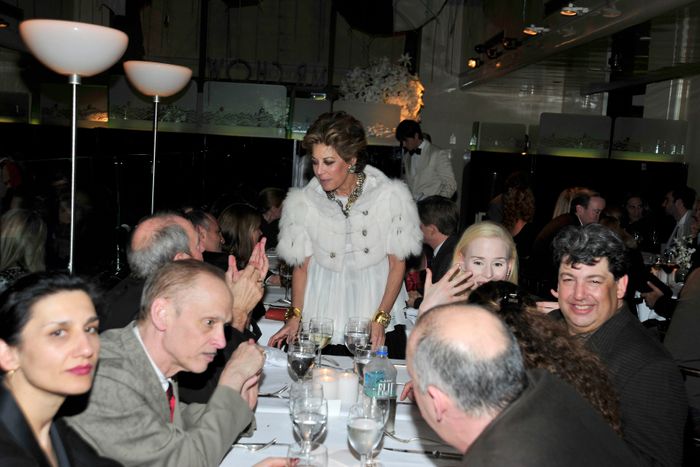
Siegal at a dinner hosted by Larry Gagosian at Mr. Chow in Beverly Hills in 2010.
Photo: Patrick McMullan/Patrick McMullan/Getty Images
Siegal repeats often that she has already paid a serious price for her relationship with Epstein. She says she doesn’t want to call it unfair, but that’s what it is.
“Seven years ago, I was trashed on the front page of the New York Times, alongside Clinton and Dershowitz,” she says. “I was trashed in Vanity Fair. No studio would ever work with me again.” Almost overnight, Netflix, FX, and Annapurna Pictures cut ties. Shortly after Epstein died, she says, she went to the Telluride Film Festival. “No one would let me in their screening. I had to buy a pass for $5,000 to go see a movie. No one would talk to me — they would walk across the street to avoid me.” She was unable to make a living and sold her apartment, a prewar two-bedroom on East 74th Street that once belonged to John Vernou Bouvier III, father of Jacqueline Kennedy Onassis.
“Why,” she says, “does Peggy Siegel, who is 78 years old, who did nothing her entire life but work as a single woman, and make a success as a result, have to suffer so badly for this story, when heads of state and royalty and presidents have done far worse than I have?”
Many people close to Siegal say that the Epstein opprobrium was less a catalyst for her expulsion than an excuse — that there was very little goodwill left for her by the time the news broke. With the exception of Siegal’s longtime pal Roger Friedman — the journalist and gossip blogger and the only person willing to go on the record in her defense — Siegal’s friends and associates say the emails provide only a tiny window into just how venomous she could be. (In the messages, she calls her contractor, with whom she’s feuding, an “Asian cunt”; her PR nemesis, whom she believes is trying to steal her clients, “a slimball [sic] who deserves to be but fucked to death.”)
In one conversation, Siegal says, unprompted, “There were people I know who always had a smile on their face, and always had a kind thing to say about everybody. That was not me.”
Her old friends and acquaintances did feel sorry for her. One, who’s known Siegal for decades says, “I think she truly believed Epstein cared for her.” Graydon Carter, the longtime Vanity Fair editor, who’s crossed paths with Siegal for many years, says, “I have begrudging admiration for her.” (Carter noted that he had “a perfect record of having never RSVP’d ‘yes’ to any of Peggy’s invitations.”) “She gave up so much to gain so little,” he said — her livelihood and most of her friends for some flattery, shinier toys and a chance to reach a higher perch. “It’s kind of a classic American story in a way.”
He didn’t seem to be wrong. In February 2010, Siegal had written to Epstein, flying high:
Had three events last night – a personal best … If these friggin dinners do not cement my social ambitions, nothing will!!! Have amazing turnouts … you will be very proud..but no Nobel … xoxxo Peg
“People have always asked, ‘Didn’t you know? Didn’t you know?’”
Siegal is talking about the underage girls. “He didn’t want me to know. And even though it was in the paper, I didn’t — I couldn’t conceive it. I couldn’t believe it.”
Epstein lied to her about his first arrest and conviction, she says. “He said that a girl lied to him — that she wasn’t 17.” (She stops and asks if that was the legal age. When told it varies by state, she says, “Well, we have to find out.”) Epstein had said he made a deal with prosecutors in exchange for pleading guilty to something he didn’t knowingly do. “He told me,” she says, “that he hired very expensive lawyers to manipulate the politicians. And from then on, I was led to believe that there was a governmental conspiracy against him.”
When pressed on the specifics of that government conspiracy, Siegal says she actually meant that the government had conspired with Epstein to cover up his crimes. “There were officials that were paid off to protect him,” she says. He bragged to her about their collusion.
Epstein eventually began to grate on Siegal. “He became a pain in the ass,” she says. “He became annoying. He started acting like I was his personal social secretary.” She was displeased when he brought the young women he was dating to screenings. “These were tall, lanky European girls, or some from Third World countries, who were like 18, 19, 20 — hopeful models,” she says. “Half of them didn’t speak English, and nobody had a last name, which would infuriate me.” She believed many were sent over by Jean-Luc Brunel, the French model scout — “Jeffrey’s purveyor,” in her words — who was also accused of child-sex trafficking and rape and in 2022 killed himself in jail. “Like Jeffrey,” Siegal adds, “who did not kill himself in jail.”
Siegal says she now believes Epstein divided the women and girls around him into two tiers: the young women he brought out in public — whom she calls “the hostesses” — and then the underage girls. “I guess, from what I’ve read,” she says, “they’re the ones you got massages from. But I don’t know for a fact.”
As for the massages, “all the guys with jets got massages,” she says. She later clarifies that she meant legitimate sports massages: “What do guys with jets do? They play golf, they play tennis, they run marathons.” And while Epstein’s interest in young women was distasteful, it didn’t seem so exceptional. In her circles, she says, especially Hollywood, “there were many scoundrels, and we all knew it. Every day, these heads of these film companies were caught with their pants down someplace else.”
Friedman says that it was common to not know anything at all about Epstein’s crimes in the years before his second arrest; he said he knew nothing himself. “This was happening in Florida,” Friedman says. “It was before social media. There were other things going on.” That might have been true for a time, other friends and associates said. But at a certain point, one said, “you could not be in his close orbit and not know.”
“We warned her for years,” says another. “We told her how dangerous it was to affiliate with him.” But it was unclear to many if she had been in denial, if she had been willing to overlook it, or if she had believed, as she’d told the Times in 2019, that “he’d served his time” and “changed his ways.”
Presented with these possibilities, Siegal says, “It’s all true.”
“I was in denial, but” — she stutters slightly as she plays out the logic — “if I tell you that he told me he changed his ways, then that’s telling you I knew that he was a pervert.”
“I mean, obviously I had a sense that he had done something wrong if he had gone to jail,” she goes on. “I wasn’t oblivious that he was morally compromised and a con man. But I don’t know how to say this to you: The idea of child pornography is so heinous that you can’t even think about it.” She seems to mean child sexual abuse generally. “You can’t even discuss it. I know it sounds crazy, but it’s nothing I wanted to deal with.”
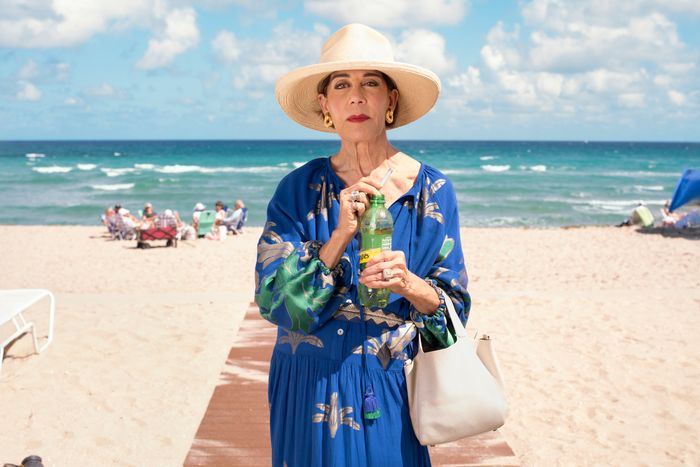
Siegal, in March.
Photo: Gillian Laub
There are moments in Siegal and Epstein’s long correspondence, as the second investigation of the former financier closed in and as rumors circulated, when it appeared that Siegal might be drawing away — when we can imagine we see Epstein worrying that she’s begun to view him differently or to reconsider their unspoken bargain.
In January 2018, he sends her a series of messages:
On the 15th: “you good?”
The 24th: “you missed my birthday”
The 27th: “where are you?”
“I have risen from the dead!” Siegal finally replies. It was then four months after rape and sexual-harassment allegations against Weinstein had sparked the Me Too movement, and Dylan Farrow had recently penned an op-ed reasserting the accusations she made against Woody Allen as a child. “I am sick about Woody,” Siegal writes. “This ‘#Me Too’ witch hunt is out to destroy an 80 year old global cinematic treasure and it makes me so sad.”
In November, Epstein again sends a series of unanswered messages.
November 1: “all good?”
Three minutes later: “instead of the friars club , can we do a pariahs club dinnr. woody me moonves wynn charlie matt. Louis ck. Etc:”
November 19: “all good?”
Nine days later, the Miami Herald would publish a damning reexamination of the 2008 charges against Epstein and the infamous sweetheart deal brokered by Alex Acosta, who would become President Trump’s secretary of Labor in his first term, despite evidence that Epstein had molested dozens of teenage girls. He waited to email Siegal again until December 10. His message is sent at nearly three in the morning: “press brutal , but I’ve been through it before. hope your holiday is peaceful.”
Siegal replied later that day; she had not abandoned him: “I have been thinking of you for days and apologize for not writing sooner. We are living in very weird political and social times and technology has become a weapon of accusation, punishment and righteousness. This is not going to get any better.” She is careful to add — perhaps knowing the wagons are circling — “I am not defending wrong doing … just can’t understand why there is no legal second act of redemption.”
She is also angry, for perhaps the only time in their ten years of messages — not for his crimes but for ignoring her PR advice years before. She’s still considering how he should play his hand. “I told you a few years ago to be the poster boy for making amends,” she writes. “I suggested inventing a support system to aid disadvantaged young women. I do not know if this too late but this self inflicted nightmare is not going away. You need to own a recovery program. No one has the guts to do this. It has to start somewhere.”
And then she addresses the issue of his “girls” directly. She seems to suggest that Epstein could become their mentor rather than whatever it was she believed him to be already. “Education is your roots from math at Dalton,” she writes. “These young girls need help to learn how to make a living and not be prey to men.”
Siegal and Epstein would not communicate again directly for nearly three months. In March, he sent her a link to a letter to the editor in the Times from his attorneys, arguing that he’d received a fair deal in 2008. Siegal’s frustration seems to have dissipated. “I have been thinking about you for months,” she writes. “Your situation is nothing more than political shananagans to extort more money from you and discredit competitive government officials. What deal the government made … there is no ‘do over’ ten years later. You have behaved impeccably. You paid your price to society. More later.”
Epstein replied within two minutes: “i can use your help this is not wht i do . people are suggesting i treat all women badly, you are the perfect example of its falsity.”
Maybe this had been what he was doing with her all along: being the good man to a woman who could be counted on to spread the news.
She’d have to call him later, she told him. She was running to a Skip Gates lecture, then a party for Julianne Moore. It was their last exchange.
Siegal was sitting on a beach four months later when a friend called and told her, “Jeffrey Epstein just died. He hung himself in jail.” She was in Patmos, a tiny Greek island in the Aegean Sea — “Very far away, very hard to get there and a lot of very hip, very cool, very sophisticated, cool people go there,” she says. “I don’t know whether it was this profound sense of relief” — she pauses — ”or sadness, but definitely a chill went through me. Like it was finally over.”
When asked what this sadness was, she says, “He had been hounded by the police towards the end of his life. They were after him.” She couldn’t make sense of the fact that he’d let himself be apprehended in the first place, flying from Paris into Teterboro. “Why would he do that?”
Siegal is in Palm Beach now. She says she still splits her time among New York, the Hamptons, and Florida, though friends say she’s been living down there for some time. She’s been writing a memoir and jokes that the Justice Department has published it for her.
A few years ago, she was diagnosed with lymphoma; “Weill Cornell cured me,” she says. Friedman and others knew she’d been sick but not the details; they thought it was leukemia or maybe blood cancer. This is how she usually was, some said — evasive when it came to herself, unless to boast. With Epstein, it appears to have been different.
Her self-awareness flickered in and out as she spoke. “I was the happiest human being in the world when everybody got COVID,” she says at one point. “Because they weren’t talking about me.”
“I feel completely victimized by the media,” she says. “It’s tragic, absolutely tragic, that someone of my talent and my business acumen and my friendships and my contribution to the film industry would be so maligned.” She offers more worthy leads to follow: “He told me he worked for the Israeli government,” she says of Epstein. “He boasted.” (Later, she emphasized that she never knew when he was lying. He “loved” to say he was working for Israel, “but I had no proof.”)
As she put it in a text message, Siegal has been “a student of media mind games” for decades. She couldn’t quite settle on how to present herself — if it was better to appear weaker and sympathetic or strong but somehow guilty. In one conversation she said, “I was alone; I was a single middle-aged woman in a very tough business.” Two days later, she sent the same idea via text message, amended: “I was an attractive and articulate middle-aged woman trying to make a living in a man’s corporate world.”
Her self-conception was consistently grand. She described her years working for filmmakers — Brian De Palma, Paul Schrader — as a type of apprenticeship: “They were all my mentors … All these guys taught me to look and listen and learn,” she said. “With all this amazing education, and amazing proximity to the greatest cinematic minds in our country at the time, I still was a jerk when it came to Jeffrey Epstein.”
Toward the end of one conversation, Siegal remembered herself. “One last thing,” she said. “I have said nothing about the girls. At the end of the day, I have felt so victimized myself that I have neglected to say that the real victims were the girls.” Some days later, in a text, she implied that the victims had had an advantage she had not. “It’s possible if I had a killer lawyer as some of the victims have, I would not be so vulnerable.”
Thank you for subscribing and supporting our journalism.
If you prefer to read in print, you can also find this article in the March 9, 2026, issue of
New York Magazine.
Want more stories like this one? Subscribe now
to support our journalism and get unlimited access to our coverage.
If you prefer to read in print, you can also find this article in the March 9, 2026, issue of
New York Magazine.