
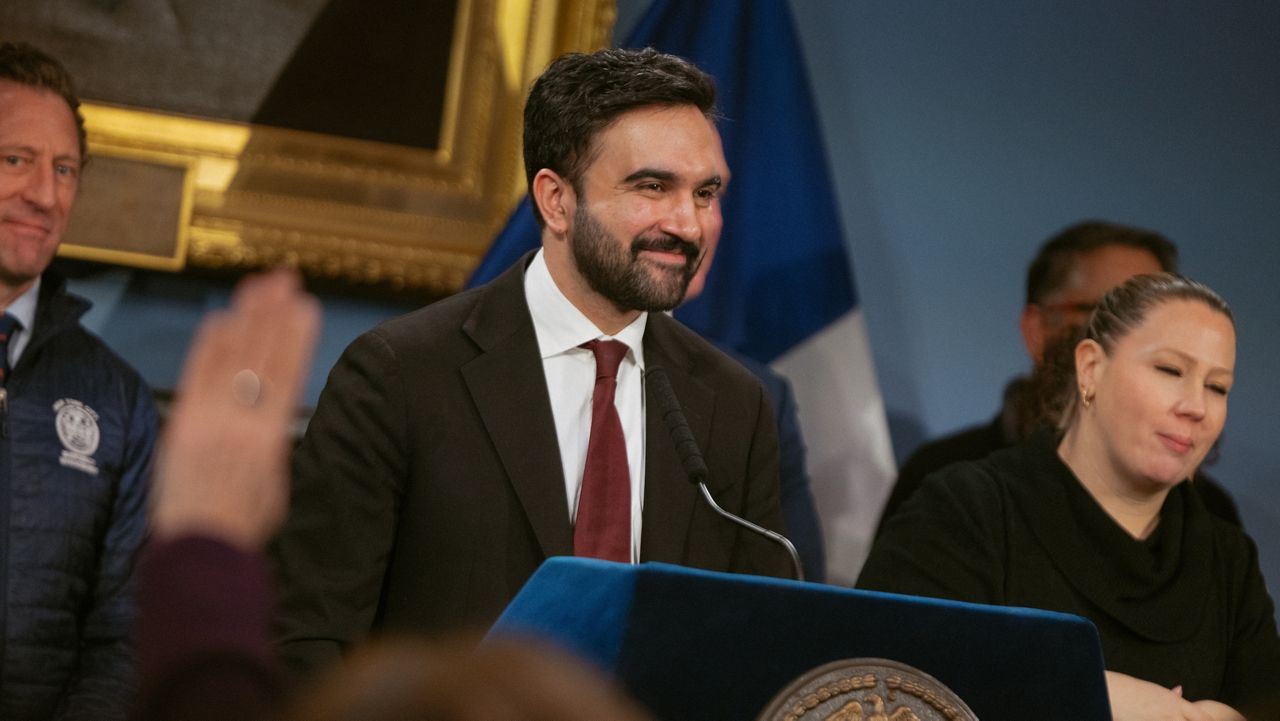
Mayor Zohran Mamdani traveled to the White House last week to pitch President Donald Trump on a plan to build 12,000 housing units over the Sunnyside rail yard in Queens, reviving a proposal that has surfaced repeatedly for nearly a century.
“The president was interested in the idea,” Mamdani said Friday.
What You Need To Know
Mayor Zohran Mamdani is proposing 12,000 affordable housing units over the Sunnyside rail yard in Queens.
The site has drawn major proposals for nearly a century, including a 1980s stadium idea backed by Donald Trump
Former Mayor Bill de Blasio advanced a master plan in 2020, but the project stalled amid political opposition and gentrification concerns
Trump’s interest in Sunnyside Yard dates back to the early 1980s. The state’s Urban Development Corporation named him to the board of a subsidiary, the New York State Sportsplex Corporation, which was tasked with finding sites for a new sports complex. Trump, then owner of the USFL’s New Jersey Generals, had been scouting stadium locations.
The New York Times reported in January 1984 that Trump “was said to have focused on a site on the Bronx side of the Bronx-Whitestone Bridge, on Flushing Meadows, and on the Penn Central rail yards in Sunnyside, Queens.”
Months later, Times sports columnist George Vescey wrote that “Donald Trump is casting his eye on the wide-open spaces of the railroad yards in Sunnyside, Queens, as a place to build the Trumpdome.”
Vescey speculated that Trump wanted to relocate the Generals from New Jersey. “He would much rather own the New York Trumps,” Vescey wrote, “and put palace guards in front of an ornate pleasure dome in Sunnyside.”
The stadium proposal never advanced.
Building over Sunnyside Yard has long been a goal of planners and politicians.
In 1931, the Regional Plan of New York and Its Environs declared: “There is urgent need of improvement of the Sunnyside Terminal district at Queens Plaza in Long Island City.”
The plan’s authors suggested an airfield or a rail hub topped by an office tower.
“This is a classic New York situation,” said Tom Wright, president and CEO of the Regional Plan Association, “where almost every decade over the last century, you could find a plan by some public agency or civic group or somebody for what to do with this asset.”
Other proposals followed, including a 1971 Urban Development Corporation plan featuring 20-story apartment buildings and a mall, and a 1973 proposal by Gov. Nelson Rockefeller that included two racetracks and a football stadium.
Sunnyside Yard was later eyed by Mayor Michael Bloomberg and his former deputy mayor Dan Doctoroff, who in 2014 pitched a convention center for the site. Doctoroff wrote in the Times that “the perfect undeveloped location for a new convention center exists at Sunnyside Yards, the more than 160-acre rail yard that carves a nasty scar through the heart of Queens.”
Mayor Bill de Blasio advanced the most detailed modern effort in 2015.
“It’s an opportunity to keep our city affordable,” de Blasio said in his State of the City address. “I’m referring to Sunnyside Yards.”
The proposal drew opposition, including from Gov. Andrew Cuomo, who told NY1 that “Sunnyside Yards, specifically, is problematic.”
De Blasio responded in an interview on NY1’s “Inside City Hall”: “You can’t have 200 acres available and all the pressures on affordability in this city and not do anything.”
Concerns about gentrification fueled resistance from local officials, including Rep. Alexandria Ocasio-Cortez and then-City Councilman Jimmy Van Bramer.
“It is almost impossible to see how the neighborhoods surrounding the yards wouldn’t be dramatically changed,” Van Bramer told NY1 in 2020.
The de Blasio administration ultimately commissioned a master plan for the site, released in March 2020 and led by the architectural firm Practice for Architecture and Urbanism.
“I do think the political winds have shifted,” said Vishaan Chakrabarti, the firm’s founder and creative director.
Chakrabarti said Mamdani can build on the prior work.
“It’s technically incredibly complicated,” he said. “Starting from scratch is a disaster, because why would you lose all of that knowledge that was built up before? So to me, the fact that previous plans have been done is a good thing.”
Mamdani has cited a goal of 12,000 affordable housing units, matching the 2020 master plan, and is seeking about $21 billion in federal funding.
“I think the mayor, just by starting this conversation again, is kind of bringing energy and focus to this issue,” Wright said. “But I think that nobody should fool themselves and think that this is going to be easy or quick or cheap or anything, because it’s none of those.”
Mamdani acknowledged the challenges.
“This is a long-standing project that will also require a long-standing commitment,” he told reporters Friday, “and we’re just at the very beginning of it.”