
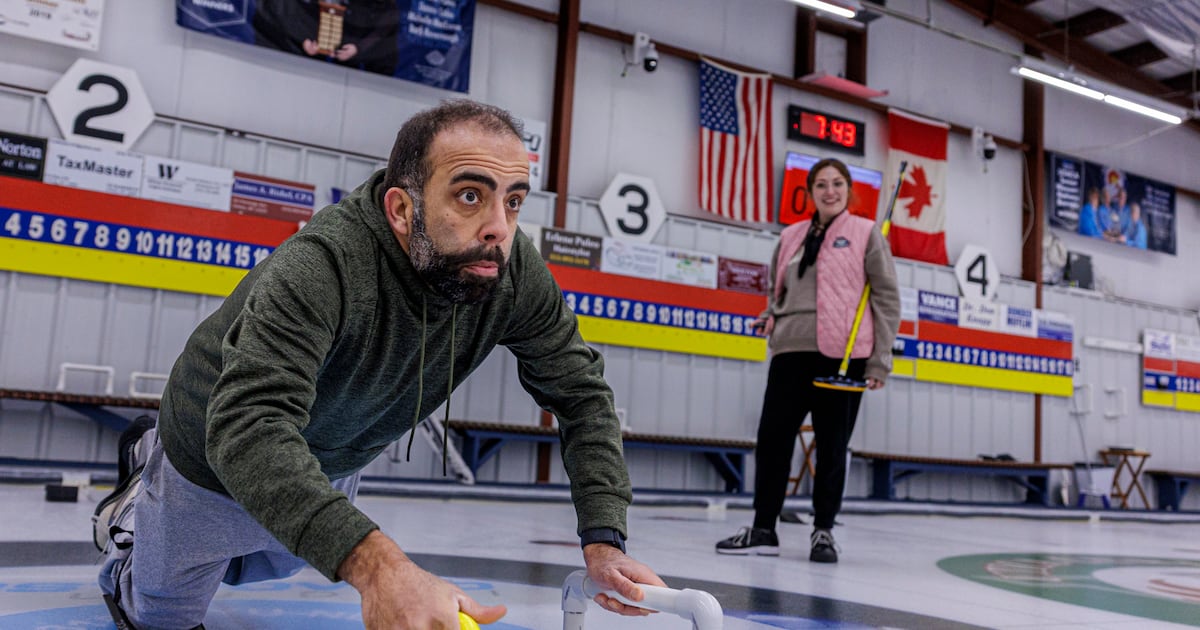
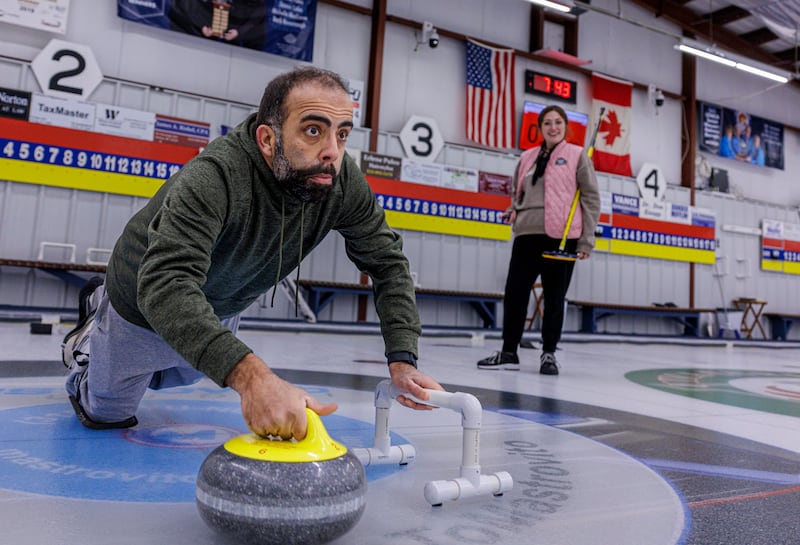
 Curling becoming a hot draw in Central New York Chris Davis, of New York Mills, prepares to deliver a stone at the Utica Curling Club, the largest curling rink in the Eastern U.S. Davis joined a popular 4-week learning to curl class at the club. Another session begins Saturday, March 8. (N. Scott Trimble | strimble@syracuse.com) (N. Scott Trimble/N. Scott Trimble | strimble@syracuse.com)
Every four years, the world is reintroduced to the curious charms of curling thanks to the Winter Olympics.
But in Central New York, curling is nothing new. People have been sliding stones on ice at the Utica Curling Club, one of the oldest clubs in the United States, since 1868.
On any given night, from mid-October through March, scores of CNYers gather in a two-story metal building in Whitesboro to carry on that tradition.
The top floor contains a lounge, bar and dance floor that overlook an ice rink on the bottom floor. The action that occurs on both levels—throwing stones below and celebrating above (winning team buys the first round)—is equally important to the sport.
The rink is divided into six sheets, or lanes, making the Utica Curling Club the largest facility of its kind on the East Coast. On a recent weekday evening, around 20 newbies marched onto the ice to the sound of bagpipe music blaring from speakers overhead.
It was the last session of the club’s four-week Olympic Try Curling program, and the newbies were getting a traditional send off.
They circled the rink, thumping the catwalk with ends of their brooms as club members pounded on the windows upstairs. Then they lined up across the ice and knocked back paper cup shots of Drambuie, a whiskey-based liqueur that, like the game of curling itself, has origins in Scotland.
“Good curling,” the players said, shaking hands.
‘An odd sport with odd people’
Mike Krumme, past president of the Utica Curling Club, watched the newbies play from a stool in the upstairs bar, which was studded with hundreds of pins from curling clubs around the world. He’d grown up watching Canadian curling on TV in Detroit, but he never tried it until he moved to Utica decades ago.
“Curling is an odd sport with odd people, because it’s a weird game,” Krumme said. “What got me interested really—although I’m not really a social kind of guy—is the social part of it.”
Krumme gestured to tables filled with players laughing and toasting each other over games they’d just finished before the newbies took the ice.
“How many sports do that?” Krumme said. “They’ll have a drink together. They shake hands at the beginning, and they shake hands at the end. There’s no trash talking. That’s what got me. Plus, it’s just a blast playing.”
Curling is a deceptively simple game. Players slide a 42-pound chunk of polished granite down a sheet of pebbled ice measuring 150 feet long and 15 feet wide. The goal is to score points by placing rocks as close as possible to the center of a 12-foot bullseye target on the opposite end.
The other team will attempt to block your team’s rocks from reaching the target, or house, as it’s called. Or they’ll slide their rocks even closer to the bullseye. Or, if necessary, they’ll knock your rocks clean out of the house.
Despite some superficial similarities, curling is not shuffleboard for people who prefer wearing fleece to Bermuda shorts. It’s far more complex than ramming a puck into a numbered square with a stick.
“When you first start, you just think of shuffleboard,” said Erin Clark, who started curling in 1987. “And a lot of people have that strategy, but then there’s a lot more to it. You don’t know it until you play it for a while.”
“The game gets very finesse as you get better and better, that’s what makes the game,” Krumme said. “Another name for curling is chess on ice.”
Down on the ice, the newbies were playing a game that looked more like checkers. They struggled with every aspect of it, from delivering stones to sweeping the ice, to say nothing about overall strategy.
But they were having a lot of fun doing it.
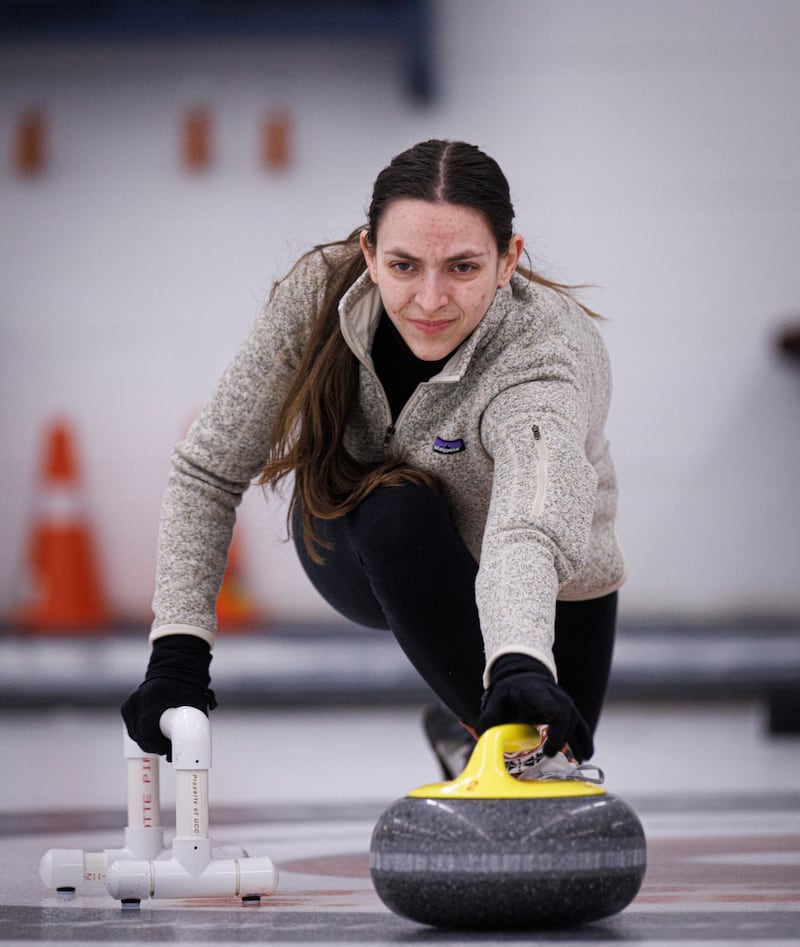 Curling becoming a hot draw in Central New York Elissa Murphy, of Marcy, said delivering the stone is the hardest part of curling. “You have to stay so present,” she said, “if you lose any amount of focus, then it’s done.”
(N. Scott Trimble | strimble@syracuse.com) (N. Scott Trimble/N. Scott Trimble | strimble@syracuse.com) Delivering stones
Forget what it looks like on TV. Curling requires a certain degree of athleticism. Superb balance, precision, coordination. It all comes together in the delivery, which is what curlers call that act of throwing a stone down the ice.
The hardest thing for newbies to learn is a smooth delivery, said coach Tim Conboy. Keeping steady while doing a full lunge on slippery ice takes a lot of practice.
“Without a smooth delivery, the weight”—curling parlance for speed—“of the stone, and the aiming, are kind of secondary. You got to get a nice smooth delivery.”
A traditional delivery begins with the thrower crouched in the hacks, a set of rubber blocks anchored in the ice behind each house. The trick is to smoothly push off a hack with one foot and slide down the ice, lightly gripping the stone by its handle.
Throwers should maintain a low crouch—the lower the better—with their front knee bent, back leg trailing behind like a rudder, and gently release the stone before they reach the “hog line,” which is like a line of scrimmage.
The stone can be turned slightly using the handle to set the rotation, but it should never be pushed. Momentum does all the work.
“It’s hard!“ exclaimed Elissa Murphy, a newbie from Marcy. ”You have to stay so present. Like, if you lose any amount of focus, then it’s done.”
Delivered at the right speed, in the right direction, and with the right amount of spin, a curling stone doesn’t just fly down the sheet like a puck skimming the ice. It glides to its destination, emitting a low rumble as it travels, and curls into a precise spot on the opposite end.
Of course, it rarely happens that way. The Scots have a unique talent for inventing frustrating games, because throwing a curling stone is a lot like trying to sink a 100-foot golf putt. Stones fall short or go wide. They curl too much or not at all. Throwers wobble or fall on their butts.
“I golf and curl for the same reason,” joked longtime club member Don Edmundson of New Hartford, “to get to the bar at the end.”
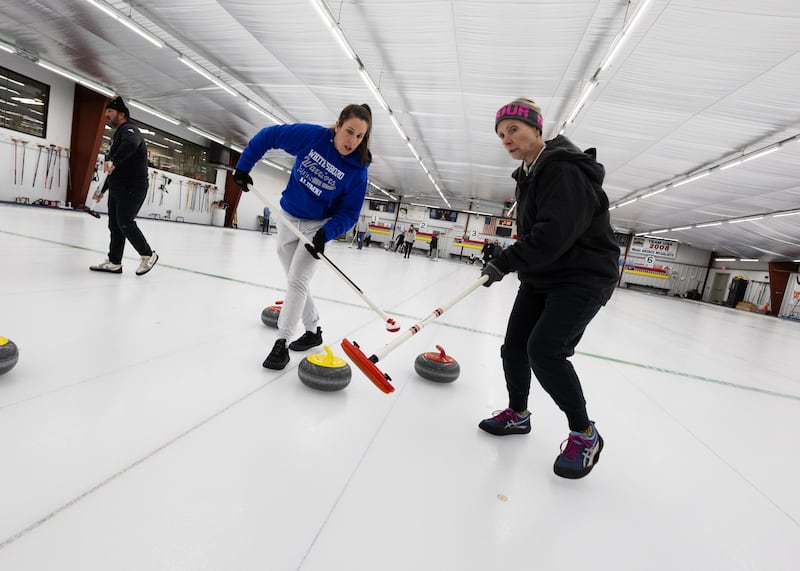 Curling becoming a hot draw in Central New York Gina Totaro (left) and Denise Comenale (right) sweep a curling stone toward its destination. Both are teachers at Myles Elementary School in New Hartford who played in an introduction to curling league at Utica Curling Club last month. They enjoyed it so much they joined the club. (Steve Featherstone/Steve Featherstone | sfeatherstone@syracuse.com) Skips and sweepers
Unlike chess, curling is a team sport. Each four-man team has a captain, or skip, who orchestrates strategy by pointing at a spot for throwers to aim at. They also shout commands to the sweepers.
During games, only the skips’ shouts can be heard echoing off the club’s metal walls.
“Sweep! Sweep! Yes!”
“Up! Up! Up!”
In the old days, when curling involved heaving a rough field stone across the uneven surface of a frozen marsh, skipping and sweeping didn’t accomplish much. Luck was more important than skill. But modern curling rinks have all but eliminated those natural variables.
“We’re always looking down to see if there might be a little bit of a gripper”—a speck of rubber from the overshoes players wear on the ice to avoid slipping—“or even an eyelash,” said Mary Ellen Sofinski, a club member from Oneida. “The stone goes over and it might stop or go sideways.”
A stone will curl four to five feet as it slows down. By scrubbing the ice in front of a stone, sweepers can speed it up and straighten it out. Truly agile sweepers can coax an extra 10 feet out of a rock and get it to curl behind another rock, kiss it, or a knock a competitor’s rock out of play.
“If you put that much energy to mopping your floor, you’d have spick and span floors,” Edmundson said.
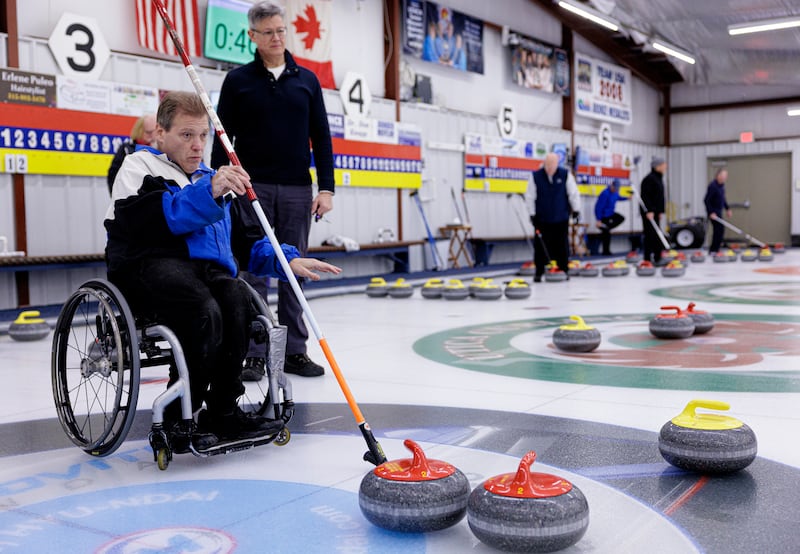 Curling becoming a hot draw in Central New York Robert Prenoveau, of Chittenango, is a champion curler and proof that the sport can be enjoyed by people of all ages and abilities. (N. Scott Trimble | strimble@syracuse.com) (N. Scott Trimble/N. Scott Trimble | strimble@syracuse.com) A game of finesse and strategy
Each team member delivers two rocks for a total of eight per team. The rock in the house closest to the bullseye wins at least one point. After six to ten rounds, or ends, the team with the most points wins.
In theory, a curling match between two equally skilled teams would consist of little more than players knocking each other’s rocks out of play. Indeed, that’s how the sport had evolved back in the 1980s, said Mike Krumme.
“Canadians got so good at hitting rocks, the game got boring because you put a rock in there, the next guy would smack it out,” he said. “Next guy, smack it. Next guy, smack it.”
In the early 1990s, a new rule established a “free guard zone” prohibiting players from clearing the first four—now five—guard stones, which are stones purposely placed in front of the house to protect point-scoring stones near the bullseye. Almost overnight, curling became a game of finesse and strategy.
Curling was named an official sport at the 1998 Olympic Winter Games in Nagano, Japan. At that level, points are won by fractions of an inch.
Jamie Williams, a curling newbie from Clinton, is a sporty guy who grew up playing hockey, football, and soccer. Last fall he joined the club after taking just one curling class.
“I went right out and bought the shoes and the broom and that was it,” he said. “It’s a great group of people. It’s a lot of fun and takes a lot of strategy, like touch, which I don’t have yet. And the beer’s nice.”
The Valentine’s Day massacre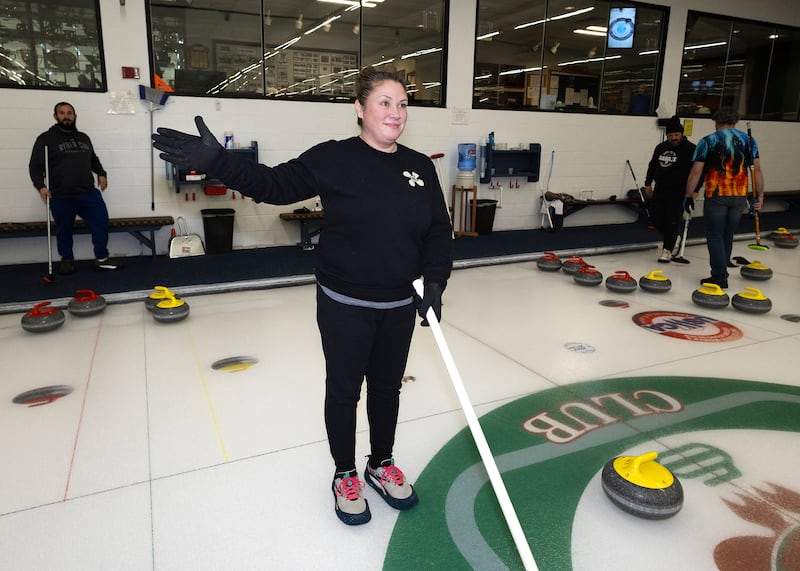 Curling becoming a hot draw in Central New York Nicole McKenna enjoyed playing the role of ‘skip’ or captain of her beginner’s team of elementary school teachers. Here she signals where to aim the curling stone. (Steve Featherstone/Steve Featherstone | sfeathersto)
Denise Comenale, a teacher at Myles Elementary School in New Hartford, pushed haltingly out of the hacks but didn’t release her stone.
“Feels so weird,” she said. “It’s like I’m not going anywhere.”
Then she realized she’d forgotten to use a slider, a piece of plastic that goes on the bottom of a thrower’s shoe to enable a smooth glide. Comenale blamed the lapse on Valentine’s Day.
“You have no idea what I’ve been through today,” she groaned. “It’s a lot of chaos. There’s a lot of candy and sugar and by the end of the day we’re all sweaty and tired.”
“Horrific,” echoed her colleague and teammate, Gina Totaro. “It’s past our bedtime.”
The third member of the team, Nicole McKenna, also a teacher, stood at the other end of the sheet, serving as skip. She pointed her broom at a spot on the ice. On her second try, Comenale’s stone sailed straight past McKenna.
Comenale shook her head and joked, “I’m gonna get kicked off this team.”
The teacher trio managed to play the other newbie team to a tie, leading to a final shootout. With just one rock to go, the teachers were behind by one point. McKenna had the last shot. As her stone rumbled toward the bullseye, Totaro furiously scrubbed the ice in front of it with her broom.
But it wasn’t enough. McKenna’s stone fell short of the house.
“We like winning, we do, but we’re happy,” Comenale said. “We had fun.”
“I have some work to do after I saw the Olympics, but I would say it’s been a pretty solid start,” McKenna said. “For a beginner, I’ll give myself a B.”
Upstairs, the teachers filled out forms to become club members. They gave the forms to the bartender, who was also the school’s music teacher, as it happened.
“It’s such a good activity because there’s really not a lot going on here in the winter,” Totaro said. “Everybody’s friendly and nice, so it’s a lot of fun.”