
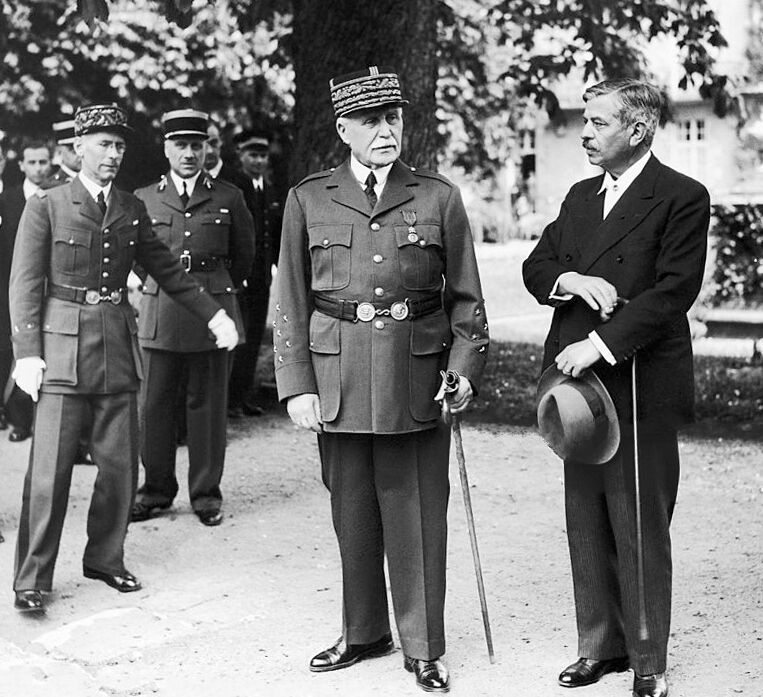
 Philippe Pétain, center, and Pierre Laval, right, in the park of the Sevigne Pavillion in Vichy, circa 1942. (Photo credit: wikicommons/Anonymous (Keystone-France))
Gerard Leval
On July 10, 1916, my great-uncle, a young French army lieutenant only 24 years old, was killed in battle as he defended the fortress at Verdun against the German onslaught, under the command of his general, Philippe Pétain. Just a few days later, his twin brother, my grandfather, was seriously wounded on another field of battle as he too sought to defend his native France against the armies of Germany. For his courage, my grandfather was twice decorated with the Legion of Honor, France’s highest military award.
These enormous sacrifices were made by two Jewish soldiers whose patriotism for France knew no bounds. Their devotion and loyalty to their homeland was unflinching and constituted an essential component of their lives. They were prepared to give up everything for their country — France.
Yet, some 20 years later, under the direction of that same Philippe Pétain, by then promoted to Maréchal, my grandfather and so many other Jewish soldiers who had demonstrated bravery and self-sacrifice in the defense of France, were declared, along with thousands of other French Jews, to be pariahs in their own country.
On the decision of Pétain, who had become chief of state, and his prime minister, Pierre Laval, the Vichy government steadily imposed restrictions and humiliations on their fellow citizens who happened to be Jewish. Unashamedly and on their own initiative, they forced Jews to be identified by a humiliating yellow star, and they promulgated a series of laws that deprived French Jews of their rights as citizens — rights that had been theirs since the French Revolution of 1789. Those deprivations, with Pétain and Laval’s complicity, would ultimately lead to the murder of some 76,000 French Jews.
This detrimental comportment was not imposed by the German occupiers, even though those occupiers were pleased to see the enthusiasm of Pétain and Laval in incorporating virulent antisemitism into their policies. Pétain and Laval established their oppressive policies against Jews of their own volition, and they did so enthusiastically and without apology.
When Jewish leaders, so many of whom had fought bravely for France and suffered mightily in the trenches of northeastern France during the four years of the Great War, petitioned Pétain, one of their former commanders, to eliminate the oppressive legislation, Pétain gave them a cold shoulder. He wrote to them that Jews simply had to share in the sacrifices to be made due to France’s defeat at the hands of the Germans.
This attitude of indifference to the suffering he was imposing on his Jewish fellow citizens was manifest when he turned his back on the pleas of the Catholic hierarchy in the wake of the horrific roundup of some 16,000 Jewish men, women and children in July 1943. He did not lift a finger even as he was informed that the Nazis were murdering deported Jews. Ultimately, when tried for treason after the end of the war, he pleaded ignorance notwithstanding that he had been fully informed of the consequences of his policies and of his collaboration with the Nazis.
No such plea of ignorance could be made by Pierre Laval, Pétain’s right-hand man for a significant part of the existence of the Vichy government. He was a collaborator through and through and favored the removal of Jews from France, and even their murder.
My father, who spent the years of occupation hidden in a small town in southern France, would often remind me that it was Laval who openly supported Nazi Germany, declaring with his strong Auvergnat accent, “I wish for the victory of Germany,” a statement that sapped the hopes of so many Jews who were being hunted by Laval’s government and reeked of treason.
Laval did not passively wish for that victory; he actively supported the occupiers and enthusiastically endorsed the deportation of France’s Jewish population.
At the end of the war, Laval was tried, convicted and executed for his treasonous behavior. His punishment was well-merited but could not erase the shame that he had brought to France. Laval’s name still elicits reactions of disgust when mentioned in France. He, more than any other individual, represents the depth to which France fell during the years of German occupation.
France does not honor Pétain or Laval. There are no statues or monuments to those traitors to the French ideals of liberty, equality and fraternity. Their memories will forever be a stain on France, and for those of us whose families suffered so terribly under their governance, any attempt to honor them inflicts more pain.
It is Menachem Rosensaft, an eloquent spokesman for Holocaust remembrance, who has made it known that New York City, a city of which the Jewish community forms such an integral part, has for years seen fit to allow commemorative plaques in Lower Manhattan, in the so-called “Canyon of Heroes,” which have provided unmerited recognition to Pétain and Laval. Mr. Rosensaft’s disclosure of the recent removal of the plaque honoring Laval, even though it is only because the plaque became an inconvenience, is a source of profound relief.
Now, however, assuredly, both plaques must be permanently removed from the streets of New York. Allowing them to remain in place would dishonor all those who were victimized by the unforgivable misdeeds of two reprehensible individuals. Since even France knows better than to bestow any honor upon Pétain and Laval, assuredly, New York City must cease doing so.
Gerard Leval is a partner in the Washington, D.C., office of a national law firm.