
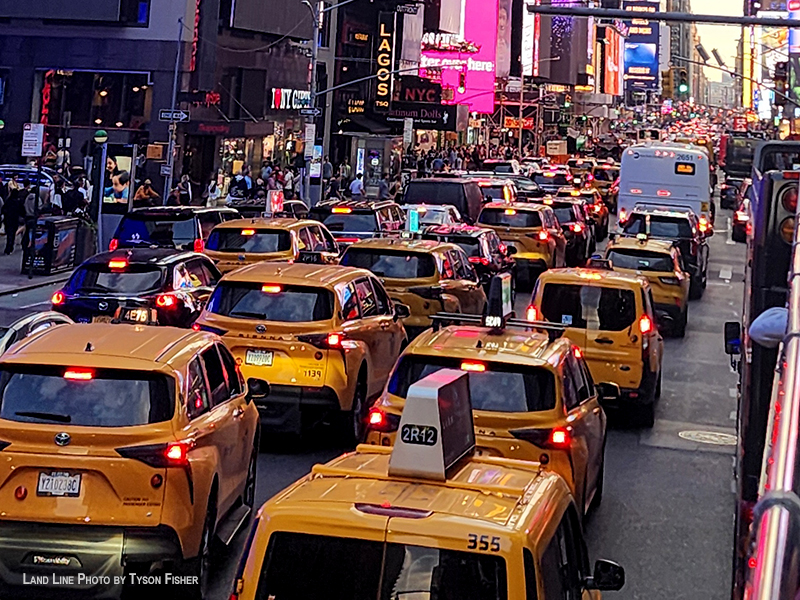
President Donald Trump vowed to get rid of New York City’s congestion pricing toll program, but a federal court just kneecapped the administration’s legal rationale for shutting it down.
The fate of congestion pricing in New York has been up in the air since before it even began. In May 2024, Trump said he would “TERMINATE Congestion Pricing in my FIRST WEEK back in Office.”
Meanwhile, numerous state and federal lawsuits challenging the program were pending. One by one, the courts struck down or severely gutted those challenges.
Toll collection was scheduled to start in June 2024, but Gov. Kathy Hochul indefinitely paused the program, citing rising living costs. About a week after Trump won the election, Hochul announced congestion pricing would launch in early January 2025 with a lower toll rate.
Last February, Transportation Secretary Sean Duffy sent Hochul a letter, informing her that the Federal Highway Administration was revoking its approval of congestion pricing. New York had one month to end the program.
That prompted Hochul to sue the Trump administration and sparked a public dispute between the two. Duffy’s deadline to end congestion pricing was extended twice. He also included threats to withhold federal funding.
The back-and-forth tug-of-war left motorists in limbo, not knowing whether congestion pricing would stay or go. Last May, Judge Lewis J. Liman delivered the first blow to the Trump administration by granting New York’s motion for a preliminary injunction, preventing the federal government from forcing a shutdown of tolling while the case was pending.
Since then, congestion pricing has continued uninterrupted in New York City, awaiting a final decision from Judge Liman. The order is in.
On March 3, Liman ruled that Duffy’s actions and letters were unlawful, effectively ending the Trump administration’s attempts to kill congestion pricing.
In the order, Liman struck down Duffy’s argument that the Value Pricing Pilot Program (VPPP), the agreement allowing New York’s program, does not include congestion pricing. That claim was central to Duffy’s move to revoke authorization.
Duffy also argued that congestion pricing toll collection is mostly a revenue generator for the Metropolitan Transportation Authority, not highway infrastructure. Liman ruled that the point is to reduce congestion and promote travel alternatives. That includes public transit. Nothing in the statute specifies that funds must be spent directly on highway infrastructure.
Hedging his bet on the VPPP claims, Duffy argued that even if it allows congestion pricing, the program does not align with the new administration’s policy priorities. However, in the case of an agreement, termination based on a change in agency priorities must be stated in the terms and conditions. No such provision is included in the congestion pricing VPPP agreement.
Liman vacated Duffy’s letters directing New York to end congestion pricing and the action taken through them. That restores the VPPP agreement and keeps the tolling program intact.
What comes next
The court stopped short of ordering a permanent injunction that would have kneecapped the government’s ability to pursue other avenues.
Liman’s order blocks DOT from using the February and April termination letters, and the legal rationale behind them, to unwind the VPPP agreement. That opens the door for the Trump administration to pursue a different route to end congestion pricing.
Trump appears determined to do just that. Last November, he called Manhattan a “ghost town,” claiming people are not entering the city because of congestion pricing. Trump called on Duffy “to take a good, long look at terminating New York City Congestion Pricing.”
In January, Trump raised the issue, calling congestion pricing a “DISASTER” and stating, “It’s got to be ended IMMEDIATELY!” After the preliminary injunction, Duffy said he would “keep fighting to end the illegal tolls.”
In addition to alternative methods, the Trump administration can still appeal Liman’s order. Neither had happened as of March 4. Until then, congestion pricing lives on. LL