
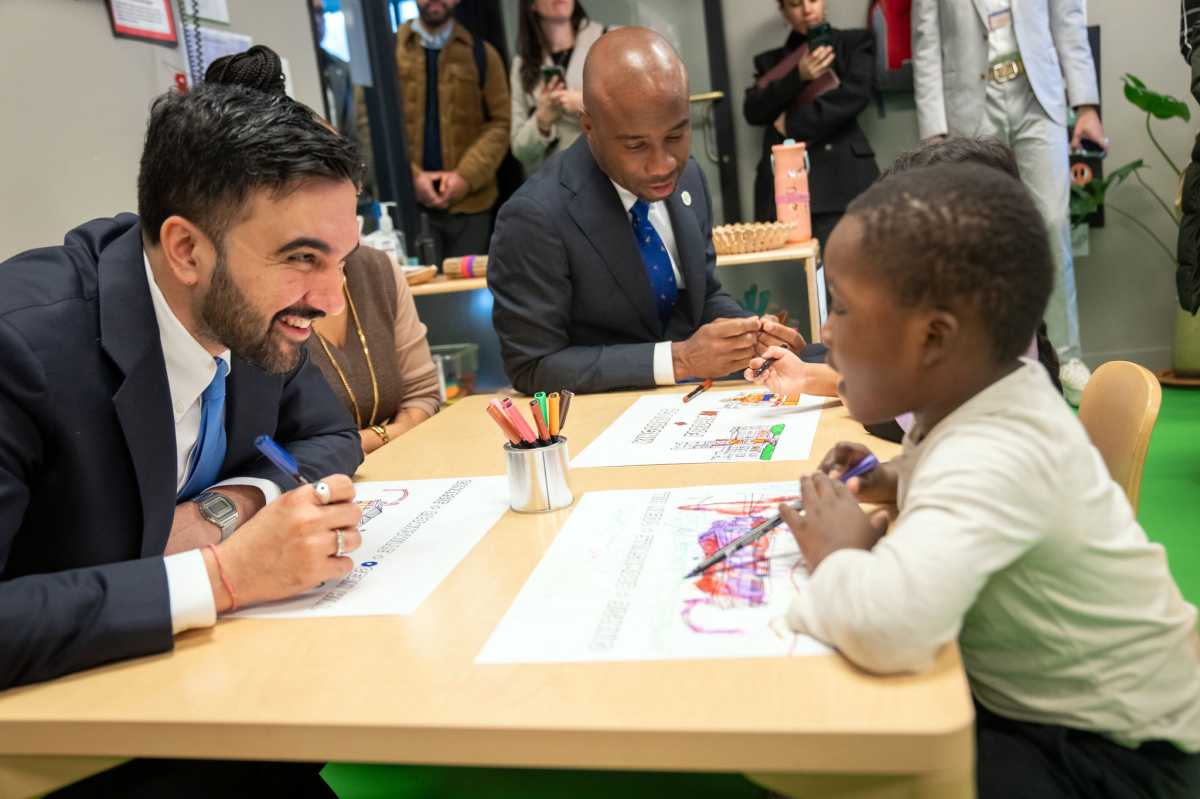
Mayor Mamdani pictured at the Sugar Hill Children’s Museum of Art & Storytelling, Manhattan. Tuesday, March 3, before announcing the 2k pilot locations
Photo by Ed Reed/Mayoral Photography Office.
Wednesday, March 4, marked the 63rd day of Zohran Mamdani’s term as mayor. amNewYork is following Mamdani around his first 100 days in office. We are closely tracking his progress on fulfilling campaign promises, appointing key leaders to government posts, and managing the city’s finances. Here’s a summary of what the mayor did today.
Mayor Zohran Mamdani on Wednesday defended his administration’s decision to exclude Staten Island from the first phase of the city’s new “2K” child care pilot, saying the borough’s single school district makes a rapid rollout more difficult than in other parts of the city.
Speaking during a tour of neighborhoods slated to receive the first 2,000 free seats for 2-year-olds this fall, Mamdani said the administration prioritized areas that showed both high need and readiness to scale quickly.
“One of the key things we wanted to do is not only identify the need in these neighborhoods, but also the readiness to be able to deliver it to an entire school district,” Mamdani told reporters in Canarsie, Brooklyn, on Wednesday afternoon.
Staten Island leaders were frustrated following Tuesday’s announcement on the 2k rollout, with Borough President Vito Fossella accusing the city of ‘dropping the ball,’ calling it a reminder that the borough’s children are “too often forgotten.”
State Senator Jessica Scarcella-Spanton also expressed concern, emphasizing how critical programs like universal 2-K are for parents and children navigating the costly, often inaccessible world of early education. She called the exclusion “a disservice to every child and every hardworking parent” in Staten Island and urged city officials to reconsider and adjust the rollout plan.
Unlike other boroughs, which are divided into multiple school districts, Staten Island has a single district covering the entire borough. Launching boroughwide in just a few months would have strained provider capacity and risked undermining the program’s stability, he said.
“We don’t want to set this program up in a way that it won’t be durable or sustainable,” Mamdani explained. “We want it to be a long-lasting program.”
The first 2,000 seats will be spread across four boroughs — upper Manhattan, the Bronx, Brooklyn, and Queens — within select school districts identified for both need and provider capacity. City officials said the seats will not be divided evenly. Instead, allocations will vary based on the projected number of eligible families in each district and the availability of licensed providers able to expand quickly.
“These are not equally sized parts of the city,” said Emmy Liss, executive director of the Mayor’s Office of Child Care and Early Childhood Education. She noted that final seat counts will be tied to anticipated demand and confirmed provider participation. The city plans to release more detailed breakdowns before the family application period opens later this year.
The seats will be offered through a mix of existing center-based programs and home-based providers. Officials said the city was able to secure commitments for the initial 2,000 spots without constructing new facilities, following a recent request for information that gauged interest and capacity among providers — including some that have not contracted with the city in recent years.
Staten Island is expected to be included next year, when the city plans to expand from 2,000 seats to 12,000 seats citywide. By the end of his first term, Mamdani said, every 2-year-old whose family wants a seat would have access to one.
The 2K rollout is backed by $1.2 billion in state funding secured in partnership with Gov. Kathy Hochul, including more than $100 million to stabilize the city’s troubled 3K program.
Islamophobia: Right-wing host apologizes after outcry
Billionaire supermarket magnate John Catsimatidis, owner and CEO of WABC, issued a public apology on Wednesday following Islamophobic remarks made about Mayor Mamdani on the station earlier this week.
In a recorded on-air statement, Catsimatidis said the station supports open political debate but does not condone personal attacks.
“We believe open conversation is important to talk radio in our country, but personal attacks on individuals is not acceptable at WABC,” Catsimatidis said. “Disagree with policies, disagree with opinions — that is fine. That is what talk radio is all about.”
The apology followed comments on Monday by right-wing host Sid Rosenberg, who acknowledged on air Wednesday that he had offended the mayor and others. Rosenberg had referred to Mamdani, the city’s first Muslim mayor, as a “Radical Islam cockroach” and a “jihadist” in a social media post directed at former President Donald Trump following his Oval Office meeting with Mamdani last week.
The remarks drew swift condemnation from elected officials and advocacy groups, who described them as dehumanizing and unacceptable.
“I was compelled to send out a tweet that was ill thought,” Rosenberg said Wednesday. “So I made my apology to the mayor this morning. I was sincere about it — him and anybody else I may have offended. And I meant it.”
Rosenberg added that while he would continue to criticize elected officials’ policies, he recognized that he had crossed a line.
“I’m still Sid,” he said. “But every now and then you got to step back and say, ‘Okay, maybe this time…’”
amNewYork is awaiting a response from City Hall on the apology. At a separate media briefing in Queens, the mayor told WABC-TV correspondent N.J. Burkett that he did not hear from Rosenberg directly, and only heard about it on social media.
Mamdani added that “time will tell how sincere of an apology it is.”
This is a developing story. Check back for updates