
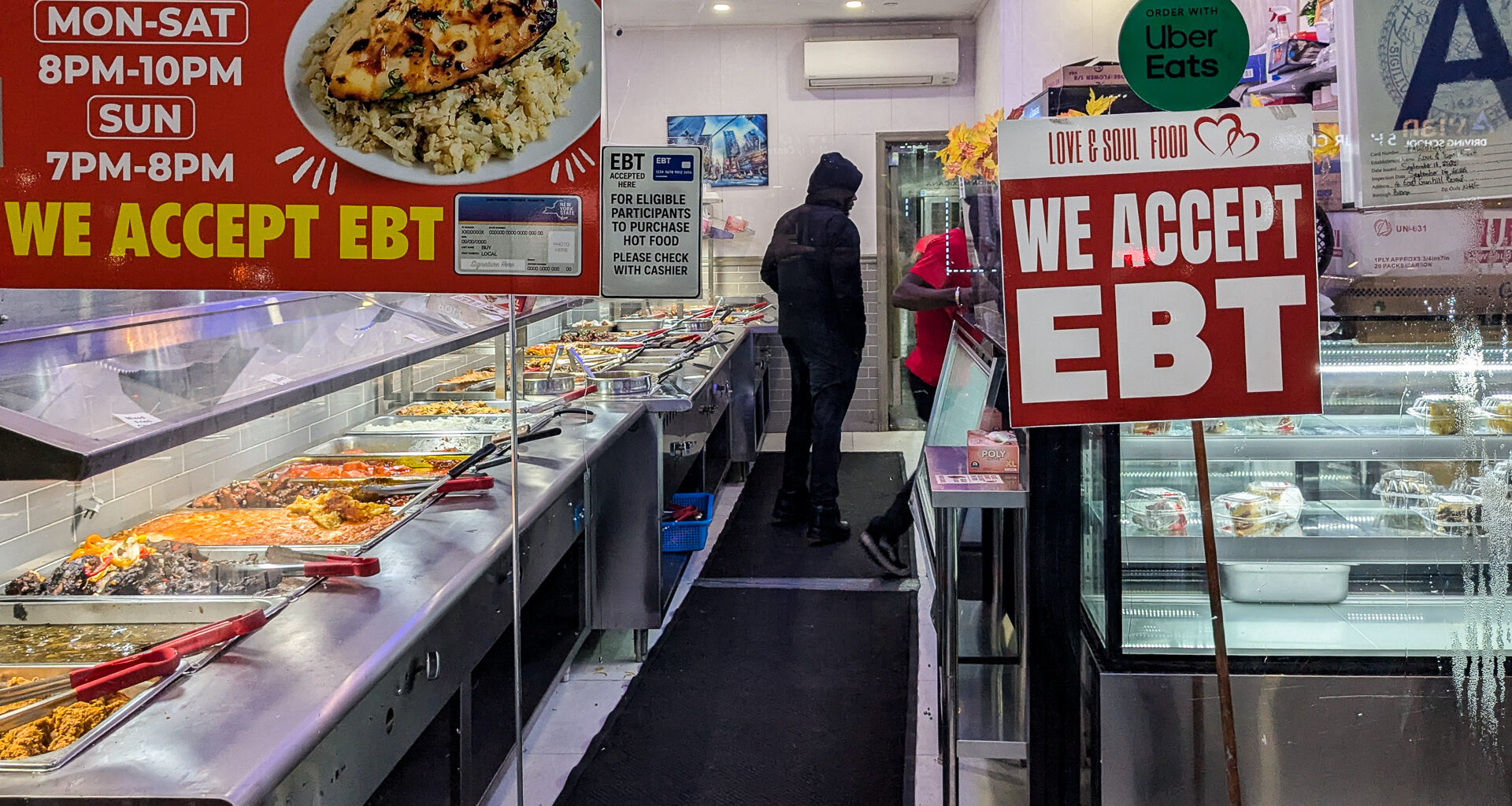
New work requirements for the Supplemental Nutrition Assistance Program (SNAP), formerly known as food stamps, took effect on March 1. Around 123,000 New Yorkers will have to comply with the changes, officials said.
 An EBT poster in the window of a business on East Gun Hill Road in The Bronx. (Adi Talwar/City Limits)
On March 1, new work requirements for the Supplemental Nutrition Assistance Program (SNAP), formerly known as food stamps, took effect in New York City—a result of the One Big Beautiful Bill passed by Congress last year.
While the federal government says the changes “reflect the importance of work and responsibility,” critics say they’ll do little to increase employment or earnings for SNAP beneficiaries, and will instead push more Americans into hunger.
Approximately 123,000 New Yorkers have been identified as Able-Bodied Adults Without Dependents (ABAWDs) who are impacted by the new rules, according to the Human Resources Administration (HRA), which administers SNAP in the city. That number that will likely rise as more beneficiaries are assessed or recertified this year, officials said.
The changes also now apply to several groups previously exempt from work requirements, including homeless individuals, veterans, and 18 to 24 year olds aging out of foster care.
Staff at HRA—and on the state level, at New York’s Office of Temporary and Disability Assistance, or OTDA—have been rushing to prepare SNAP recipients and notify people about how to comply with the new rules. HRA began mailing notifications, known as “Work Activity Letters,” to impacted SNAP participants in October and November.
After talking with officials and advocates, City Limits prepared this guide to provide an overview of the changes.
Who is considered Able-Bodied Adults Without Dependents (ABAWDs)?
Individuals aged 18 to 64 who do not live with a child under age 14 in their household, or
Are not pregnant or caring for someone who cannot care for themselves, or
Have no mental or physical barrier to employment
SNAP recipients who have mental or physical barriers to employment—a health problem, pregnancy, or treatment for substance use, for example—should report them on their Medical Statement form (an OTDA version of the form is available here; those in the city should use HRA’s version. HRA considers the circumstances of each case, and other conditions may apply.)
What are the new work rules imposed on SNAP recipients?
SNAP beneficiaries identified as ABAWD are required to spend at least 80 hours (20 hours per week) each month doing one or more of the following:
Paid work (full-time, part-time, and gig and “in-kind” work count)
Participating in HRA-approved job training programs
Participating in employment or training programs for veterans operated by the Department of Labor, the Department of Veterans Affairs, the Workforce Innovation and Opportunity Act or Trade Act
Volunteering
Engaging in a mix of work and qualifying programs
In short, compliance can be shown through a combination of employment, education, training, or community service.
“One of the interesting pieces is that it’s a work requirement, but there’s also a volunteering component that can help people satisfy their compliance,” said Zac Hall, senior vice president of programs at Food Bank For New York City.
The number of volunteer hours someone is required to complete is determined by a unique formula that considers the amount of a household’s monthly SNAP benefits and the number of beneficiaries, divided by the state minimum wage. A volunteer participation record is available here.
Community organizations interested in creating a new program to support SNAP recipients’ compliance with the new requirements through volunteer opportunities should complete the city’s inquiry form.
What should I do if I get the Work Activity Letter stating I now have to meet work requirements?
People should follow the instructions in the letter they received from HRA, which is personalized and gives details on where to go and what steps to take, officials said. An OTDA sample letter is available here. For many, it’s most convenient and least burdensome to follow the step-by-step instructions in their letter—which, in some cases, includes appointment details to connect them with a career services provider who will help them complete their paperwork.
What if you met the ABAWD criteria, but didn’t receive a letter?
HRA administrator Scott French said people should report to the agency as soon as possible. Officials and advocates stressed the importance of SNAP participants having an accurate and up-to-date mailing address on file.
HRA acknowledged that youth aging out of foster care, people experiencing homelessness, and veterans—a new group included in the work requirement process—may face additional barriers to receiving mail. Officials encourage people to contact HRA right away if they have questions or concerns.
A spokesperson for the Department of Social Services, under which HRA operates, said that although work requirements are punitive and meant to reduce the public benefits caseload, the agency doesn’t want any New Yorker to lose access to SNAP.
How else has HRA notified people?
HRA is also publishing notices via the “E-notices” section in ACCESS HRA, the agency’s online portal and app. The agency recommends that people have an account and allow notifications so they don’t miss updates on their case.
Where can I file my documentation?
Participants can file documentation showing their compliance with the new rules either in person (at one of the various HRA Benefits Access Centers—find them all here), through their ACCESS HRA account, or even by fax (917-639-2544). Documentation can include things like pay stubs, a letter from your employer stating your hours and pay, receipts or statements from volunteer work and letters from training or job programs, according to HRA.
If you have any questions about ABAWD rules, please call 718-SNAP-NOW (718-762-7669).
When can people start losing SNAP benefits?
“Under the ABAWD rule people can receive up to three months of benefits in a 36-month period” without complying with the work requirements, said Krista Hesdorfer, director of public affairs for Hunger Solutions New York.
New York uses something called a “fixed statewide clock,” meaning the 36-month period starts and ends on the same date for all SNAP users; the next three year window will restart on Oct.1, 2026.
That means those who failed to report their work hours for March, April, and May could lose their benefits in June (except for adults in Saratoga County, where the rule was initiated last year).
People will receive monthly notifications through their ACCESS HRA account if they’re not in compliance. “So in early April, we will send out notices to individuals who we have identified didn’t comply,” French explained. “And we’ll do that monthly. Letting them know, ‘This is your first strike.’ ‘This is the second month. You only have one more month before your benefits get impacted.’”
Someone who has exhausted their three months of noncompliance, however, can re-establish eligibility at any time by meeting the work/training requirements for 30 consecutive days, HRA says.
Are there any additional tips?
Respond to all notices and appointments provided by the SNAP office in your county—or if you’re in New York City, HRA—as soon as possible.
For further assistance, “reach out to the Nutrition Outreach and Education Program, New York’s network of SNAP navigators managed by Hunger Solutions New York,” Hesdorfer said.
To reach the reporter behind this story, contact [email protected]. To reach the editor, contact [email protected]
Want to republish this story? Find City Limits’ reprint policy here.