
Real journalists wrote and edited this (not AI)—independent, community-driven journalism survives because you back it. Donate to sustain Prism’s mission and the humans behind it.
After almost 15,000 New York City nurses ended the largest strike in the city’s history in full by Feb. 26, union leaders say the negotiated contracts have set new industry standards, while some nurses say they don’t go far enough in a few key areas.
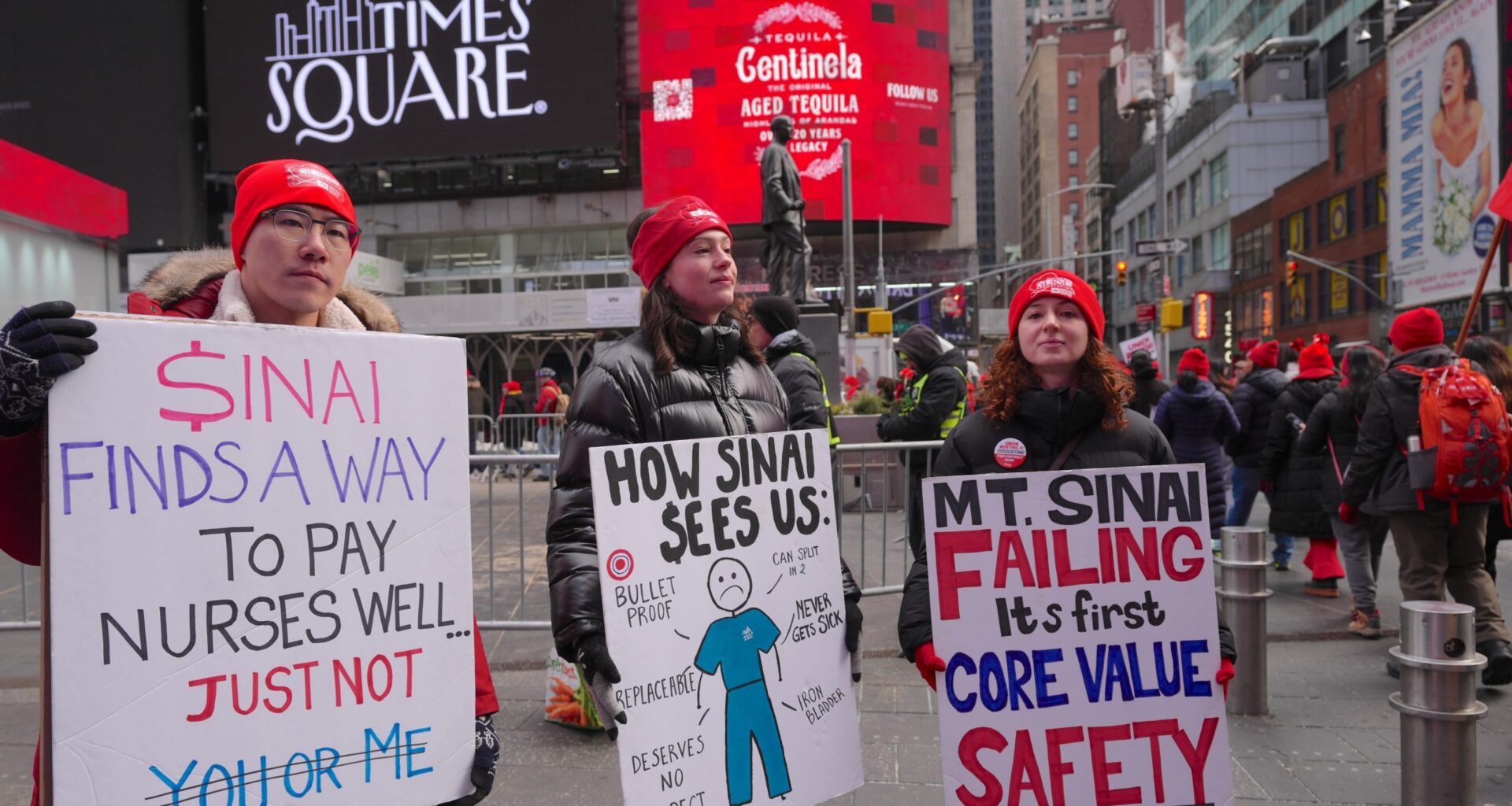
The strike at some of the nation’s largest hospitals went on for longer than a month after nurses at Mount Sinai, Montefiore, and NewYork-Presbyterian hospitals, represented by the New York State Nurses Association (NYSNA), walked out of the job on Jan. 12.
During the strike, workers lost their pay and their health care to secure better working protections, including better staffing ratios that nurses say also improve patient care, new workplace safety measures, and fair health benefits. The hospitals spent millions on out-of-town nurses during the strike to cross the picket line and continue providing care.
“Nurses went up against the wealthiest, largest private employers who tried to undermine nurses’ spirit and union power repeatedly,” NYSNA Executive Director Pat Kane said in a press statement. “Nurses remained strong through one of the hardest fights the labor movement has seen in this city in years and proved to employers that when you mess with nurses, you have to face the city’s entire labor movement.”
Mount Sinai CEO Brendan Carr said in a statement the strike was challenging and exhausting.
“Many over the last month have faced hard conversations in public, at work, and at home. We may have differing perspectives, but we are united by our shared mission of caring for our community,” Carr wrote in a statement.
In their new three-year contracts, NYSNA officials wrote in a press release, nurses won concessions around safety, including enforceable safe staffing standards; more nurses at all hospitals; and workplace safety measures such as additional weapons detection systems at entrances, additional visitor screening, wearable panic alarms, and steps toward implementing behavioral health rapid response teams. Nurses also won paid time off to appear in court if they are affected by workplace violence.
Other concessions won include protections to nurses’ health benefits and no additional costs to nurses; guardrails against AI in all contracts for the first time; and increases to salaries by more than 12% over the three-year contract.
Nurses also won protections for immigrant and trans patients and nurses, including clear guidelines for protecting patient care and interacting with Immigration and Customs Enforcement at Mount Sinai Morningside, Mount Sinai West, and Montefiore, and new protections for trans workers at Mount Sinai Hospital.
The new contracts, however, didn’t go far enough in key areas where nurses wanted to see transformative change, according to some nurses who said they did not secure significant gains to protect trans and immigrant workers and patients.
KA Hogan, a nurse at the emergency department at Mount Sinai, said they organized for months to secure more commitments from the hospitals to protect and make queer workers, particularly trans workers, feel comfortable at work.
Additionally, Hogan and a group of other nurses demanded that the hospital commit to reinstating gender-affirming care for trans youth under the age of 19, a practice that Mount Sinai has recently decided it would no longer provide.
Mount Sinai is but one of the several hospitals in New York that decided to stop providing this type of care to trans youth, following months of threats from the Trump administration to cut funding to hospitals that do so.
New York State Attorney General Letitia James recently sued the federal government to stop such threats and has said that hospitals that deny this type of care to trans youth could be in violation of state laws against gender discrimination.
Hogan said nurses asked the hospital to share the state of care on Mount Sinai’s website.
“We saw [that] as protection of both nurses’ scope of practice, as well as patients,” Hogan said.
A Mount Sinai spokesperson did not respond to questions about its policies on protections for trans patients and workers. They also did not provide comment on nurses’ claims that the contract does not do enough to protect trans and immigrant patients and workers. NYSNA officials also did not provide comment on these claims.
Nurses also fought for more streamlined ways in which nurses’ and patients’ preferred names could be displayed. Hogan said there can be discrepancies in how patients’ names show up in the electronic medical record provider. It is not clear if patients’ preferred names and pronouns will be on display.
“We were asking for that to be streamlined, which is a protection for our ethical practice as providers and patients, of course, affirmation safety in the hospital,” Hogan noted.
Mount Sinai, they said, declined to provide clarity and protection, noting that the hospital was not going to use the nursing contract to protect patients.
Similarly, the hospital added new language to the contract noting that workers could use their preferred names in official identification badges, and that the hospital should not unreasonably deny said requests.
“This is a small movement towards affirmation, but doesn’t actually make it there. It doesn’t actually protect people,” Hogan said.
The language in the contract is not forceful enough, they said. Hospital leadership tells workers that their badges and emails are legal documents and therefore, should reflect workers’ legal names.
“So it really depends on the manager whether this is going to be affirmed or denied, and it also puts the onus on the employee to request it without the guarantee of actually being supported,” Hogan said.
Nurses also advocated for as many gender-neutral bathrooms as possible.
The hospital, Hogan said, did provide two pieces of gender-inclusive language in the contract for all employees, mostly related to bathroom usage. One of these states that Mount Sinai affirms that employees may use the facilities that align with their gender identity. The other states that the hospital should use reasonable efforts to provide gender-inclusive bathrooms and locker rooms in areas under new construction.
“But despite those real concerns, what they’ve left us with is a statement that lives only in our contract,” they said.
Hogan said that nurses lobbied for signage provided by New York City in the multi-stall “men’s” and “women’s” bathrooms. Hogan, who is nonbinary, said this signage would have encouraged people to use the bathroom that feels most comfortable to them. They noted that that would have been a clear show of support and solidarity with gender-diverse workers and patients.
“It’s challenging, and it’s challenging for visitors, families, patients, and employees,” Hogan said. “So it is a small movement towards protection, but it is not going to prevent harassment.”
Hospitals also did not provide enough key protections for immigrant patients and workers, some nurses said.
Lila Goldstein, a nurse at Mount Sinai’s postpartum unit, said nurses had requested that the hospitals provide clear language that would block the infiltration of ICE in the hospital without a signed judicial warrant.
“I think there could have been a lot more that was done,” Goldstein said. “We did not get that language in the contract.”
The current policy states that there is a designated person from the hospital meant to deal with ICE, but it does not delineate the conditions in which ICE can come to Mount Sinai to detain a patient.
“We’re a private hospital, I think we have a lot more wiggle room. … We can say who comes in and out of the hospital,” Goldstein said.
Editorial Team:
Sahar Fatima, Lead Editor
Lara Witt, Top Editor
Stephanie Harris, Copy Editor
Related