
It’s usually quiet at the highest natural point in Brooklyn, where visitors to Green-Wood Cemetery pause to take in sweeping views of New York Harbor and Lower Manhattan.
But the hilltop is called Battle Hill for a reason.
What You Need To Know
The Battle of Brooklyn, also called the Battle of Long Island, was fought Aug. 27, 1776 during the American Revolutionary War
British forces defeated the Continental Army, but George Washington successfully evacuated thousands of troops across the East River overnight
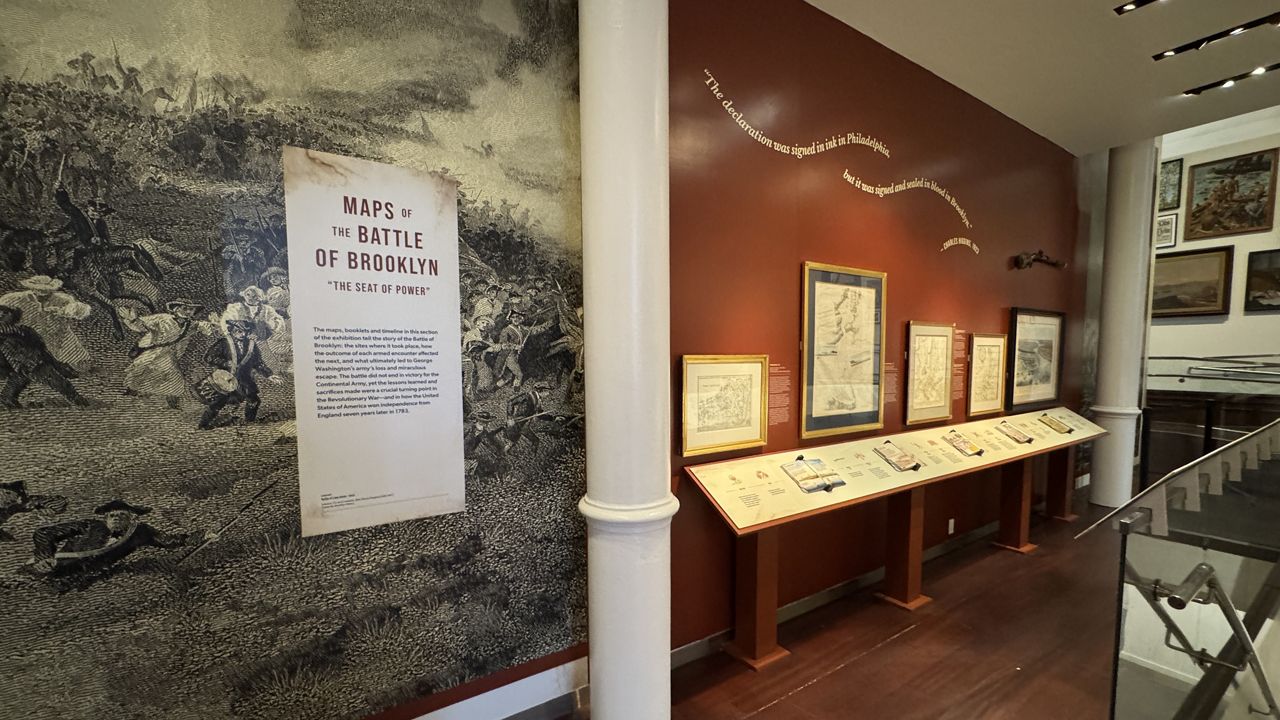
A new exhibition at the Center for Brooklyn History explores the battle through artifacts, artwork and historical context
TThe free exhibition, “The Battle of Brooklyn: Fought and Remembered,” will be on display through the end of 2026
On Aug. 27, 1776, the site and surrounding neighborhoods were the scene of some of the fiercest fighting of the American Revolutionary War during the Battle of Brooklyn, when British forces overwhelmed the Continental Army in what became the largest battle of the war.
Nearly 250 years later, the pivotal moment in American history is the focus of a new exhibition at the Center for Brooklyn History titled “The Battle of Brooklyn: Fought and Remembered.”
“The Battle of Brooklyn, even though it’s a defeat, is a turning point in the Revolutionary War. It’s a turning point in American history,” said Dominique Jean-Louis, chief historian at the center, which is part of the Brooklyn Public Library.
The exhibition brings the battle to life through artifacts, including uniform buttons and a cannonball, alongside artwork and historical interpretation that trace how the conflict unfolded across Brooklyn.
Outmatched by British troops, the Continental Army faced near-certain destruction. But a dramatic overnight evacuation led by George Washington helped preserve the revolutionary cause.
“It’s always described as a miraculous fog,” Jean-Louis said. “A dense fog drifted down the East River and provided cover for Washington and his remaining soldiers to float back across the East River to Manhattan. Not a single man was lost during that procedure overnight. Every rowboat and every sloop in the city was used to transport them, and the Continental Army lived to fight another day because it very much could have been all over here in Brooklyn.”
Stories of sacrifice are also central to the exhibit, including that of the Maryland soldiers who held off British forces long enough for Washington’s troops to escape.
Plus, tales of the British prison ships that were anchored in Wallabout Bay, where more than 11,500 Americans died. Many are believed to be buried beneath the Prison Ship Martyrs Monument in Fort Greene Park.
Beyond recounting the battle itself, the exhibit also explores how it has been remembered and commemorated over the centuries.
“Part of what we get to do is update the story and make sure it’s not only about American soldiers and British soldiers,” Jean-Louis said. “It’s really a much more diverse universe of characters that’s framing the events of the Battle of Brooklyn.”
“The Battle of Brooklyn: Fought and Remembered” is free to the public and will remain on display through the end of 2026.