
By Jacob Kaye
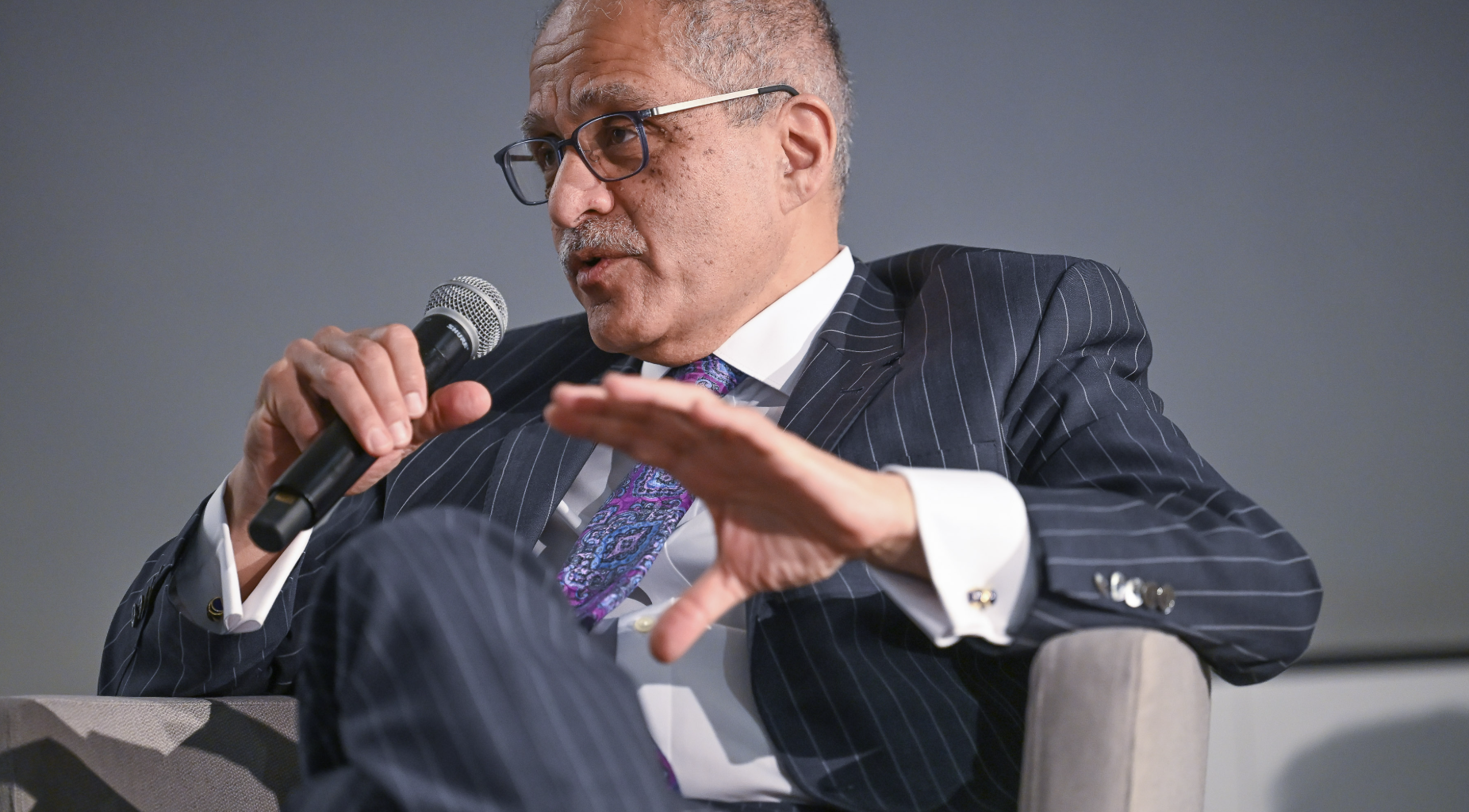
New York’s top judge last week bashed the state’s sentencing laws, claiming “everything we are doing here is stupid,” while continuing his public plea for lawmakers to pass sentencing reforms.
Chief Judge Rowan Wilson said at the CUNY School of Law in Queens that it was past time for the state to pass the Second Look Act, a bill that would give New Yorkers serving lengthy prison terms an opportunity to have their sentences reviewed. No current process for challenging potentially excessive sentences exists – unless the sentence was handed down illegally.
Wilson, who has effectively advocated for the bill’s passage since taking office in 2023, said it was “stupid” that New York’s laws don’t allow for judges to reevaluate massive sentences given to New Yorkers who have likely changed while being held behind bars.
The judge said the state’s current approach to sentencing makes little sense. He argued that judges, over the past several decades, have handed out large sentences to defendants whom they know little about. Then, the state spends large sums of money to keep them incarcerated for years. And while many transform their lives while incarcerated, they are left with few ways to contribute to society.
“None of us are really very good about predicting the future, but the system depends on what I consider a stupid assumption that judges can do that,” Wilson said.
Wilson also endorsed recent efforts by several criminal justice reform groups that have called on the governor not to reappoint judges who have issued lengthy sentences overturned on appeal.
“When those judges come up to be elected, don’t vote for them, get other people not to vote for them,” he said. “That’s something you can do for me.”
The judge made his remarks during a Second Look Act symposium hosted by the law school and advocacy group Communities not Cages. His second-in-command, Chief Administrative Judge Joseph Zayas, also attended the symposium and advocated for the legislation, which has stalled in Albany after first being introduced in 2021.
Zayas, who previously served as the administrative judge in Queens Supreme Court, Criminal Term, said it was his own childhood growing up in public housing in Manhattan, and getting up to no good himself, that spurred his support for the bill.
“I see so many people who start out with these difficulties and later turn their complete life around,” Zayas said. “I’m supportive of this because of my strong belief that people can change and will change.”
The Second Look Act, which is sponsored in the State Senate by Queens and Brooklyn Senator Julia Salazar, would create a process for people to request a resentencing hearing 10 years into their sentence, regardless of their conviction.
The bill would be a singular lifeline for the thousands of New Yorkers slapped with massive sentences during the tough-on-crime era of the ‘80s and the ‘90s, when mandatory sentencing laws resulted in judges sometimes ordering over 100 years prison time to nonviolent defendants.
Among those defendants was Percy West, a Brooklyn man who spoke alongside Wilson and Zayas on Friday.
West was 19 years old when he was sentenced to 132 years in prison, which a judge gave him after prosecutors offered him six to 12 years behind bars as part of a plea deal he turned down. West served 33 years before the Brooklyn district attorney’s office agreed to review his sentence as part of a unique second look program started by Brooklyn DA Eric Gonzalez. He was released from prison last year, and immediately began advocating for the Second Look Act in Albany.
West said that without any opportunity for release beyond clemency, a practice that the governor has appeared to largely abandon in recent years, he had little incentive during his first years in prison to behave well.
“I had a chip on my shoulder,” he said. “I’m sentenced, I don’t see no light, I’m not following the rules and regulations at all. For what?”
Prison officials put him into solitary confinement, where he remained for six years.
Eventually, West said that he decided he had to change his life and began taking classes and participating in programming. The Brooklyn man said Friday from Queens that young incarcerated New Yorkers would be quicker to make the same change themselves if they knew they had an opportunity for release.
“If you start seeing people leaving prison as a result of benefiting from the Second Look Act, that will get their attention,” he said. “Because a lot of them do not have hope.”
But the possibility of the Second Look Act passing has already begun to stir hope in some who have been in prison for years.
Shawn Peace, who was convicted in 2014 of killing a cab driver in Queens four years prior, is currently incarcerated in Green Haven Correctional Facility after being sentenced to 102 years in prison.
In a video played for attendees of the Second Look Act symposium, he described his sentence as a “slow death.”
“His number was meant to tell me and everyone else, that my life was over and that my future had no value,” he said. “Honestly speaking, for a long time, I believed it. But over time, something changed.”
Peace said he chose to confront parts of himself that were “painful, difficult, and uncomfortable” because he had realized the harm he’d caused.
The Second Look Act would not result in an automatic release for Peace and people like him, but would afford him the opportunity to make his case to a parole board.
“The Second Look Act is not about erasing the past, it’s not about overlooking harm, and it’s not a free pass,” he said. “It is the last hope, not just for me, but for all the people who have done the work of taking responsibility and earned the right to be evaluated not by who we once were, but who we’ve become.”