
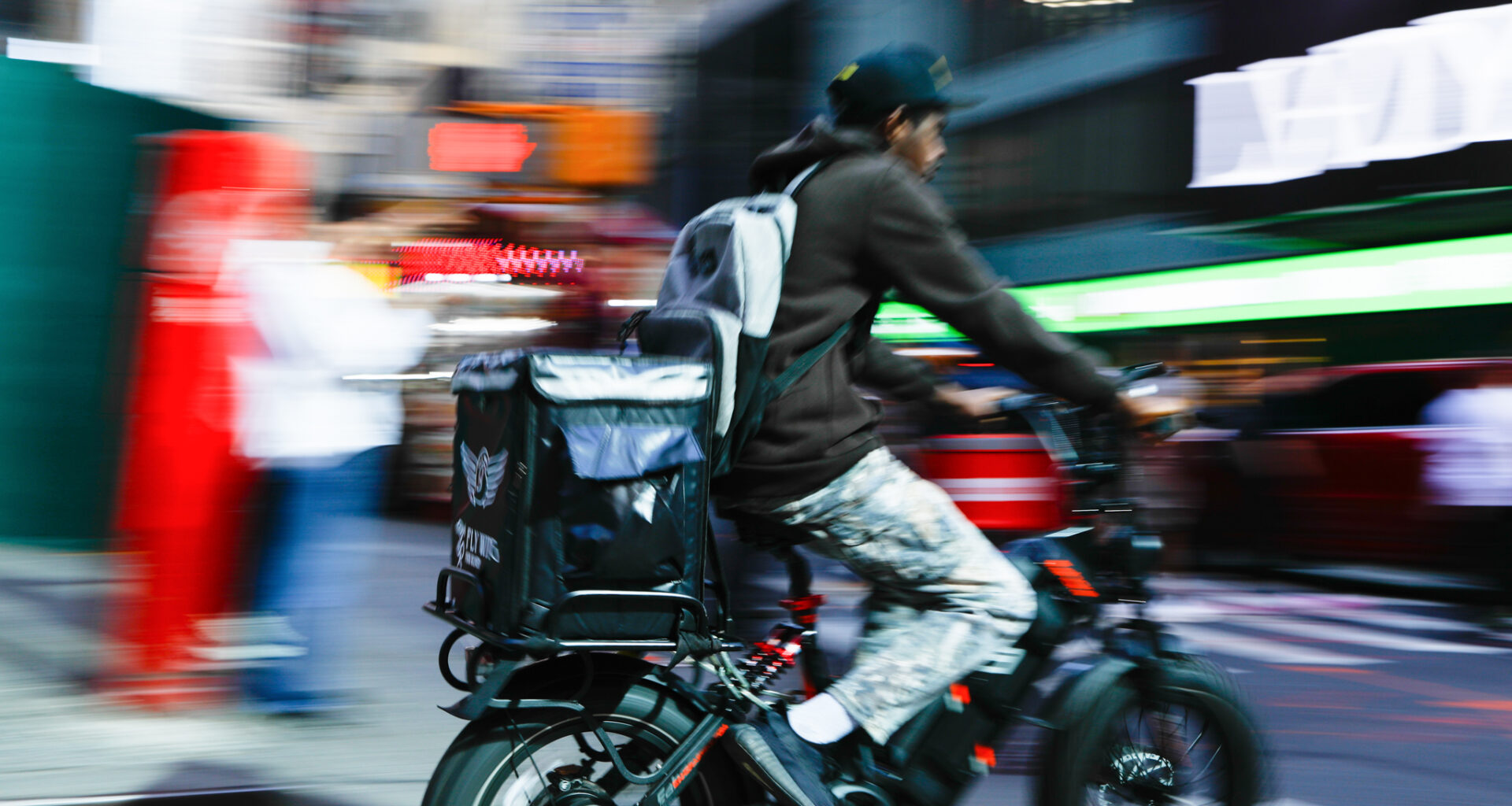
Delivery workers have become a fixture of city streets, rushing on bicycles to make the next drop-off with bulky pouches strapped to their backs and “delivery mittens” on their handlebars.
In any condition — pounding rains, snowstorm or blistering heat — these workers known as deliveristas have to hustle. And as they have increasingly gained workforce representation in recent years, their jobs have evolved — from the minimum in take-home pay to how customers tip.
But it can be confusing for customers to grasp the proper etiquette for tipping those delivering their meals.
In January, the city put the number of estimated delivery workers at more than 80,000, with many performing often-dangerous duties with no benefits. Many restaurants no longer hire delivery workers directly, instead going through third-party apps like DoorDash, Grubhub and Uber Eats. This makes the workers independent contractors, who buy their own bikes or scooters and cover costs that can include parking, gas, e-bike batteries and repairs.
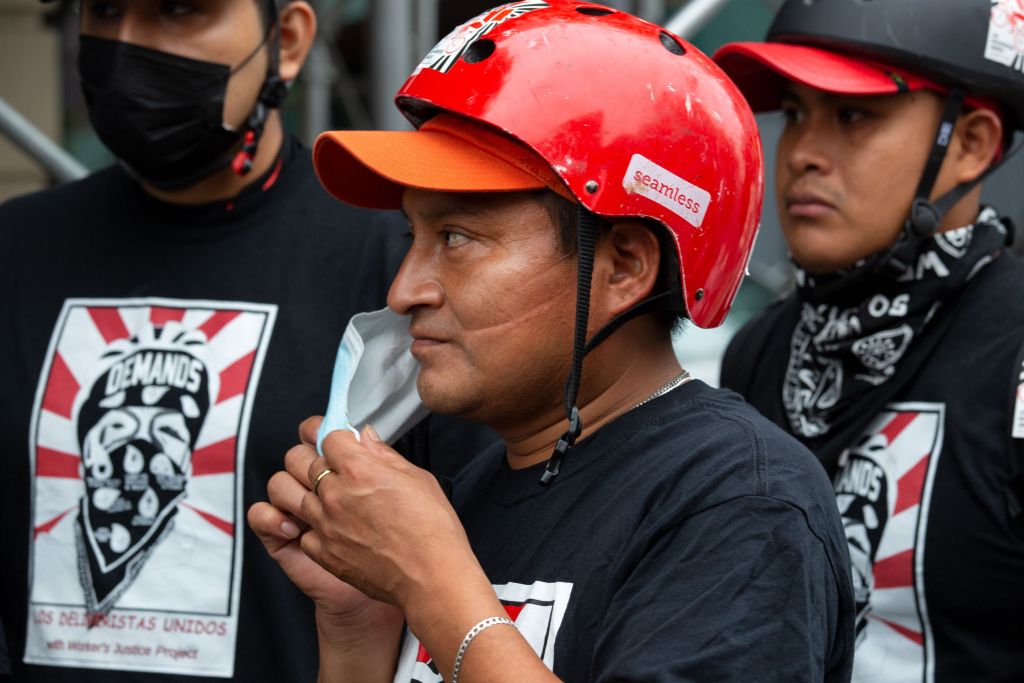 Deliverista Rufino Marcelo showed a scar he endured after falling off his bike. Credit: Ben Fractenberg/THE CITY
Immigrant workers largely make up the workforce, and the job is sometimes deadly — with fatality rates the highest of any industry in the city. A 2024 study by the Journal of Urban Health found that 36 out of 100,000 full-time “two-wheeled food delivery gig workers” sustain deadly injuries.
So, how best to reward a job well done by them?
THE CITY asked delivery workers and their advocates: How much is right? Do I really have to tip, especially since workers now earn a minimum pay rate? And is cash still king, or does the money from apps really make it to their pockets?
Here is what you need to know about tipping delivery workers in New York City:
Should I tip? How much do delivery workers earn without tips?
Short answer: Yes, absolutely tip. Deliveristas depend on tips for their livelihoods.
“Tipping is part of the lifeblood of delivery driver income,” said Nicki Morris, spokesperson for Justice for App Workers, a nationwide coalition of delivery workers and drivers for ride-hailing apps. “It is something that every customer should do if they care about the well-being and stability of delivery workers.”
Not only is the work arduous, but the minimum pay rate is not as clear-cut as people assume, explained Gabriel Montero, spokesperson for the Workers Justice Project, a Brooklyn-based immigrant laborer organization.
“It’s not like a waiter who clocks into a restaurant for a shift,” he said. “We’re in a very kind of asymmetric situation with the app companies, in which they have all the data. They’re constantly monitoring, surveilling, tracking, recording what workers are doing and constantly wanting them to go faster.”
Deliveristas won the hard-fought battle for a minimum pay rate in September 2023, when New York became the first major U.S. city to guarantee that workers for app-based food services would be paid at least $17.96 per hour. On April 1, the current minimum pay rate will increase from $21.44, adjusting for inflation to $22.13.
 Credit: Hiram Alejandro Durán/THE CITY
The four companies that make up 99% of food deliveries in the city: Uber Eats, Grubhub, DoorDash and Relay — which is closing operations in New York City next month — fought the minimum wage, arguing it would irreparably harm their business.
In a statement, DoorDash said the “ill-conceived, extreme minimum pay rate for food delivery workers in New York City will have significant consequences for everyone who uses our platform.”
The law does not require the tech companies to pay workers by the minute or hour. Instead, the companies calculate pay, using one of two methods and they are not required to inform workers in advance how pay is calculated. However, they must do so after their pay period has ended and apply the same method to all workers.
“It’s at the discretion of the app companies,” Montero explained about how the apps calculate the amount a worker is paid while idle, waiting for orders. “Nobody understands, because their algorithms are like a black box.”
He said the apps also control how many hours per week deliveristas may work via a tier system that he called a “competitive class system.” For example, a worker in a higher tier may have the hours they deliver orders capped at 40 per week, while a worker in a lower tier may work no more than 20 hours per week.
Tips, in cash or via the apps, are always appreciated, said Sergio Gustavo Ajche, a delivery worker and leader of Los Deliveristas Unidos, a coalition of delivery workers.
Positive reviews also go a long way in ensuring workers’ good standing with the companies.
“Sometimes, customers will leave us a negative review because of something that wasn’t our fault — maybe we were delayed because of traffic, or the restaurant gave us the wrong order — and the company will lock us out of our accounts indefinitely,” he said.
Positive reviews “help us keep our jobs,” Ajche said.
How much should I tip?
If your order is under $100, Montero suggests a tip of 10 to 15%. For orders more than $100 that are physically large and require more effort, think generously — he recommends a 20% tip.
“We always encourage people to really think about the fact that this is a human being who’s taking risks to be able to deliver food,” he said.
Elizabeth Wagoner, a city Department of Consumer and Worker Protection (DCWP) policy director, noted that the hours deliveristas work are low on average.
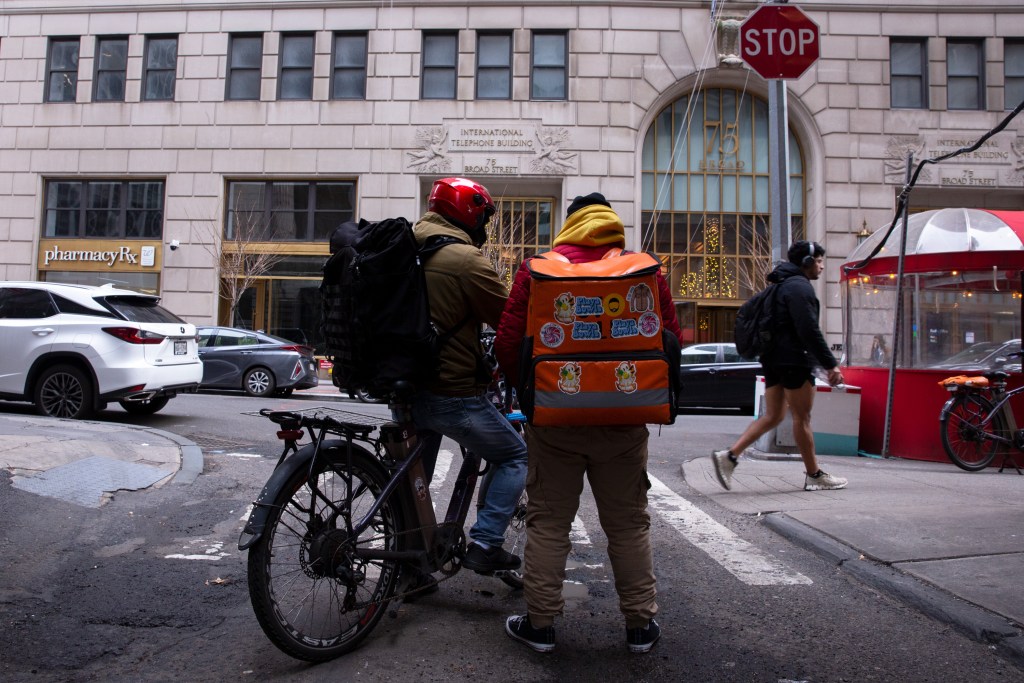 Delivery workers make the rounds in Lower Manhattan, Dec. 5, 2023. Credit: Ben Fractenberg/THE CITY
According to a DCWP quarterly report from September 2025, deliveristas work an average of 17.4 hours per week and take home an average of $366.51 in weekly pay, adding up to an annual income of under $20,000.
“How many hours they work and make are pretty low,” Wagoner said. “Many minimum wage workers depend on tips to supplement their income, and delivery drivers are no different.”
Is cash always best?
If it is possible to tip in cash, do so, Montero recommends.
“Cash is definitely most appreciated because it’s direct and instant,” he said. “It goes right into the workers’ hands.”
Most apps use a so-called bundling feature that obscures the tip on an order until later. When workers sign up for a trip, they receive multiple orders at the same time, with an estimated tip amount for the entire delivery. They don’t find out the tip-per-order amount until later.
Workers prefer to know up front how much customers tip so they can assess if a delivery is worth making, depending on the time, effort and pay. Greater transparency is important.
Morris from Justice for App Workers underscored this.
“If you are in a situation where you are able to leave the tip for the worker in person and exchange the cash tip for your food, cash is best to ensure the total amount of the tip goes directly to the worker,” she said.
Some customers told a delivery worker, who asked to be identified as “AK,” that they wanted to tip him but were confused by how to do it, since some delivery apps recently hid the tipping option until after checkout. He said if a customer is unsure, cash is always best.
AK asked customers who place large orders to “please, be generous.”
“One day, a customer ordered something like $500. It was a lot, a lot, a lot of items. They sent me an offer of only $5,” he said.
Workers can often see receipts and know when customers pay a lot for the food, then leave a meager gratuity for the person who brought it to their door.
What about when the weather’s bad?
If you are ordering food when conditions outside are hazardous, be ready to leave a nice tip as a thank you. In extreme weather events, like a snowstorm, workers must traverse dangerous roads in weather that puts them at risk.
“Thirty percent and upwards in extreme weather is really a good norm to live by,” Montero said.
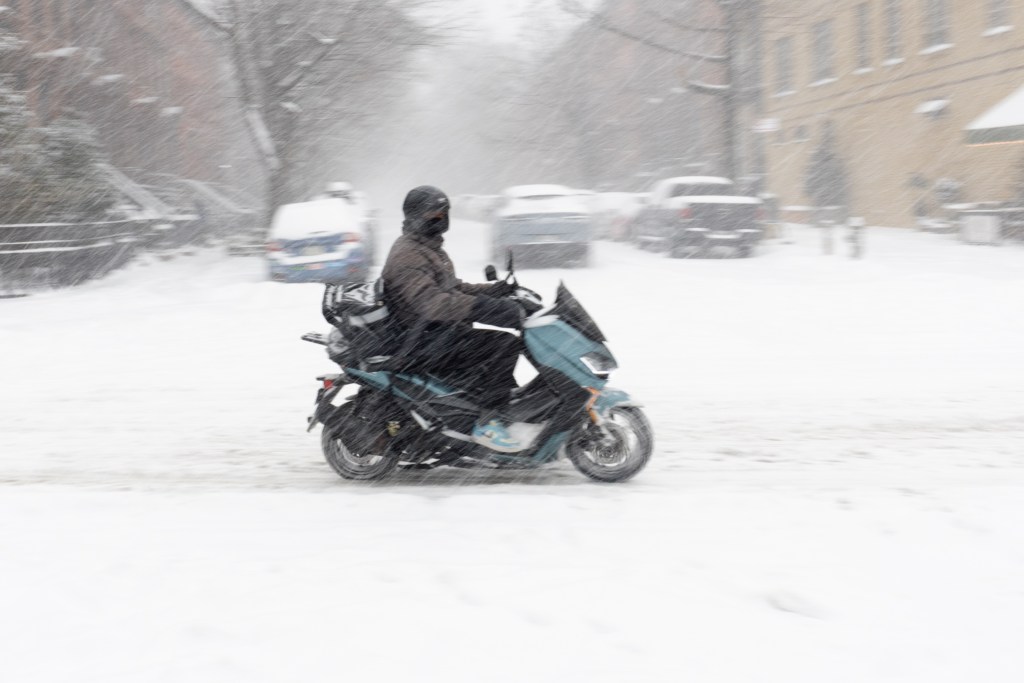 A delivery worker braves the snow in Brooklyn, Jan, 25, 2026. Credit: Ben Fractenberg/THE CITY
Ajche said some deliveristas try to take advantage of the bad weather and work to make more tips, and some customers need important items delivered no matter the conditions outside, like medicine.
“Be generous because the worker is putting himself at risk,” he said. “Many times I personally decide not to go, but sometimes, necessity forces me to go out.”
Is tipping through an app OK? Does the delivery worker get that money?
Yes, delivery workers told THE CITY that they do receive the money sent through delivery apps. But complications with the tipping options on apps have confused customers in recent years.
After delivery companies lost the legal fight over the minimum pay rate in December 2023, changes to the tipping option within delivery apps made it harder for customers to find — resulting in less money for workers.
Uber Eats and DoorDash began making it harder for customers to tip workers by putting the tipping option after checkout on the apps. According to the Department of Consumer and Worker Protection, Uber Eats and DoorDash tips fell by more than $550 million when the apps made it so people could only leave tips after delivery rather than during checkout.
Montero explained that once the tipping option is removed, it affects people’s ability and attention to be able to provide a tip.
“These apps are in the business of engineering human behavior all the time through their interfaces,” he said.
Since the minimum pay rate took effect, AK told THE CITY that customers began tipping less. Previously, he said, $3 to $4 tips were common, but afterwards orders with $0 added were more regular.
On Jan. 26 of this year, changes to city delivery worker laws took effect, requiring delivery apps to show customers a tipping option before checkout.
Wagoner acknowledged that it is legal for apps to offer tipping options of less than 10% at checkout, which she described as “not ideal.” Workers’ “Notice of Rights” information must also be displayed in the apps, emailed and texted to all deliveristas and sent to new workers before their first trip.
Ajche, a veteran delivery worker who goes by “Gustavo,” said that workers have noticed a positive difference in their paychecks in recent weeks since a city law requiring tipping options at or before checkout went into effect.
“The other day I received a call from a fellow member, and he said ‘Gustavo, I’m so grateful you got this fixed. Now this work is as good as it used to be before,’” during the pandemic boom of the industry, he said.
When AK immigrated to New York City from the West African country Burkina Faso, delivering food was his only source of income. Before getting a second job, he would work every day of the week, often 10 days in a row. Now he delivers whenever he has the time — at 6 p.m. after he clocks out, or in his spare time during the afternoon — time windows for the lunch and dinner rush.
Montero said tips for delivery workers are “really the difference between being able to make it and not” in a city as expensive as New York.
With additional reporting by Claudia Irizarry Aponte.
Related