
Scottish Ballet’s Mary, Queen of Scots is a sweeping, stylised account of two queens – Mary as remembered by her cousin, England’s Elizabeth I. Covering three countries and many decades, the ballet sometimes sprawls, but it’s packed full of ideas, and danced with fierce conviction.
In recent years, Scottish Ballet has built a reputation for sharp story ballets, from a Silicon Valley Coppélia to its stark retelling of The Crucible. Created by different teams, these productions share a contemporary sense of theatre, with a dash of the surreal.
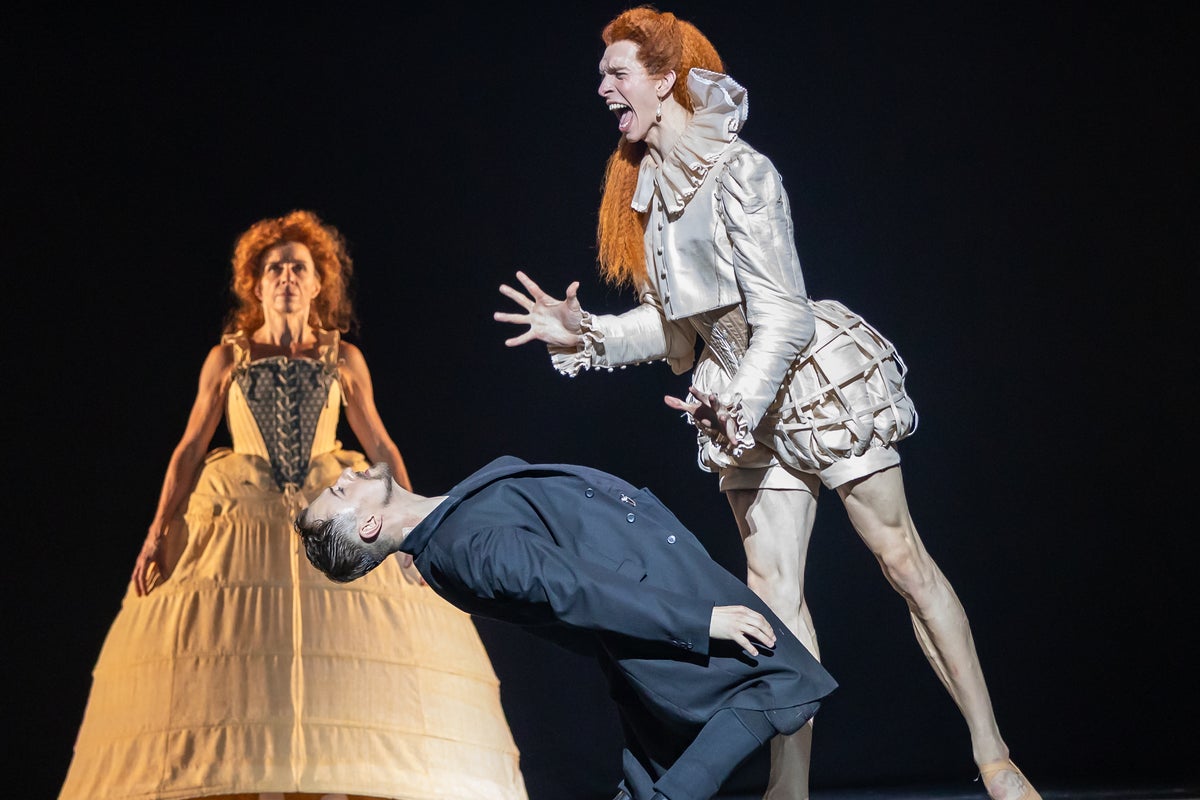
The new Mary, staged at Sadler’s Wells, was co-created by Sophie Laplane, Scottish Ballet’s resident choreographer, with director James Bonas, who collaborated on The Crucible. We see Mary’s life through the dying Elizabeth’s eyes: guest artist Charlotta Ofverholm moves through the action, observing and reaching into the story, interacting with her younger self. Perhaps unexpectedly, Elizabeth becomes the more nuanced figure: while Roseanna Leney is a glamorous Mary, luxuriating in Laplane’s moves, the production gives her less inner life.
Moving from France to England to Scotland, Laplane creates distinctive moves for the hierarchies of each court. Monarchs loom over their subjects: Mary stalks grandly on pointe, with those around her standing flat-footed. Early on, young Elizabeth is literally on stilts, with Harvey Littlefield commanding in a role that can be played by a dancer of any gender. Things become more layered when we see characters as Elizabeth imagines them. Mary transforms into a spider to consume Evan Loudon’s Darnley, other dancers providing extra stabbing limbs.
Throughout, Soutra Gilmour’s designs amplify the danced images. The French queen Catherine de’ Medici’s huge, steel farthingale evokes both a prison and a climbing frame. Walsingham, Elizabeth’s spymaster, sends out agents wearing insect masks, crawling across Mary’s private life. The erotic first duet for Mary and Evan Loudon’s Darnley is full of power play, her finger in his mouth; there’s a wonderful moment when Thomas Edwards’ Walsingham has to replay it all for Elizabeth.
-Evan-Loudon-as-Darnley-in-Scottish-Ballets-Mary-Queen-of-Scots--Credit-Andy-Ross-9.jpeg)
open image in gallery
Evan Loudon as Darnley in Scottish Ballet’s ‘Mary, Queen of Scots’ (Andy Ross)
Most dramatisations of Mary and Elizabeth can’t resist bringing the two heroines together, for a meeting that didn’t happen in history. This ballet keeps them apart, even showing proxies dancing for them. The storytelling is full of stylised distances. Kayla-Maree Tarantolo’s lime-green jester prods the action forwards, an image of fate as both perky and heartless.
Laplane and Bonas play with narrative and expectations – a strength, but also a weakness. This long, complex story sags in places, overloaded with plot points that need more time to breathe. But it bubbles over with energy and thought, ardently performed by everyone involved.
Until 8 March. www.scottishballet.co.uk