
In the hidden chambers of Japanese forests, a quiet rebellion has been unfolding for decades. Scientists have now confirmed that one rare ant has broken almost every rule of ant society.
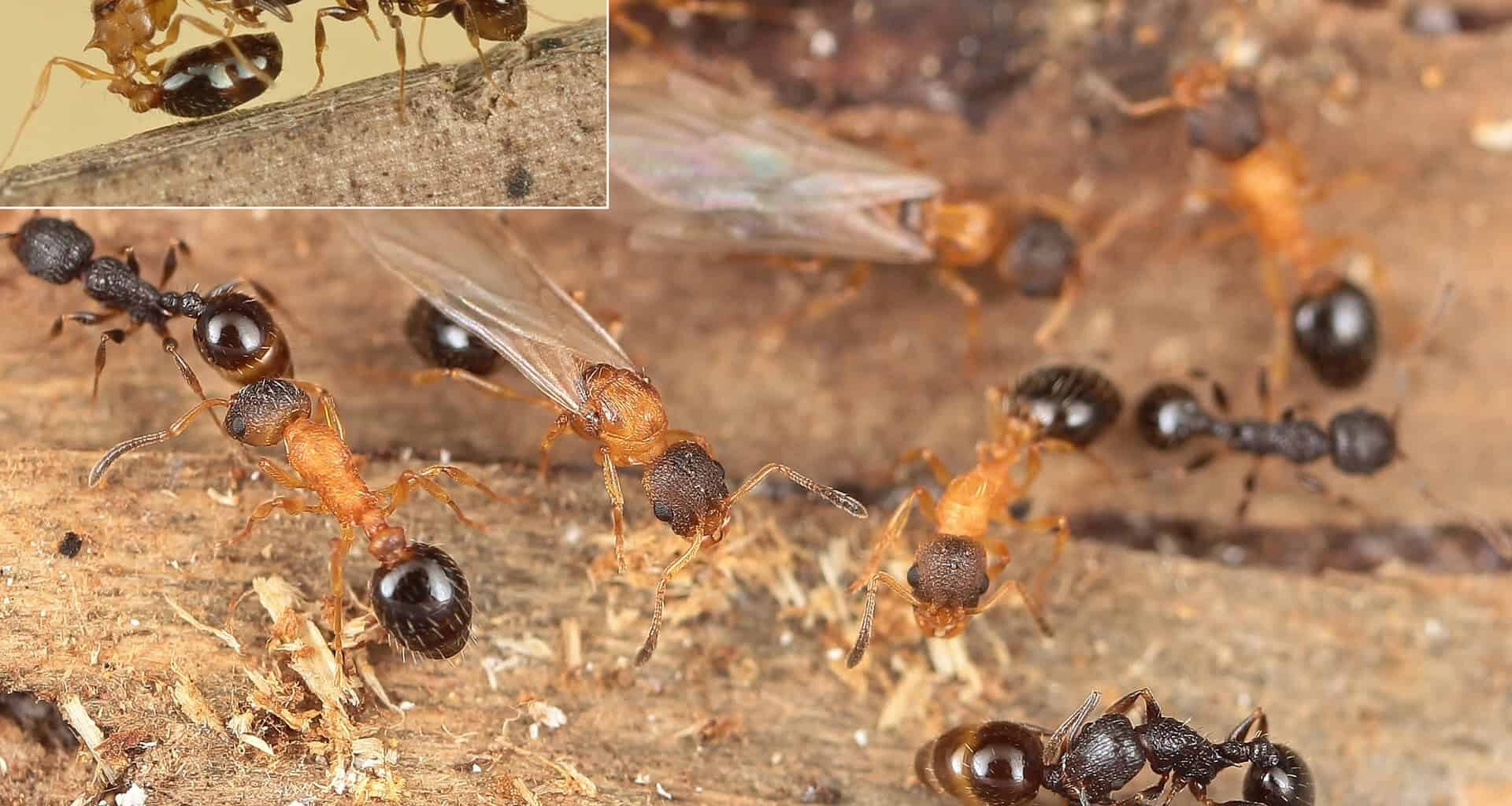
 A T. kinomurai colony with T. makora host workers (dark brown). Image credits: Hamaguchi et al/Current Biology (2026).
The species, Temnothorax kinomurai, doesn’t bother with males. It doesn’t even produce workers. Every single individual is a queen. Instead of building its own workforce, this ant invades the nests of others and turns the resident workers into unwilling caretakers.
For more than 40 years, researchers suspected this species might operate in such an extreme way, but they couldn’t prove it. Now, a new study confirms it. This is the first known ant species made up entirely of queens. Adding to its rarity, the species has been found in only nine spots across Japan.2
This ant species exhibits “an entirely new form of social organisation, adding another exciting dimension to the already rich and varied world of ants,” Jürgen Heinze, one of the study authors and a professor emeritus at the University of Regensburg, Germany, said.
When ants turn against their own queen
Ant colonies usually follow a strict structure, where one queen lays eggs, female workers gather food and care for young, and males live briefly to mate before dying. While parasitic ants and asexual reproduction are known separately, no species has ever been shown to permanently combine both strategies.
The parasitic queens of T. kinomurai target a closely related species, T. makora. A young queen sneaks into a host nest and launches an attack. She stings the resident queen and the most aggressive workers who resist her.
Earlier field observations even documented cases where host workers ended up killing their own queen after the invasion — an extremely rare act in ant societies, where workers normally dedicate their lives to protecting her.
If the takeover succeeds (and many attempts fail) the surviving host workers begin caring for the intruder’s offspring. They forage, defend the nest, and feed the brood, unaware they are raising a different species.
Proving the impossible
To prove what was happening, researchers collected six colonies led by T. kinomurai queens and placed them in artificial nest boxes in the lab. From these colonies, they reared 43 offspring. Careful examination of their bodies, especially their reproductive organs, revealed no males and no smaller worker ants. All 43 were queens.
×
Thank you! One more thing…
Please check your inbox and confirm your subscription.
None of these queens had mated, yet they laid eggs that developed perfectly. This confirmed the ants use parthenogenesis—a form of asexual reproduction where females produce offspring without any help from males. Then, under the microscope, researchers confirmed that the queens’ mating structures showed no signs of use, further proving that fertilization had not occurred.
The team then tested whether these new queens could repeat the process. They introduced the 43 unmated queens to fresh T. makora colonies. Seven successfully carried out coups—a high failure rate, but typical for parasitic ants. Those seven queens produced 57 offspring. Once again, every single one was a queen.
After examining multiple colonies and populations, researchers concluded that Temnothorax kinomurai is the first ant species known to lack both workers and males and to consist exclusively of queens.
“The life history of T. kinomurai is characterized by the unique combination of workerless parasitism and thelytokous parthenogenesis, i.e., the ability to produce female offspring from unfertilized eggs,” the study authors note.
The end of evolution?
Temnothorax kinomurai is one of the most unusual social insects ever documented. It is a society that has replaced internal cooperation with external exploitation.
Researchers describe this as a “final step” in the evolution of social parasitism. It shows just how flexible insect life can be, but there is a catch: the strategy is incredibly fragile. Because T. kinomurai is entirely dependent on its host, the extinction of one would mean the immediate end of the other.
Future studies will dive into the genetics of this “all-queen” system to see if such an extreme lifestyle can actually survive the test of deep evolutionary time.
The study is published in the journal Current Biology.