

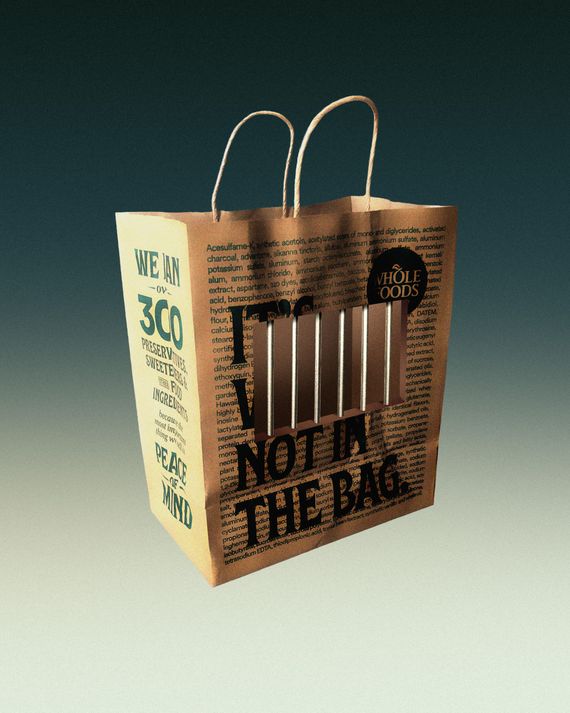
Photo-Illustration: Curbed, Getty
About a decade ago, a designer we’ll call Joanne had a cart filled with Thanksgiving dinner for ten as she idly considered the beauty aisle of the Tribeca Whole Foods. It was there that she noticed a $30 pot of Dr. Hauschka eye cream and made an impulsive calculation. She was about to drop a small fortune on organic potatoes and a heritage turkey — pocketing the eye cream seemed somehow … fair. While waiting to check out, a security guard approached, escorted her out of line, and led her to what she remembers as a small, windowless office near the baked-goods section. Joanne was asked to empty her pockets and complied, forfeiting the Dr. Hauschka. This is how she learned about Whole Foods Jail. (Actual jail, she would learn after being escorted out of the store by police, was the 1st Precinct on Ericsson Place. She got 20 hours of community service.)
It sometimes feels like everyone I know steals from Whole Foods. For a certain subset of the city’s wealthy-ish, a little shoplifting on your grocery run has become about as mundane as jaywalking. When asked, no one could quite explain why they do it. Some gestured at something like corporate protest; others blamed an unaffordable city. Entitlement, one thief admitted. I’d call it a form of collective nihilism. Everyone has their strategy: “Look like you have money and talk on the phone,” says a casting director of her technique. A graphic designer at a high-end fitness brand labels everything from the hotbar as “soup.”
As I found myself inadvertently conducting an anthropological survey of Hu chocolate theft among creative-director types, I became intrigued by stories of Whole Foods Jail — the mythical storage closets, Amazon return desks, and personnel-only areas of the store that are largely unseen by the law-abiding (or the stealthier thieves). Like Old City Hall Station or Katie Holmes’s rumored private entrance to the Whole Foods at the Chelsea Mercantile, there is a secret topography at play here. I wanted to learn everything there is to know about Whole Foods Jail.
A good place to start, I thought, would be talking to people who work as security guards at Whole Foods. An oddly difficult task. In Gowanus, I was passed around like a weird uncle until a general manager on a vape break outside told me to contact their press team. At the Williamsburg location, I tried the pizza counter first, which sent me to a stockist, which very nearly got me into the employees-only section in the basement, but I soon found myself back at customer service. Again I was told to contact the press team. (I did. They declined to comment, too.) On the Upper East Side, it was the same thing. Deflated, I made a last push at my least favorite Whole Foods: the Fort Greene location — a hellacious, windowless space in the basement of a luxury rental building. A security guard parked by the exit upstairs told me to find Mike, “a big guy in a T-shirt.” When I found a man who matched this description, he denied being Mike. I briefly considered dropping a bag of yogurt-bathed pretzels into my bag, a sort of gonzo attempt to learn about Whole Foods Jail by going there, but thought better of it. I took the escalator up and went home.
My gumshoe days behind me, I turned to the internet. Whole Foods doesn’t publish its shoplifting policies publicly (last year’s annual report didn’t even mention theft), but I’ve been able to piece some of it together. Like many retailers, Whole Foods instructs employees not to physically intervene if they see someone stealing. (On Reddit, employees refer to this as the “no-heroes policy.”) And despite long-standing rumors to the contrary, Whole Foods (and Jeff Bezos) apparently isn’t building a dossier on your petty theft, waiting for you to hit a certain threshold before swooping in to ruin your life. And vaguely nonconsensual biometric-data collection, at least for now, seems to be a Wegmans thing. (Only Whole Foods customers who opt in to the Amazon One program have their handprints surveilled.) But you are, apparently, being monitored by a swarm of security officers, some of whom wander the aisles in plain clothes, and Whole Foods’ surveillance tech is improving. And when security officers catch you, they will take you to Whole Foods Jail. Sometimes with glee.
The Union Square Whole Foods jail is a windowless storage closet near the entrance, says Astrid, a photographer. (Astrid is a pseudonym, as are all the names used in this piece.) She mostly remembers the wallpaper: “Layers and layers of grainy faces,” she tells me.” All the thieves that had come before me.” For years, she had thought of the California rolls, brownies, and protein shakes she stole as a kind of artist’s subsidy while she got her own practice off the ground. But on this particular day, her luck had run out. Astrid was late for therapy and hadn’t eaten, so she stopped in for a quick lunch. As usual, she began her meal in-store, moving toward the door with confidence, while ripping open a sushi tray. Soy-sauce packet between her teeth, one foot out the door, she felt a hand on her arm. “Memorably vicelike,” Astrid says. The man wasn’t aproned, there was no green vest — he wasn’t even one of those security guards for hire in black polos. Instead, she says, he wore a Burberry patterned button-down. She remembers being transfixed as he escorted her to the storage closet, scolding her as they walked: “What were you thinking?” (That she was going to miss therapy and still be charged for the session, mainly.) After her lecture, Astrid says she was asked to fill out a piece of paper with her sentence — she was banned from all Whole Foods in the tristate area for stealing approximately $30 of food. “I remember thinking it was funny that I could ostensibly continue my habit in Massachusetts, where I’m from,” she says.
A sculptor we’ll call Gina found herself in the Bowery Whole Foods Jail after a brief walk of shame from the sidewalk on Bowery and Houston, past the baked-goods section, up the escalator and down a long, Malkovichian hallway. She was late to an Alex G concert at Bowery Ballroom and had decided to slip into Whole Foods for a quick spicy-tuna-roll walk-and-dine. She had a system: Approach the item with confidence, grab it, then head upstairs to the dining area and surreptitiously place it into her bag. But this time, she skipped the trip upstairs and headed straight for the exit. “A rookie mistake,” Gina says. “Ma’am,” said a badgeless man, suddenly beside her, in head-to-toe black clothing. When she couldn’t produce a receipt for her stolen item, she says the man maneuvered her hands behind her back and placed her in handcuffs. Gina remembers keeping her head bowed and her eyes low, careful not to make eye contact with her fellow customers as she was escorted back to Whole Foods Jail. The windowless office was almost too bland to recall, she tells me, except for a rudimentary banner, printed out on a few sheets of paper that read: ALL SHOPLIFTERS ARE BANNED FROM WHOLE FOODS FOR LIFE. A few weeks later, Gina says her parents received a $90 ticket in the mail from the company. Her father intercepted it and, to this day, Gina’s mother still doesn’t know that her daughter is a Whole Foods thief. (The only person I encountered who had evaded Whole Foods Jail after being caught stealing was a musician we’ll call Tim, who, when stopped at the Bowery Whole Foods, found himself shouting “Am I being detained? Am I being detained?” to a group of security officers trying to apprehend him. As if by hex, the room — or more accurately, the customer-service desk — went quiet. Then, an answer: “No.” Tim walked out. He has since continued to steal from Whole Foods.)
There is even a Whole Foods Jail in Greenwich, Connecticut. Sam, a food stylist, concedes that being in a wealthy suburban enclave may have led her to be a little more brash than usual. At checkout, she went about paying for some of her items while her backpack was heavy with a lifted strip steak, a round of soft French cheese, and some chocolate. As she approached her car, moving at a less-than-urgent clip, a man yelled out to her. “It was like all the blood suddenly drained from my body,” she says. Turning to face him, she realized she had seen him before: first in the snack aisle and again at the meat counter. She followed him to a windowless office at the rear of the store, where a woman was sitting behind a desk, waiting. “She was definitely excited,” says Sam, as she began sorting through the stolen items in her backpack. But the total was $48 — apparently, she says, just shy of a good-enough reason to call the cops. Like a fisherman left empty-handed after a heavy pull at her line, the woman sullenly took Sam’s picture. Her photograph was placed in a binder, and she was charged $300 and told never to step foot into a Whole Foods again. For years, she didn’t — though she’s ventured back in more recently. She doesn’t steal anymore, she says.
But are the days of stealing instead of going to therapy numbered? Retail theft is down in the city, for one thing. (By 14 percent since last year, according to the governor’s office.) Surveillance technology is improving rapidly and many retailers are looking to replace in-store employees altogether. In 2018, Amazon introduced a contactless checkout program called Just Walk Out — an unsurprising shift given Bezos’s whole thing — but the company appears to have abandoned it. In other corners of the retail world, some Walgreens employees in New York have started wearing body cameras. So what does the future of petty theft look like in our increasingly contactless, ever-more-surveilled world?
Certainly we’ll find out. With a new Whole Foods opening in a Beaux-Arts bank in Ridgewood this spring, someone, soon enough, will try to lift a probiotic or two. One wonders where they’ll be escorted.
Sign Up for the Curbed Newsletter
A daily mix of stories about cities, city life, and our always evolving neighborhoods and skylines.
Vox Media, LLC Terms and Privacy Notice
Related