
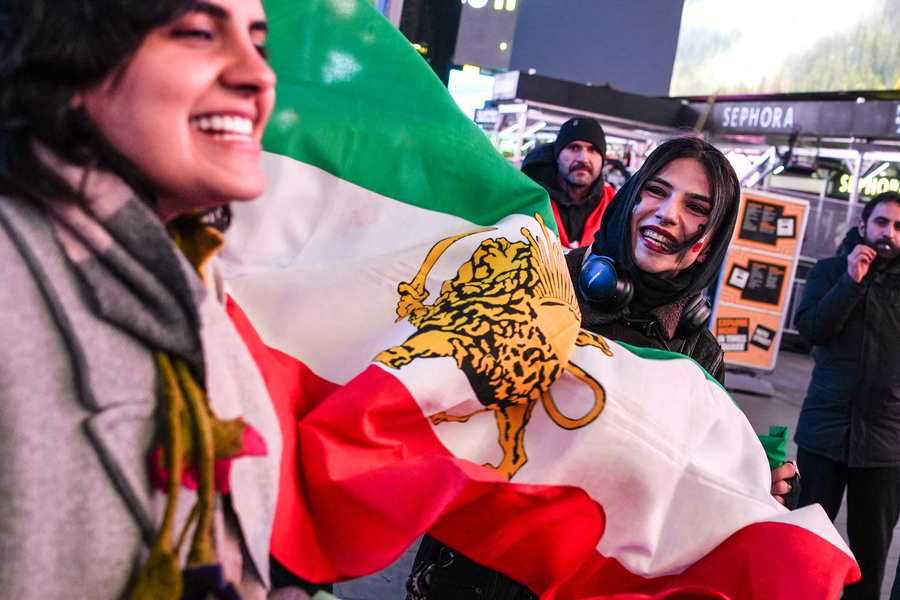
On March 1 when the Pentagon confirmed that U.S. forces, in a precision airstrike codenamed “Operation Epic Wrath,” had successfully killed Iran’s Supreme Leader Ali Khamenei, who had ruled for over thirty years, New York City—thousands of miles from Tehran—erupted in unprecedented fervor. As home to one of the largest and most active Iranian diaspora communities in the U.S., New York had never experienced a day full of so many complex emotions. From Great Neck in Queens to Dag Hammarskjöld Plaza in Midtown Manhattan, the streets were filled with festive singing and dancing, tears of excitement, and a sense of vengeful relief. Meanwhile, the New York Police Department (NYPD) initiated its highest level of counterterrorism deployment.
‘At this moment, Tehran is in New York:’ On-the-ground celebration
For thousands of exiled Iranians in New York, this day was a long overdue “liberation day.” Before the first morning sunlight pierced Manhattan’s skyscrapers, the plaza opposite the United Nations headquarters had already turned into a sea of jubilation. Thousands cheered for U.S. President Trump and Israeli Prime Minister Benjamin Netanyahu, while others waved signs reading “Make Iran Great Again” and the former Pahlavi dynasty “Lion and Sun” flags, occupying First Avenue. The air was fragrant with saffron and rosewater—scents traditionally reserved for Nowruz, the Persian New Year.
Contrary to expectations of chaos, the scene was one of cathartic joy. People embraced in the cold wind, crying openly. Many older exiles knelt on the asphalt, kissing banners inscribed with “Free Iran.” 64-year-old Nahid Farahani stood at the edge of the crowd, clutching a yellowed photograph—her brother, executed in 1982 at Evin Prison in Tehran.
“The Americans find it hard to understand why we celebrate death,” Farahani said with a trembling voice. “Under dictatorship, your entire life is trimmed and controlled. They decide what you wear, what music you listen to, who you can love, even how you think. That fear is in your bones. Even after thirty years in New York, my heart still skips a beat at sirens. Khamenei wasn’t just a ruler; he was the architect of all our nightmares.”
A taxi driver in his sixties pulled over, tears streaming. “I left home at 20, they told me it was just temporary madness. I waited 44 years, my hair turned white, and now this tyrant is finally gone to hell. I won’t drive today; I’m going to buy the best liquor to toast the children who died at his hands.”
Success
You are now signed up for our newsletter
Success
Check your email to complete sign up
At the famed Times Square, giant electronic screens stopped showing commercial ads, replaced by breaking news of the strike. Every time Khamenei’s death was confirmed on screen, thunderous applause and cheers erupted. A group of young Iranian students climbed the red steps, tearing black cloth strips symbolizing the enforced hijab and singing the famous protest song “Baraye,” their voices echoing along 42nd Street.
In Great Neck, Long Island—home to many Persian Jews who fled after the 1979 revolution—the celebrations had a strong community flavor. Families opened their doors to distribute a traditional Persian sweet called “Shirini,” typically reserved for weddings or major joyful events.
The owner of a local bakery said, “Before we even opened this morning, a long line formed outside. People weren’t here for bread—they were ordering celebratory cakes. This is more than politics; it’s the blood and tears of every family. That man’s death means our wounds can finally begin to heal.”
Communist organizations in New York, such as the “People’s Forum,” held so-called “anti-war marches” condemning U.S. actions. Yet almost no Iranians joined; the crowd largely consisted of recent pro-Palestinian activists.
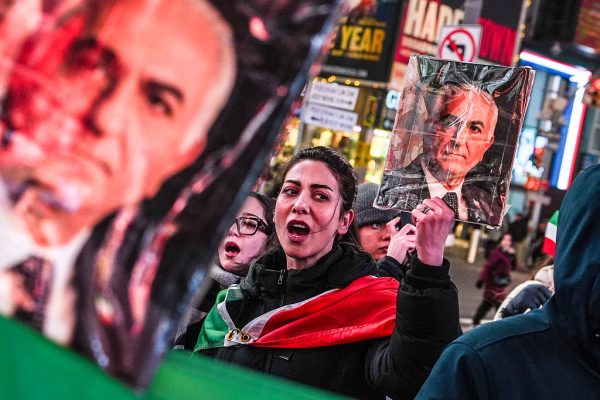 A woman holds a portrait of Reza Pahlavi, son of the last shah of Iran, during a “Freedom for Iran” protest in support of the Iranian people in New York on March 2, 2026. (Image: Ryan MURPHY / AFP via Getty Images)
City on high alert: From ‘Hercules’ squads to radiation detectors
The NYPD, however, faced a stark reality. While FBI briefings from the New York office indicated “no specific or credible threats against the city,” police leadership knew the Iranian Revolutionary Guard Corps (IRGC) and its proxy groups have long considered New York a top target for retaliation.
An unnamed senior counterterrorism officer said, “The situation is very delicate. We must guard not only against external terrorists but also lone-wolf attackers inspired by extremist rhetoric. Khamenei’s death could drive some dormant actors to extreme revenge.”
On Manhattan streets, tension was palpable:
Heavy deployments: Heavily armed counterterrorism teams, nicknamed “Hercules,” were stationed at Times Square, Grand Central Terminal, Wall Street, and the World Trade Center site, wearing heavy bulletproof gear, carrying long guns, and manning temporary observation posts.
Religious site protection: Patrols were increased around major synagogues, mosques, and the Israeli Consulate. Concrete barriers were set up at the Iranian mission near the UN, with doubled police presence to prevent celebratory crowds from approaching.
Nuclear/biochemical monitoring: Witnesses reported portable radiation detectors at Lincoln and Holland tunnel checkpoints, with increased Hudson River patrols to guard against unconventional attacks.
Protecting dissidents: Following the heightened exposure of activist Masih Alinejad due to her public conflicts with the mayor, the FBI and NYPD secured her residence with 24/7 protective personnel to prevent any last-ditch retaliation by remaining Iranian regime elements.
Senate Majority Leader and senior New York Democrat Chuck Schumer said, “Regardless of our differences over Middle East policy, removing this long-time terror sponsor, a dictator with the blood of Americans and Iranians on his hands, is justice. It’s a major turning point for global security.”
New York Governor Kathy Hochul also announced enhanced security patrols for key statewide infrastructure, including power grids, dams, and transit hubs. “New Yorkers have endured dark times; we understand the cost of freedom. We will remain vigilant but will never live in fear,” she emphasized.
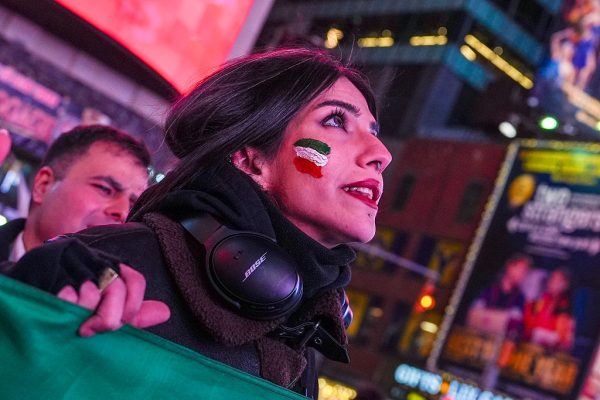 A woman with Iranian flag face paint looks up during a “Freedom for Iran” protest in support of the Iranian people in New York on March 2, 2026. (Image: Ryan MURPHY / AFP via Getty Images)
A sleepless night
Night fell on March 1, yet New York remained awake. In Times Square, despite subfreezing temperatures, celebrants lingered. A Columbia University doctoral student studying human rights held a cup of hot coffee, staring at the rolling war news on screens.
He said, “War is terrible. My family is still in Tehran, and I don’t know if they are safe tonight. But seeing these people around me, seeing the fear of forty years disappear from their eyes… I feel maybe it’s worth it. For us, Khamenei being alive was a constant war in itself.”
This was New York—this was the reality of March 1, 2026. At this crossroads, the complexity of human nature was on display: desire for revenge, commitment to peace, ecstatic liberation, and deep uncertainty about the future. Dictators once tried to flatten humanity into obedient conformity. Yet here in New York—a city of languages, races, faiths, and dreams—freedom lived vividly.
By Tian Jingxin