
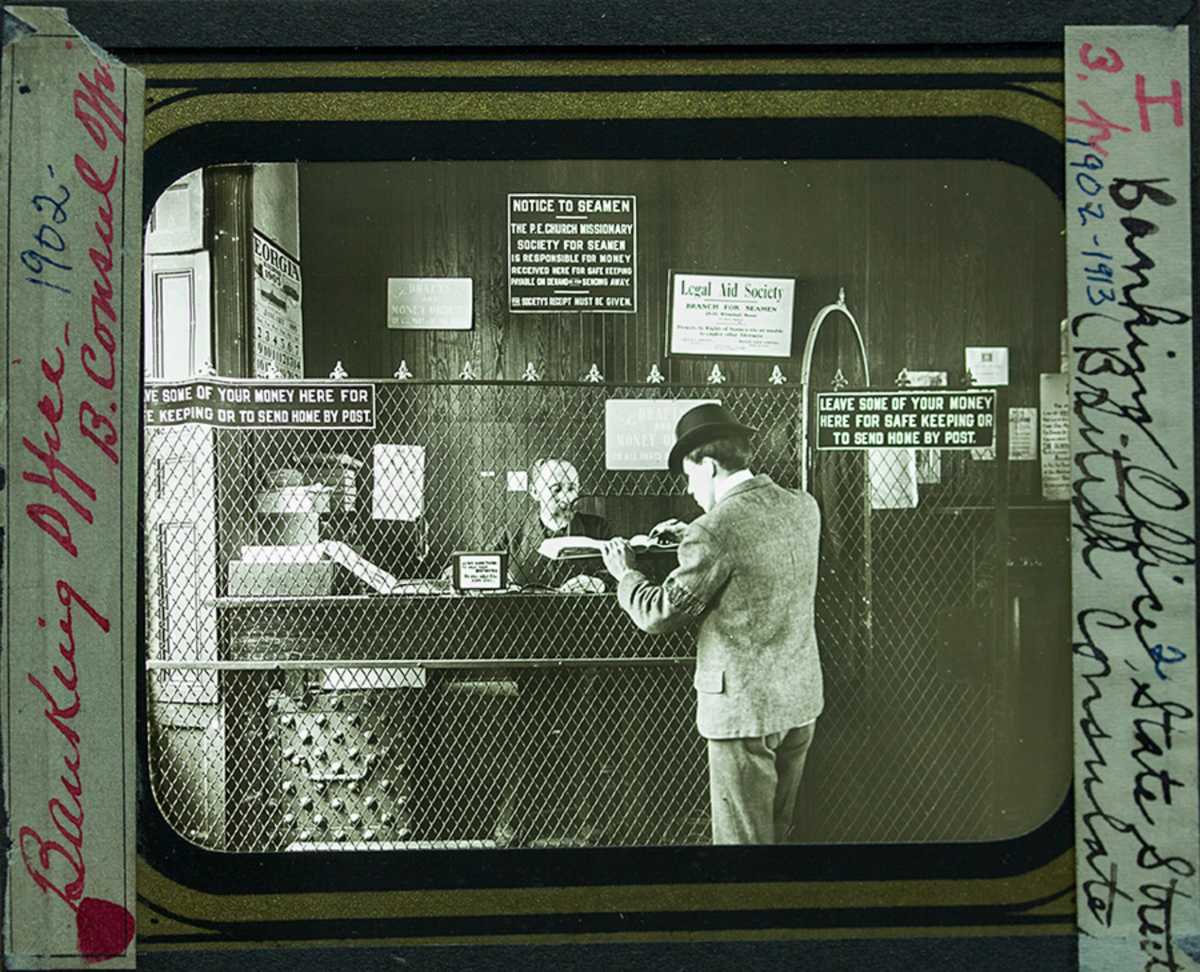
Legal Aid Seamen’s Branch. (c) Courtesy of the Seamen’s Church Institute Archives
Unidentified photographer
Banking Office, State Street, 1902
Reproduction
Founded in 1876 as Der Deutsche Rechtsschutz-Verein, New York City’s largest provider of legal services for low-income litigants began as a small-but-mighty outfit concerned the rights of recent German immigrants to the U.S.
The newcomers “had not had the opportunity to learn our language and the methods of some of our unscrupulous gentry” and were thus vulnerable to exploitation, one public defender wrote in a 1954 article for the Buffalo Law Review on the history of the New York City Legal Aid Society.
“At this time the integrity of the courts was questioned, and the Bar Association was unequipped to cope with this situation,” wrote Elmer C. Miller, then an attorney for the Legal Aid’s Buffalo counterpart. “However, a particular group became aware of the grave injustices practiced upon these persons newly come to our shores.”
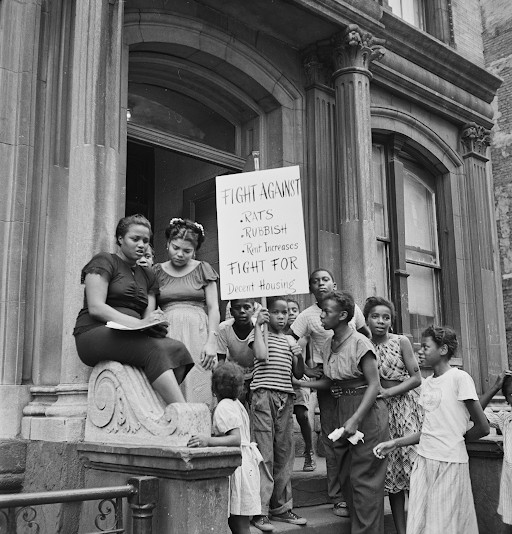 “Harlem, 1949” photograph. (c) John Vachon; Museum of the City of New York
In the ensuing decades, Legal Aid grew from a group made up mostly “merchants, importers and professional people other than lawyers” that handled a few hundred cases for just one immigrant community to a necessary component of the city’s legal system, annually serving some 2 million New Yorkers of all stripes.
“From its defense of incarcerated people during the Attica Uprising, to its role in the landmark Willowbrook State School litigation, to decades of advocacy for unhoused families and people detained at Rikers Island, Legal Aid’s history is deeply intertwined with the defining civil rights struggles of New York City,” the organization proclaims in a release for its sesquicentennial celebration: “Delivering Justice: 150 Years of The Legal Aid Society.”
Beginning today, images from Legal Aid’s century-and-a-half history will be on display at the New York Historical at 170 Central Park West.
Its calendar of events for its 150th also includes a March 18 panel discussion featuring New York City Corporation Counsel Steven Banks, current Legal Aid Attorney-in-Chief and CEO Twyla Carter, and historian Bekah Friedman.