
Artists like Andy Warhol and Jean-Michel Basquiat once flocked to NoHo‘s cobblestone streets, establishing studios in buildings that once housed textile factories.
Those artists likely couldn’t afford to live in the neighborhood today. In their place, a new generation of well-heeled celebrities has moved in — and some are now fighting new housing that would include affordable units. Sarah Jessica Parker, Matthew Broderick, Edward Norton and Rachel Maddow are among those backing an advocacy organization seeking to preserve a surface parking lot in the neighborhood.
Within the past few years, hurdles to development have been struck down across the city, giving developers access to areas of Manhattan that have long been untouched. Landmarks review has emerged as one of the few processes left for residents to control what gets built.

Bisnow/Sasha Jones
375 Lafayette St. in NoHo, where a 19-story mixed-income housing project is planned
Development advocates have shot back, asserting that such preservation efforts are not being made in good faith, with affluent residents simply trying to block new development they don’t like as the city faces record-high rents and a 1.4% vacancy rate.
“Since City of Yes, we’ve seen neighborhoods across the city really trying to pursue new historic designations to block housing now that the restrictive zoning is being loosened,” Open New York Executive Director Annemarie Gray said. “That really undermines the will that New Yorkers expressed in November, when they so clearly said they wanted their government to do as much as possible to address housing affordability.”
SoHo and NoHo were rezoned in 2021 to allow for the construction of more housing. Under City of Yes, developers gained other opportunities to build taller. Plus, recently passed ballot measures further streamline approvals and limit local city council members’ authority to block projects.
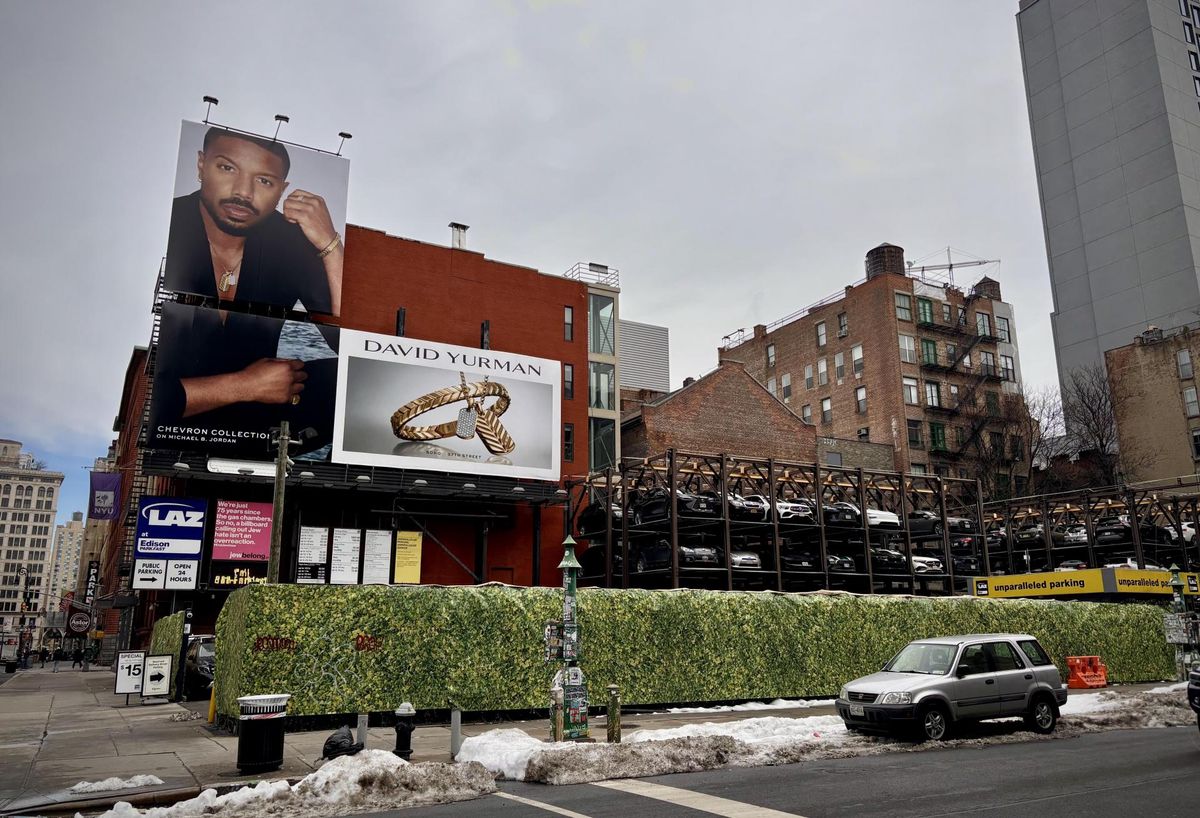
Those changes have helped intensify the debate over the future of 375 Lafayette St. in the heart of NoHo. Today, a billboard of Michael B. Jordan modeling David Yurman jewelry looms over the parking lot on the site, where drivers pay $15 to leave their cars for a half hour.
Edward J. Minskoff Equities and Edison Properties have proposed a 19-story, 200-unit building at the site, with a quarter of the apartments set aside as affordable. But NoHo is a historic district, meaning developers must obtain approval from the Landmarks Preservation Commission to renovate or build anywhere in the area.
Local opposition is using that requirement to its advantage.
“My window faces that funky parking lot with the cars going up and down. It’s a real neighborhood feeling,” one NoHo resident said during a Feb. 9 Community Board meeting. “And we are now going to have this massive behemoth.”
Not NIMBY, Not YIMBY
Advocacy group Village Preservation is leading the charge against 375 Lafayette. The group has helped secure landmark designation of more than 1,300 buildings and zoning protections for nearly 100 blocks of Greenwich Village, the East Village and NoHo.
Many developers would hurl the term NIMBY — a pejorative that stands for Not In My Backyard — at groups like Village Preservation. But Executive Director Andrew Berman said the label is too often “misapplied.” He claims the organization is not arguing against low-income housing but rather in support of more of it.
Berman said the proposed 195-foot-tall, 290K SF building at 375 Lafayette is “monstrously gargantuan.” Proving that the development would not overwhelm the neighborhood is key to getting the green light from the LPC.
A rendering of the terracotta building proposed for 375 Lafayette St.
But Berman also argues that the development will not do enough to solve the housing crisis.
Under the plan, the majority of the units will be market-rate. About 50 apartments would be held for those making 60% of the area median income. Given the neighborhood, that will still be higher than what most New Yorkers can afford.
“We should also be cognizant of what it is that we’re getting,” Berman said. “What it is that we’re calling affordable.”
Village Preservation is using the same argument against the city-backed redevelopment of Gansevoort Square, where Douglaston Development and Kinwood Partners plan to build nearly 600 apartments. Up to 55% will be permanently affordable.
The tower would rise 600 feet, high above other nearby structures. Village Preservation is seeking to ax the market-rate housing and downsize the development.
But Village Preservation also opposes 388 Hudson St., an underutilized city-owned site that is set to become 280 units of 100% affordable housing. The organization said that while it appreciates the affordability, at 355 feet, the building will cast shadows on James J. Walker Park and the Greenwich Village Historic District.
How To Afford Affordability?
For developers, building affordable housing is difficult to make work on paper. Market-rate units typically subsidize the low-income ones.
Studies have shown that producing more market-rate units drives down rents for all forms of housing. The notion underpinned former Mayor Eric Adams’ goal of creating 500,000 new homes over the course of a decade.
Under the Adams administration, the LPC designated the fewest landmarks of any mayor, according to Village Preservation. At nine designations per year, his rate was less than one-third that of his predecessors overall, who averaged more than 30 per year.
Mayor Zohran Mamdani has taken up the pro-building torch, promising to deliver 200,000 units of affordable housing and cut red tape for private developers. He has shown support for projects to house formerly homeless or incarcerated individuals and is attempting to revive plans for Sunnyside Yard, both of which have been controversial.
The proposed development at 375 Lafayette St. in relation to the rest of the NoHo historic district
Some opposition may come from those who simply do not want low-income neighbors. Berman claims that’s not the case for Village Preservation.
“People have a lot of fears and concerns in these areas, some of which I think are legitimate and, with good information, can be addressed. Some are just biases or prejudices,” Berman said. “There’s no credible preservation organization that I know of, and certainly not ours, that is motivated by seeking to keep low-income people out of the neighborhood.”
Preservation advocates like Berman note that new developments can be used as second homes or investment properties, sitting vacant for most of the year. That has been documented in ultra-luxury buildings such as those on Billionaires’ Row, where apartments are used as vaults for the rich.
Berman also said the approach of increasing development overall is “an incredibly slow, indirect process” to reach affordability.
“Ironically, a lot of these policies, which are wrapped in this rhetoric around promoting housing and affordability, are actually causing these problems because they are incentivizing the demolition of older, less expensive housing,” he said.
What Gets Saved
But just because the outside of a building gets frozen in time does not mean the inside is also preserved.
One study found that between 2010 and the first half of 2022, historic districts lost 4,000 housing units as multifamily buildings were converted to single-family homes and adjacent apartments and buildings were combined.
Parker and Broderick, both of whom are donors to Village Preservation, purchased two West Village townhouses for a combined $35M in 2016 and spent another $50M to merge the two into a megamansion.
Preservationists highlight that historic districts cover less than 5% of the city’s buildable land, but landmarked sites tend to be concentrated in some of the wealthiest parts of Manhattan and Brooklyn. In 2021, the LPC launched its equity framework to ensure that the agency looks across the five boroughs in its evaluation of landmarks.
Below is a map of every landmarked building and historic district in New York City.
“LPC actively supports efforts to increase housing production and regularly approves work that creates additional housing, including new buildings, additions, and adaptive reuse projects, all while ensuring the historic character of our landmarks and historic districts is preserved,” an LPC spokesperson said in a statement.
Not all preservation groups are concentrated in one area.
Historic Districts Council works with local advocates across the five boroughs to support them in navigating the designation process. Among the areas the group has worked to protect is Addisleigh Park, a suburban enclave in Queens nicknamed the “African-American Gold Coast of New York.” It was once home to a plethora of prominent Black figures, including Ella Fitzgerald, Jackie Robinson and W.E.B. DuBois.
“Preservation as a movement or as a community may have that reputation, historically, of being a white, affluent initiative or idea,” HDC Executive Director Frampton Tolbert said. “But I think we’ve shown, especially in New York, that we’re really focused on all communities, and a lot of the communities we’ve worked with have been underserved by the Landmarks Commission or by the city and really haven’t had their stories told.”
HDC has not yet taken a position on 375 Lafayette, Tolbert said.
The New York Landmarks Conservancy President Peg Breen said that as the housing crisis has escalated, groups like hers are encountering more backlash. She would like to reach across the aisle.
“Instead of the emphasis on, ‘Let’s bust through historic districts and let’s get all these giant towers going,’ let’s concentrate on the people who actually want to build affordable housing,” Breen said. “How can we make that easier for them? What incentives do we have for them?”
The Landmarks Conservancy has distributed $63M in loans and grants to assist owners in restoring their historic buildings. HDC similarly plans to launch a program to provide financial resources for owners of rent-stabilized buildings, as landlords have struggled to find the capital needed to maintain the housing stock.
“We could be better in the preservation community at making those connections with the housing organizations,” Tolbert said. “I do think we have a lot of overlapping interests, but we’re not really at the table together that often.”
Bisnow/Sasha Jones
The existing parking lot at 375 Lafayette St.
If Not Now, When?
At the Feb. 9 Community Board meeting, the developers of 375 Lafayette emphasized that the building is nothing like the glistening high-rises that preservationists often oppose.
The architects drew inspiration from other buildings in the district. The facade will be clad in terra-cotta with ornamental detailing. The tower is tiered in a way to make it look more dimensional and less bulky. Greenery will be planted on the street and the terraces above.
Still, some residents described the building as having the “potential of ruining the neighborhood.”
“I know that more housing is needed but not at the expense of destroying the soul of the city,” one said.
In a neighborhood where the average rent exceeds $6,400, according to a February RentCafe report, some New Yorkers countered that leaving the site untouched would come with its own cost.
“Whatever nitpicking critiques of the current development exist, I would propose that they be placed in the context of potentially years of onerous negotiations over what should be done with the currently existing multilevel parking lot, which I would actually characterize as a gaping, ugly void in the streetscape,” a participant said. “And do we really want that around for more years while we discuss scaling for so long?”