
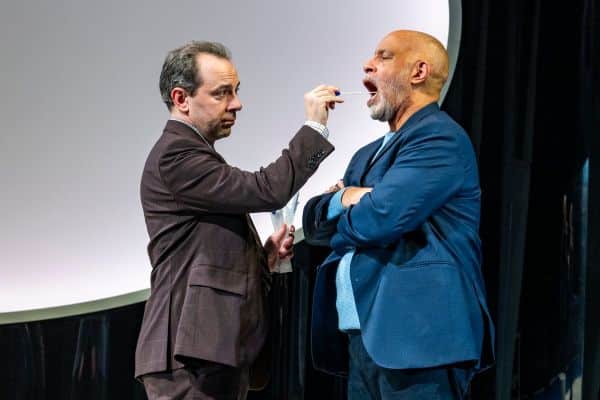
Would you want to live forever? And if you did, at what cost? Those are the questions posed in Spare Parts, a new play by David J. Glass, now playing a limited engagement at NYC’s Theatre Row. The thought-provoking and unsettling work combines dark humor and sexual attraction with angry confrontations about blind ambition and the privileges of wealth, issues of individual identity, autonomy, and consent, and the ethical boundaries and moral consequences of scientific research, human experimentation, and their funding for personal gain in the not-too-distant future of “Tomorrow” – leaving us to ponder if it isn’t already well underway.
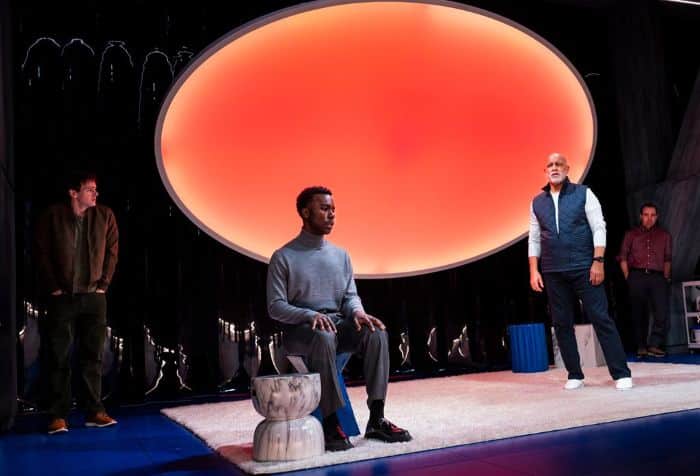 Matt Walker, Jonny-James Kajoba, Michael Genet, and Rob McClure. Photo by Russ Rowland.
Under the incisive direction of Michael Herwitz, a compelling cast of four delivers the driven personalities, their goals, evolving interconnections, and ultimate decisions with calculated benefits, as they meet, clash, agree to move forward, and, in so doing, uncover some shocking truths that lead to an even more shocking conclusion, with comic touches along the way to lighten the intensity. Michael Genet is the impatient and imperious 64-year-old billionaire Zeit Smith, who is becoming increasingly aware of his approaching mortality, is determined to live forever, and bankrolls the project to make that happen, enlisting the leading researchers in the field to conduct the experimental procedure that will reverse aging and increase longevity. Jonny-James Kajoba is Ivan Shelley, Zeit’s English-born-and-raised professional assistant in his early twenties, whose mother (unseen in the show but about whom we will learn much more as the story progresses) encouraged him to apply for the high-status position in uptown Manhattan, and who is aided in his dedicated work by the essential omnipresent AI technology they call George (heard in the format of voiceovers from Ivan’s and Zeit’s digital devices).
Following an extensive investigation into their work and backgrounds, they have invited Professor Chris Coffey, portrayed by Rob McClure, and his graduate student assistant at Columbia University, Jeffrey Jordan, played by Matt Walker, to discuss the plan and to make them an extremely lucrative offer that would not only pay them exorbitant salaries but also fund their research, after failing to secure grants. The professor is hesitant to undertake the project, which is in defiance of existing regulations and years in advance of its readiness to be performed on human subjects (thus far working largely with worms), as he describes in specific scientific terminology that is incomprehensible to Zeit (in addition to being a playwright, Glass is also an M.D., educator, and researcher, with a specialization in the process of aging), clarified in more easily understood language by Jeff (Walker, too has a combined education in theater from Julliard, neurobiology from Harvard, and a Ph.D. in genetics from Columbia), who is enthusiastic about the possibilities of advancement – and the money. Zeit is impressed with the young research scholar, and ready to dismiss his principled professor, until Jeff convinces him that his advisor, from whom he is learning, is needed for the experiment to succeed.
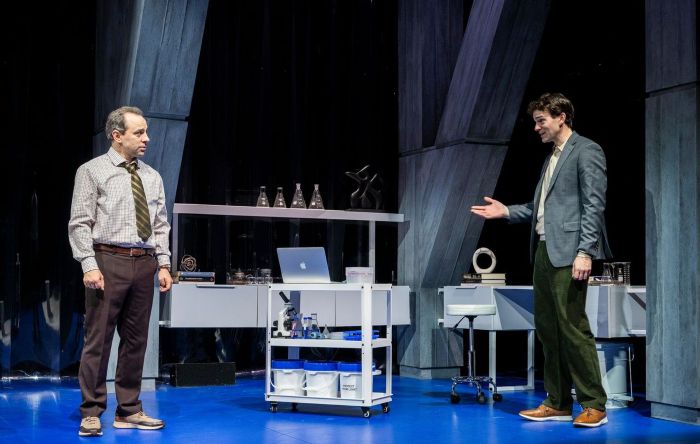 Rob McClure and Matt Walker. Photo by Russ Rowland.
Genet embodies the self-serving personality and domineering attitude of the short-tempered Zeit and his stern mantra, “Never show people your soft spots.” McClure, a master of physical comedy, gets the laughs with his facial expressions, body language, responses and reactions to the others and the situations, but also makes us consider the serious ramifications involved with his readily legible justifiable concern over what they’re doing and the test results he’s getting. Walker manifests the excitement and willingness of the up-and-coming student to undertake the project, to advance the science of aging, and to receive the credit and the large pay-off for it. By contrast, Kajoba, whose character shares with Walker’s a seemingly awkward admission of their attraction to one another, is more controlled in his demeanor, evoking Ivan’s steadfast representation of Zeit and his due diligence in overseeing the progress of the proposed experiment, and then embraces a dramatic shift in his mindset and behavior (though his extensive reliance on George to control important data remains), triggered by a staggering revelation that upends the power dynamics of the story.
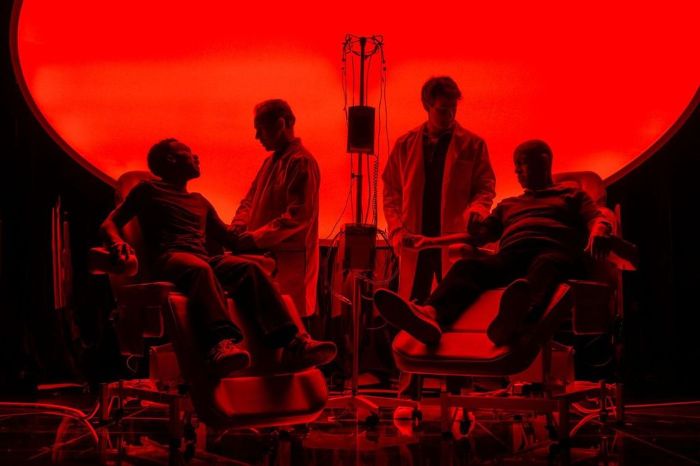 Jonny-James Kajoba, Rob McClure, Matt Walker, and Michael Genet. Photo by Russ Rowland.
A smart artistic design suggestively blends different times and genres, underscoring the relevance of the theme now and into tomorrow. Realistic contemporary costumes (by Amanda Roberge) make the characters relatable in our present time and props (by Sean Frank) include the familiar lab, medical, and digital equipment used today. But the set (by Scott Penner) combines the office spaces at both sides with a mostly empty center stage, backed by a large-scale oval (or modified egg-shaped) pendant light that changes color between scenes, glows, and emanates throughout the performance area (lighting by Zack Lobel), enhanced with menacing sound and original music (by Ryan Gamblin) that create a disturbing futuristic sci-fi tone.
Spare Parts (no spoilers here; the title will explain itself when you see the show) offers a knowledgeable look into the evolving science that could either benefit humankind with a longer lifespan or, in so doing, destroy our inherent humanity. It’s razor-sharp, intellectually provocative, darkly funny, and admonitory, brought to life by a top-notch cast, director, and design team.
Running Time: Approximately 90 minutes, without intermission.
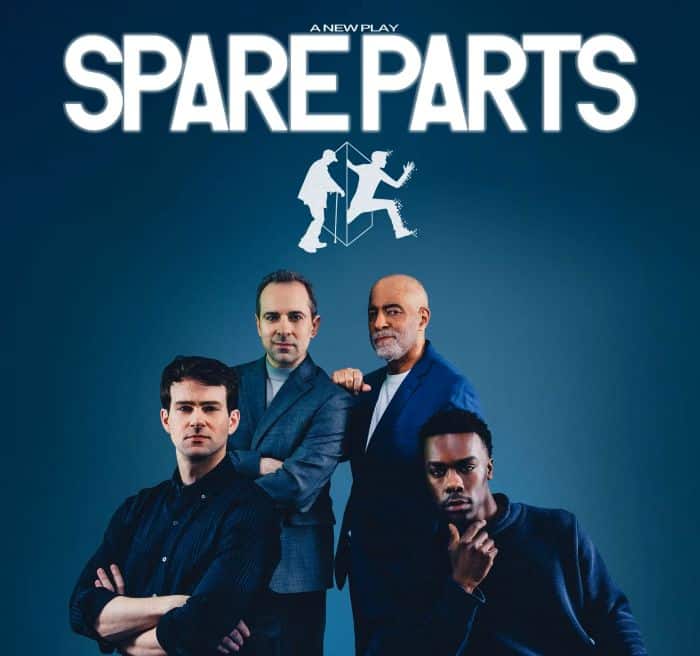
Spare Parts plays through Friday, April 10, 2026, at TOSOS, performing at Theatre Row, 410 West 42nd Street, NYC. For tickets (priced at $39-129, including fees), go online, or find discount tickets at TodayTix.