
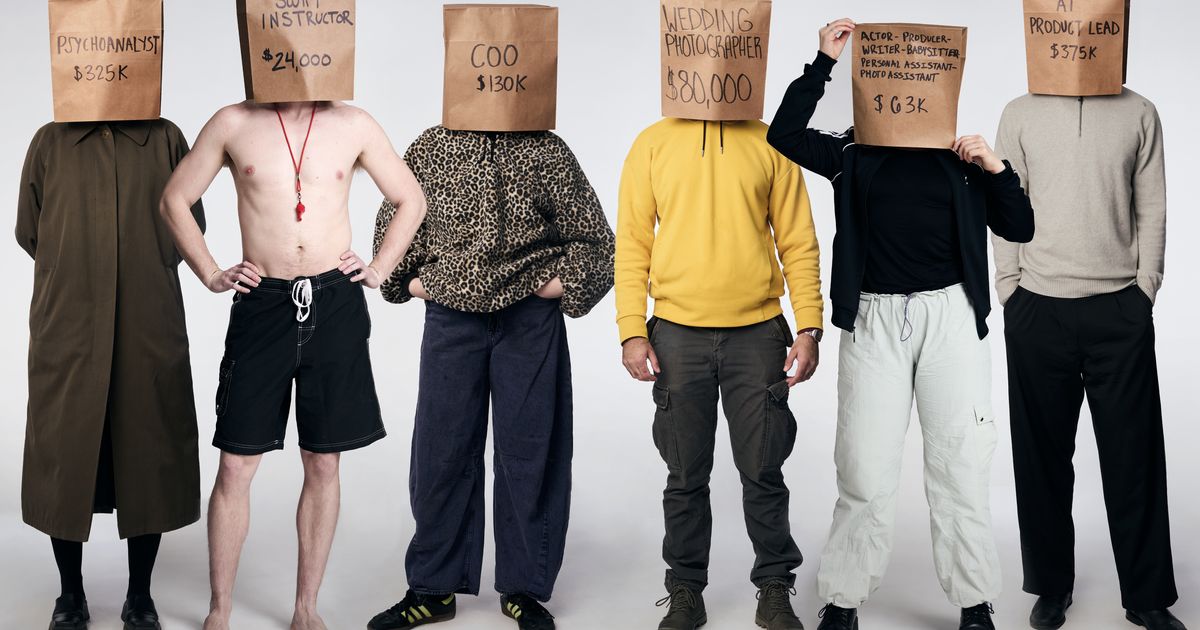
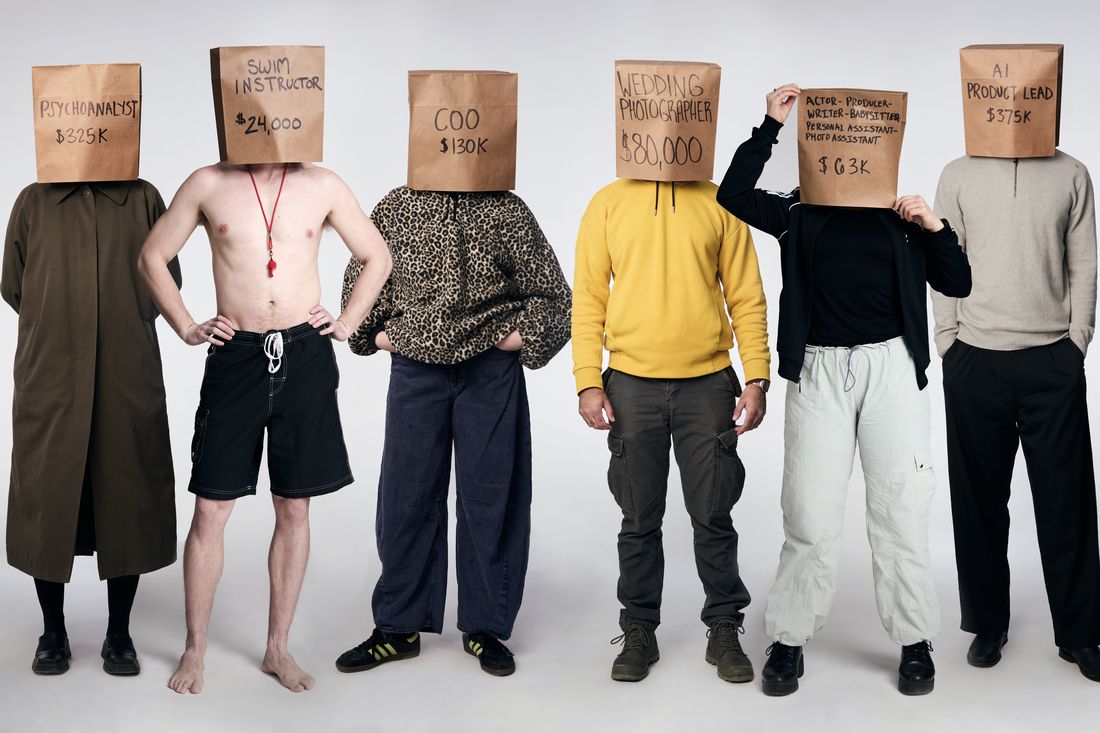
The last time we surveyed New Yorkers about their paychecks, the math was easy. Well, easier. In 2005, a blogger at Gawker made $30,000 and the CEO at Lehman Brothers more than $35 million. Back then, there was no “gig economy,” at least not as we know it today, and coffee shops from Bed-Stuy to the Upper East Side weren’t lousy with model–pickleballer–nanny–actor–producer–DJ–creative directors. Some 20 years later, amid a radically different economic environment in which the nature of work feels as if it’s about to change forever, we set out to conduct a similar experiment. We reached into our network of sources, blind-messaged LinkedIn profiles, put out a casting call on Instagram, even stopped strangers in Union Square. What we discovered, just before a jobs report earlier this month confirmed a dwindling labor market, is that salaries across most industries have not kept up with inflation in a city that has become exorbitantly expensive. For so many professionals we spoke with, some of whom agreed to pose for the paper-bag portraits in this story, the answer to stalling wages and cost-of-living expenses is hanging out their own shingle and juggling freelance projects and social-media collaborations.
So What’s Everyone Making These Days?
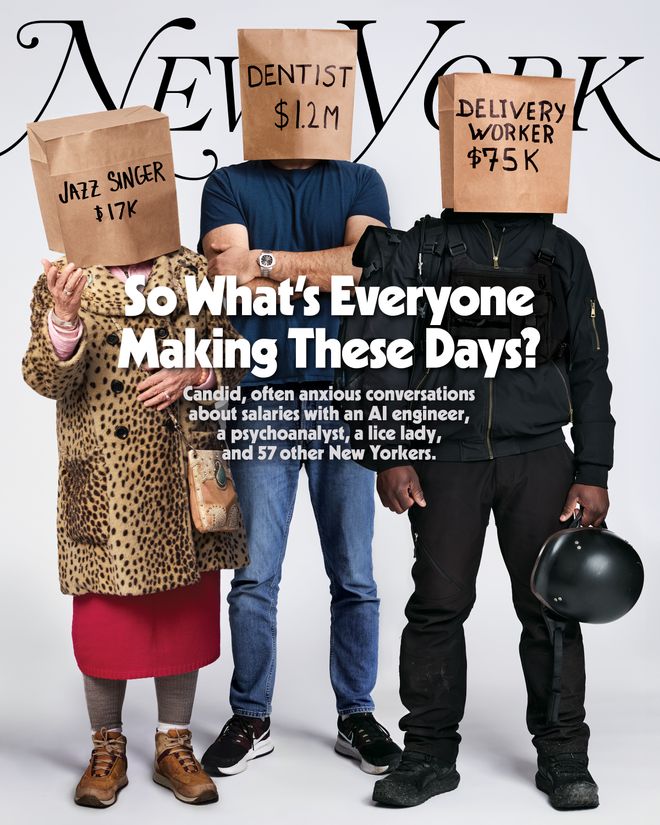
No one’s immune to professional anxiety, though. “Am I going to be a 40-year-old influencer posting my outfits?” one TikToker wondered. Finance used to be the stock answer for those musing a career pivot. Now we’re all thinking, Should we just go into AI? The only worry on one engineer’s mind seemed to be his equity stake shrinking as recruitment ramps up. Of course, there are plenty of people, especially at the very top, doing all right on their salary plus bonus and stock options as well as exterminators and dentists and dog walkers making a decent living who won’t be replaced by a chatbot anytime soon. Claude can’t rid your household of a lice infestation! New Yorkers have always fretted about how much (or how little) they make and have been since long before this magazine started keeping track in 1972. The aim of our latest investigation wasn’t simply an excuse to be nosy. The hope was to capture this moment and provide some sideways service to those wondering what else there might be to do. It’s not too late to try to become a tugboat engineer, is it?
90 percent from walking
10 percent from dog-sitting
I charge at least $40 an hour. I have a steady base of around 30 dogs, but the unpredictability is hard. Sometimes you start off the day thinking you’re going to make $500, then clients cancel. I’ll have a slow day around once a week and make only about $250. One client whose dog got walked twice a day, five days a week, moved away, which meant I lost $15,000 in annual income. And then, you know, the dogs die. It’s a real one-two punch. Your friend you see every day dies, and you also take a massive pay cut. Suddenly, you need to put feelers out to find new clients. I know I have to stop dog-walking the way I am. It’s too physically exhausting. I want to switch to training dogs, but it’s hard to get going on its own and I don’t have enough of a safety net.
I own my practice, and I use a kind of sliding scale. People pay anywhere from $35 to $450 a session. There are some patients I have an agreement with that as they make more money, I increase my fee. The ethos is very much that therapy should be accessible, but I should also have a comfortable lifestyle. There was definitely a point where I realized people who had means were underpaying. And I learned to charge those people more because there’s also a therapeutic element in that — if it’s meaningless to you to throw away $65, for example, you’re going to cancel at the last minute and you’re not going to have a lot of respect for the process. What I’ve observed is that people’s relationship to money has actually very little to do with how much they make. I have a billionaire who feels poor every day, and the high cost of the treatment is very much a part of their treatment.
$450,000 base salary and from dividends
$2 million in equity
AI companies are offering these eye-catching amounts on paper, but the only way to support compensation at that level is by diluting employees’ equity. I suspect many newer hires will be surprised by how slowly their shares grow relative to the headline valuation. I do think the job will look very different in thenext few years, but the most in-demand engineers are more in demand than ever right now. Technical people actually have a leg up because you can become a 100x engineer if you know how to optimize the environment for your coding agents. Learn to recognize when something is taking too long because the approach or architecture is set up incorrectly. Learn what to delegate and when. These are skill sets that non–software engineers won’t have.
$104,000 from taxable income (escorting, porn, cam modeling)
$160,000 from nontaxable income (cash gifts from partner for living expenses)
$20,000 from investment income
In 2024, I made $800,000, and the year before that, I made $1.2 million. But last year, I took a kind of maternity leave to get to know my primary partner’s children. I also started a business helping adult-industry professionals with their finances. The industry has the NFL problem where people get a great deal of money in a short period of time and then they retire with very little because they don’t know how to handle their money. Escorting comes and goes in waves. A lot of girls say they’re making less money these days camming — for many reasons, including age-verification laws and foreign competition. Clients can pay a Ukrainian something like 50 cents a minute instead of paying you $6 a minute.

Photo: Frankie Alduino
I’ve been an interior designer for 30 years and running my own firm for more than 20. My clients are mostly in finance and entertainment. I have anywhere from 12 to 18 projects in various stages and sizes going at all times. If I’m doing a three-bedroom in the city, that could cost at least $1.5 million to $2 million to complete. I’m charging 35 percent on top of that as my markup. At the beginning of a project, I charge a design fee, which starts around $75,000, and it goes up from there. It’s amazing to me how expensive design has become. I used to be able to get a custom sofa made from a great fancy upholstery shop for maybe ten grand. Now it’s, like, $25,000. But it’s quite hard to achieve the look that I want without spending a decent amount of money.
In addition to the vows that priests make to remain unmarried or be obedient to the bishop, we also vow to live a life of poverty. I receive a salary from my parish, and that is redonated to the motherhouse, which provides the necessities: room, board, insurance, use of a car as necessary — all those sorts of things. I live near Columbus Circle, where the church is, with 20 other priests; all of our salaries or pensions go into the house, so it’s kind of a socialist setup. Then we’ll get an allowance. We do have some limits, like on how much clothing we can buy in a year, but it usually covers the incidentals like going to CVS or getting a haircut. I think we have around the same salary as the priests of the Archdiocese of New York, and I do know that they’re always complaining it’s not enough.
$107,768 from Substack, book proposals, and other projects
$55,000 from ghostwriting books
$2,000 from personal writing
Because I had a slow year, I did a lot of moonlighting on smaller projects: Substacks for famous people, book proposals. I had 11 different clients, wrote five proposals, finished two books, and started another book at the end of the year. I get paid a flat fee per book; there’s a wide range and a lot of factors in a deal. Some people like to have their name on the cover, but sometimes you get paid less that way. I started ghosting five years ago. I called my agent and said, “I want to be a writer full time. What does that mean?” My agent said, “Can you write a book in three months?”
$30,000 from book advance
$14,000 from teaching two retreats
$5,000 from narrating own audiobook
I’m trying to manifest more abundance, but I’m really feeling the income streams have dwindled. I have over 800,000 Instagram followers. Before, if I wanted to do a brand partnership on social media, $10,000 was an easy get. Now it’s, like, $500. I pretty much live from a bucket of savings.
$45,000 from working at the cart
$2,000 from Grubhub deliveries
On a daily basis, the cart will sell between $500 and $700, and that will net a profit for me anywhere between $150 and $200. The expenses include all the supplies, like water, coffee, and pastries, but also another worker who gets paid a salary every week and the driver who tows the car back and forth from the garage to the spot in midtown. The cart is open Monday to Friday between four in the morning and 1 p.m. Then I go to the garage, clean the cart, and prep it for the next day. In the first three months of the year, when it’s so cold out, things are very slow. For the most part, it’s workers and staff in storefronts and construction workers, not suits and finance people. Also a bunchof tourists. Compared to other years, 2025 was kind of slower. There is this regular customer who would always get a coffee, a bacon-egg-and-cheese, and a Danish. Now, he skips the Danish.
$250,000 from social content and brand partnerships
$60,000 from consulting
$10,000 from selling clothes
I have more than 300,000 followers across Instagram and TikTok, but Instagram is where I make 70 percent of my money. For brand partnerships, the pay really ranges. If I like a brand, I’ll charge under my rate, which is usually between $5,000 and $8,000. But I did a holiday campaign that was $25,000 for three videos. The market has changed a lot. In 2018, 2019, I really hit my peak — over $400,000. That was before TikTok was really popular, which meant new competition. I think about what’s next a lot: Am I going to be a 40-year-old influencer posting my outfits? When I do consulting or influencer marketing, I’ll charge about 20 percent of what the spend is, so $20,000 if they’re spending $100,000. My biggest personal expense is rent, $5,500 a month for a one-bedroom in Manhattan, and I also spend about $1,000 a month on a personal trainer. I feel like I need to look good, travel, show people my life is interesting — you know, fly to Europe three times a year — to stay relevant.
$120,000 base salary
$50,000 commission, representing 10 percent of the gallery’s profit on dealers’ sales
The art world has gone through a shock. From 2020 to 2025, all these speculators entered the market. There were some pieces that sold for tens of thousands of dollars in 2020 and then for 100 times that from 2021 onward. Then the industry crashed. We lost about a third of our revenue stream from speculators who got involved during the pandemic. It was a rough year for the art market and for artists. Galleries had to say, “Who do we really want to grow with?”
$30,000 from barista work
$18,000 from part-time personal-assistant work
$12,000 from babysitting
$3,000 from acting, writing, and producing
I’ve been living a gig lifestyle ever since I graduated from college about seven years ago. I definitely don’t want to be doing this forever. I’d rather just act and write and produce; it’s the other jobs that allow me to do those things. But it can be really rough. I never clock out. I’ll work one job in the morning and then I’ll go to another job afterward, or I will be sending emails while the kids I’m babysitting are at soccer. Technically, I’m working seven days a week. It is what it is. Today I spent an hour on the phone tracking a health-care claim for one of the people I’m an assistant to, but I also worked on stuff for a show that I’m producing and then I picked up a babysitting job for tonight. I’m always just trying to fill a pocket of time if I have it, to find something else to do.
$62,000 from hourly wages
$13,000 from tips
I like smiling, and I like talking. So the job is easy in that regard. But I work in a luxury building, and the wealth disparity is extremely apparent. People have their dog walked three times a day, and I know that could be up to $50 each walk; they get food delivered constantly. I think 99 percent of tenants are extremely nice. They tip us well. I have no complaints there. It’s just knowing there’s a big difference in how we live. Plus I was a volunteer for Zohran. We’re not supposed to talk about politics, but sometimes they bring it up, and you kind of have to just be like, “Oh, yeah, crazy.” My whole job is code-switching. I put on the act, I put on the uniform, and that is my job for the day. In the past, my wife has even had to say, “Yo, turn off the voice. You’re home.”
$55,000 from surrogacy
$54,000 from substitute teaching
I got interested in surrogacy because my sister can’t carry a baby. So I decided that after I was done with my kids, I wanted to help another family find that joy. Even if it weren’t compensated, I would still do it, but it is an added reward. I got a $4,000 sign-on bonus and then $750 when we started the IVF medication. When we did the embryo transfer, I got around $1,500 and then another $1,000 when the pregnancy was confirmed. After we heard the heartbeat, I started getting my $6,000 monthly payments. I also get an extra $300 a month for transport, gas, tolls, and child care when I have appointments. I’m currently at 34 weeks. I call the baby my “friend.” When we go into a sonogram, I’m like, “Hey, friend, I need you to show up for your parents.” The compensation is going straight into my own kids’ college funds.
$9.5 million from consulting fees
$7.5 million in stock in companies that went public
The big-picture way that I make my money is consulting; that work covers my day-to-day. Separate from that, I had stock in a couple of companies that went public. Because I made money later in life, my tastes and needs are a lot simpler. I don’t spend money on things like having multiple homes, or flying private, or watches, or boats. I make enough money that I do what I want and I don’t think about it. I also don’t believe in leaving my kids a crazy amount of money because everyone I know who has that is fucked up, so why would I do that to them?
I worked around 40 hours a week with Uber Eats last year and then 20 hours a week with Grubhub and DoorDash. I work ten-to-12 hours a day. Ever since the minimum-wage bill passed in New York, Uber only lets you work a set amount of hours, based on your track record, but anyone can work during “busy time” — around lunch and dinnertime. Also, any time it’s raining, any time it’s snowing, anyone can work. With DoorDash, you often cannot work if you don’t schedule your shifts. I like Grubhub the most — they ask the customer to tip at the beginning. Up until recently, Uber and DoorDash asked them to tip at the end, which means sometimes people forget and you don’t get a tip at all. But the city just passed a law forcing food-delivery apps to make tipping easier. So many customers have told me, “I tried to tip you, but I didn’t see the tipping option.”
$150,000 from art sales
$100,000 from investment income
I’ve been a working artist for 20 years. Some years I can sell a few six-figure paintings to museums or through galleries. Some years, it’s just one six-figure painting. I sold work to six museums last year, including one big six-figure sale, and I can barely afford to pay for my studio, mortgage, and maintenance, plus basic living expenses and probably going out once a week for dinner. That’s the scary part of where we are in New York right now. A lot of the middle- and lower-tier galleries are gone. And sales figures are down; auction and secondary-market sales are down. If you leave the city, you trade visibility and access for a better quality of life. But you have to come to terms with the fact that a quality-of-life change comes without recognition and without your work being seen. I don’t think that would make me happy.
$127,000 from Substack subscriptions
$148,300 from brand partnerships
I launched my Substack a few years ago. I was freelancing and trying a bunch of stuff out. My subscribers have gone up around 50 percent year over year; 2025 was my best year yet. I post about twice a week. Every few days, I get an email from Stripe that says, “Hey, we’re depositing X amount of money into your bank account.” Sometimes it’s $150, sometimes $1,200. Still, the newsletter as a steady income stream has been a major stress relief. And not being tethered to any sort of editorial calendar or mandate is so freeing. I am the writer and the editor and the editor-in-chief and the publisher. And I am making more than I ever could as a journalist.

Photo: Frankie Alduino
$36,000 from freelance event photography
$20,000 from rental income
$17,300 from licensing and royalty income
I’m 60, and I’ve been photographing events for 40 years. I make about $300 to shoot a red carpet, which doesn’t include any of my expenses. Corporate clients and brand events tend to be more, between $750 and $1,500. Sometimes a great gig comes around and you’ll get $3,000. Last year, I made $14,000 from stock-photography sales, which have really been a race to the bottom. When I first started, a photo in a magazine could get $5,000. Now, my cut is 80 cents or $4 for a photograph, maybe $18 if a national paper runs it. In the early ’90s, I was making over $100,000 a year freelancing. In those days, going viral was Madonna dancing at a nightclub. I would go there, get a photo, develop the film overnight, and, in the morning, shop the photos around. Making what I made then today is impossible. The industry really peaked in the Paris Hilton era.
After my expenses and my agents’ 20 percent, I took home $285,000 last year. That’s mostly from eight active clients on my roster of around 20. You’re working basically as much as your clients are working. During a press tour, you’re doing maybe 20 looks, so that could be $30,000. And there are ways to supplement your income, like a brand paying you a few thousand to dress your client in its clothes. The studios are really screwing us all and are tightening their grip on glam costs for talent. Netflix can say, “We have only $500 for a look for a press event,” and those of us who have worked for a while won’t take it. But they just give it to a younger stylist who will be like, Hell yeah. It’s why a lot of us stylists are looking at other ways to make money and trying to become tastemakers. I did one influencer-adjacent thing with a brand and got $15,000.
I’ve been here for a little over ten years and make the average amount for entry-level workers at the company. After three years, you basically max out. You don’t make much more. Most of the raises that Amazon will give you, regardless of your tenure with the company, are inflation raises. I have to work mandatory overtime from the end of November until the New Year. And then you have Amazon Prime. In July, there’s one week of mandatory overtime for Prime Day, then there’s Prime Big Deal Days in October. So all those mandatory-overtime hours, 55 hours a week for three months, are included in my salary.
$65,000 from freelance writing and teaching
$40,000 from social-media posts
$30,000 from social-media consulting
$5,000 from investments
$2,000 from stand-up
During the pandemic and the writers’ strike, I stopped thinking about how to make a TV show — which is the dream for most comedy writers — and started thinking about how to make money. That’s when I turned to social media. The people who are making a lot of money in comedy are not who you’d expect. I imagine that there are famous people making $40,000 a year, but others with 100,000 followers are making $200,000. I sold my stand-up special for $20,000. Other than that, I’ve lost money doing stand-up, if you count the Ubers. You usually get paid nothing.
I mostly work in Manhattan and Brooklyn, around the Park Slope area, where there are lots of kids. We go house to house, and we also do school checks and camp checks. We get paid by appointment. If a family is fully infested, it takes two or three hours — it’s around $150 to $225 per head, depending on hair length and severity of infestation. Tips are very individual. You might get $100 or maybe $20. Or maybe $10. You never know. I made around $2,000 to $3,000 in tips last year. But I’m so grateful for everything. I have a daughter; she’s 8 years old. She’s living in Georgia, my home country. This is such a hard time for me, but I’m so happy that I get to have contact with kids all day. It’s a lot of fun.
A paper was six cents when I started in this business in 1967. But I haven’t had a newspaper on my stand for seven years. You don’t make money like you used to. I sell a lot of water in the summer. Gum sells for $2.50. Some days, I don’t even make $10 and I still sit here. You get used to it because you’re always gonna have somebody come by and start a conversation. I pay $1,076 for my license, and I’m lucky if I make $4,000 a year. Friends help me pay my electric bill, my insurance; my Social Security check goes to rent. See, my rent is very, very cheap: $280-something a month for a Hell’s Kitchen townhouse. I do this because I love what I do, not because of the money.
My practice brought in about $6 million last year, which is on trend with past years. I wanted to have my own practice so I could have control and make more money. I had no idea what to expect. I had a decade of surgical training, but none of it was oriented toward running a business. It’s really shooting in the dark because nobody in school talks about this stuff. Fees in plastic surgery are very opaque. You kind of get a sense of what to charge over time by talking to colleagues and patients who fit the standard socioeconomic profile. At my practice, a mommy makeover is between $50,000 and $80,000. A breast augmentation is between $20,000 and $30,000. So many more people have been coming in for loose-skin operations since the rise of GLP-1’s, but lipo is still a third of my practice, and it can range anywhere from $6,000 to $10,000.
$113,115 from the SHSAT
$31,940 from the SAT
$13,080 from the SSAT
$11,160 from the ACT
$5,767 from academics
$4,200 from ISEE
$1,440 from Regents
$240 from TACHS
$300 from tips and miscellaneous
I started working in high school for a woman who owned a small tutoring business. When she died in 2020, I effectively inherited it. I charge $240 an hour and mostly do hour sessions — some group, some individual. I mainly tutor middle-schoolers for the SHSAT (Specialized High Schools Admissions Test), and I also do private-school exams and the ACT and SAT, which are making a big comeback. In 2020, when schools went standardized-testing optional, I made $1,950 on SAT and ACT tutoring. In 2022, I made $16,700 from them. And last year, I made $43,100 from the two tests. In the fall, before the SHSAT, it’s two months of nonstop work, seven days a week. That’s when I make about 40 percent of my annual income. Then it gets quiet in December, January, and February, when I might make $700 in a week.
$19,137 from Off Broadway
$12,322 from unemployment insurance
$4,580 from Broadway
$3,450 from social-media brand collaborations
$1,801 from freelance performances
$822 from workshops
In December, I debuted on Broadway as an ensemble member for the first time, after a decade working in the business. I get paid $3,395 a week before my agent takes 10 percent, 2.5 percent union dues, and taxes. If I’m performing a bigger role, I get a bump: $475 a show. I’m on a contract until May, so I’ll make about $50,000 from the role. It’s a feast now, but it will be famine. Before this show, I was sending out auditions for smaller things, like regional theater, where I’d make closer to $1,000 a week. A lot of actors do workshops, when they’re not on contract, where they work on developing someone’s musical, which pays about $600 a week for more nine-to-five days. I also do brand collaborations on social, and I get about $900 for a video, but that’s not reliable.
$250,000 base salary
$40,000 from bonuses
Pediatricians in New York get paid less than in other cities since the market is saturated. I get emails from recruiters multiple times a day offering me twice my salary to work upstate or in Tennessee — or $500,000 a year to work abroad. If you finish your notes within 24-to-72 hours, or if you do a really good job following the guidelines, like testing all females over 15 for chlamydia, you get a bonus. You can take shifts in the ER and get an extra $1,000 to $2,000. When I was younger, I did that, but now I have kids.
My salary in 2011 was $45,000. Teachers’ salaries go up significantly after you’ve been working for ten years because you get a longevity boost. I can’t remember when I started making six figures, but I remember being like, Oh my God, I’m making six figures now. I have enough money every month to pay rent and eat and travel. I put away about 10 percent of my salary for retirement, and that’s on top of my pension. I have a railroad rent-stabilized apartment I’ve been in for 15 years. I pay $1,400, so I know I’m luckier than most, but it’s absolutely falling to bits. If I didn’t have that, or if I had to support someone else, it would be much, much harder to get by. I’ll probably end up moving so I can have a chance of owning a home, but the problem with leaving New York before retirement is you don’t get the full benefits.
$85,000 base salary
$26,000 doctoral stipend
$150 from monthly tutoring
There are definitely moments when it feels difficult to know that many families at my school pay full tuition, which is more than $65,000 a year, which is almost all of my salary. I’m still in a doctoral program because the stipend makes it significantly more possible for me to live in New York. It’s too much money to give up. Right now, when I get that stipend check, I put it into savings and it becomes an emergency fund. I’ll almost certainly have to pick up another job once my program is over, especially when I think about having a kid in a couple years. There’s been real panic where I’ve been like, Should I enter another program so that I can continue getting a stipend and put off having to pay my student loans again?
$1 million base salary
$2.5 million in carried interest
Venture is actually a really terrible finance career path from a near-term cash perspective. Because if you are working at a venture fund, you are compensated with a base salary and then a carry, which is effectively an ownership interest in the funds that you’re helping to invest. But that carry pays you only when a company exits — an IPO or gets bought. For a partner like me, the carry is typically high. I probably vest into $2.5 million to $3 million a year; last year was pretty standard. It could be ten years until I see a dollar of it, or I could get nothing. From a financial-planning perspective, I can’t count on it. And so venture is very much a business for people who are comfortable living off their base salary for a very long time. And then in theory, in the long run, it’s very good. There’s a lot of money to be made.
$250,000 from journalism
$250,000 from investments
I’ve always been a 1099 guy. My journalism income comes from a lot of different places, including my regular column, but everything is funneled through my literary agent, who takes 15 percent. When you write an op-ed for the Times, you suck it up and just take what they give you. When I was writing for magazines in the late 2000s, I was making around $5 per word; the price now is a lot less. I write books, too. I’m always kind of surprised when I get to April 15 and my accountant presents me with what I owe. I don’t know how I’ve been able to — year after year — keep this going. I’m not personally worried about AI, but, you know, I’m at the end of my career.
I started in 2021, and it’s definitely gotten harder to make money. I work at least 12 hours a day, usually seven days a week. I start at 5 a.m. I have to rent a car to drive for Uber because the city is giving out very few TLC vehicle licenses. I spend $850 a week on the car, $300 on gas, and $200 on my E-ZPass, which leaves me with $700 a week — so $36,400 a year. I struggle a lot. I am paid by the trip. It depends on the amount of time a trip takes and how many miles away it is, but I don’t know how it works. Tips are random. Sometimes you get a tip right away; sometimes you get it months later. Sometimes you’ll talk with a customer and he’ll say he’s going to tip you $50 and then tips you only $5. You just never know.

Photo: Frankie Alduino
$78,000 base salary
$3,400 from cycling lessons at $55 a class
$2,500 from running a church choir
We were facing a funding gap of $55,000 because of DOGE cuts to federal agencies. In response, our neighborhood really stepped up and donated. Some are big gifts, but mostly it was smaller contributions. Soliciting donations can be really awkward. There are a lot of soft asks. I’m at the top of the food chain here at this particular organization. It’s a fine salary, and I can make it all work, but if something happens, it throws us for a loop. Of course, there are times when I see people my age at director levels making a lot more money. I wish I had that sometimes, but the work I do is for the greater good.
My practice brought in $5 million. I’ve had better years, but I’m taking more time off as I get older. I work four days a week and take ten days off every month. I’m the only dentist here, but the overhead is high. I would say our income is 25 percent preventative care, 25 percent fillings, and 50 percent veneers, crowns, and Invisalign. The price of Invisalign depends on the length of the treatment, but since we prescribe it fairly often, I’m able to keep it between $6,000 to $7,000. We take insurance, but we’re not in-network. And since COVID, patients have been asking more questions about their out-of-pocket costs. Still, sometimes I’m like, How do people just say “yes”? I’m always amazed by what people can afford and are willing to spend.
$750 a day on the boat
$5,000 from 15 days of working as an electrician with his cousin
I work for a company that transports petroleum, so I make more than someone who pushes less-expensive products like gravel and salt. New York is one of the higher-paid ports. The people in the New York Harbor make a lot more than, say, the people down in the Mississippi River doing the same job. What we do here is 14 days on and then we have off for 14 days. If you do want to work extra, you can definitely do that. I know some people who pay off their houses in two years by just staying on the boat for two years straight. You can make extra money or just go on vacation every time you get home. Sometimes during my weeks off, I go and do electrical work with my cousin. But when I’m off watch, I value sleep more than anything.
$292,000 from commissions
$8,000 from teaching barre
Even though I’m teaching barre in Cobble Hill only two-to-four times a week and it’s just a small percentage of my income, half of my real-estate business is generated from teaching. My clients are people I meet in the studio or connections I make through them. My sales volume has been steadily increasing, and last year I did slightly better than in 2024; it’s a wide range. Here in Cobble Hill and Boerum Hill, I represented clients who bought a $2.3 million duplex, a $3.5 million luxury condo, and a $2.5 million condo in a converted church. I also helped clients buy a $385,000 studio in Gramercy and a $450,000 one-bedroom on the Upper West Side.
I work for a nonprofit. There’s city funding, there’s a ton of private donors, so it’s a mix of private and public funding. My impression is that immigration attorneys who work at public-defense organizations like Legal Aid or Bronx Defenders generally make more toward $80,000, which is really the max you can make as a first-year in my field. With everything going on right now, the pressure and the workload have increased. Pretty much every aspect of the immigration process has gotten riskier and more dangerous for clients; the law changes literally every week. People are working a lot, and the burnout is really high. It feels underpaid for sure. My family paid for law school, so I don’t have debt, but that’s a huge burden on other lawyers. And then there’s the emotional toll of the work.
My business brought in $924,000 in 2025. It was a good year. Around $350,000 went to staff. I do have quite a bit of overhead, about 50 percent. The other $100,000 is literally entertainment. I’m out every night. I’m going to every hot restaurant; we’re getting caviar and all that hocus-pocus. I rent a house in the Hamptons in the summer, and we’re getting tables and bottles. A lot of living the life goes into this. It’s a seven-days-a-week hustle. I have eight clients currently on retainer, ranging from $5,000 to $25,000 a month. The $5,000 clients I keep for portfolio diversity. I could bill another account for five times that, but I’m looking for the right fit. I’m happy living in a one-bedroom apartment. I’m not looking for the next best thing, and there’s really nothing I seek. How many Cartier Love bracelets does one really need?
We opened in 2023. We fundraised $600,000 for the restaurant, so I didn’t put any money into it. A lot of our investors are people in the neighborhood. Paying them back is a slow process. Labor is always the thing that we spend the most money on, but it’s really important to us to pay our teams well. And shit always goes wrong. We spend so much money on, like, the HVAC or fridge breaking. We’ve increased prices subtly over the last year. The big area is cocktail prices, which across New York have bumped up. I think we’re finally in a position where it doesn’t feel as daunting to owe so much money, but it’s definitely a responsibility. People really believed in us, and it’s our job to make sure that we are distributing dividends, so that’s always stressful. It makes every mistake count a little bit more.
I’ve been a home health aide for ten years. My main patient last year was in Brooklyn. I spent most of my time taking care of her. I worked two days a week, and I was being paid for 13 hours of work each day — my agency, Loyal Home Care, budgets eight hours of sleep and three hours for mealtimes into our wages. But I was basically working 24 hours a day. She was active, and I was worried she would fall, so I would watch her all day and night. This is a pretty common experience for health aides. The agency can deny our overtime, but you can’t deny a patient. When they say, “Oh, I need a drink of water; I need to use the bathroom,” how could you possibly say “no” to them?
60 percent from Pilates lessons
40 percent from freelance professional dancing
Lincoln Center pays us dancers about $233 per performance and about $65 an hour per rehearsal. I get to dance on one of the largest stages in the world, but Pilates is the paycheck. I do a lot of private lessons since they’re easier to reschedule. But because it’s one-to-one, I’m expected to be their therapist. We talk about their divorces, their affairs, what their kids are doing. I have to take notes on my clients’ lives and review them before I see them. All three studios pay me differently. One studio is a flat rate. Another I start at a base rate and get a bonus if more people come. My Google calendar looks insane; I ride the subway six-to-eight times a day. When I say my income out loud, a lot of people in the arts say, “That’s good,” but it’s pennies. I make enough to survive in my tiny Brooklyn apartment, but I work seven days a week, sunup to sundown.
$25,000 from budtending
$5,000 from background-acting work
Marijuana has been legal for five years, but last year the market really ramped up. Everyone is trying to do the newest and best thing, trying to push New York weed forward. But there’s a lot of false advertising: Some products claim they’re quad-infused when they’re only infused twice. There are a lot of opportunities, but there are also so many more people joining this industry. It’s really competitive. Finding a job is first come, first served and mostly luck. Our store’s advantage is that we offer delivery and we include the taxes in the price. Also you can smell our product; in a lot of places, it’s behind a screen. I get paid $19 an hour, but I also get extra money from background work — I was in Stranger Things.
My clients are getting to a point in their lives where they’re looking to settle down. I am the founder of my own company. I do everything from admin to sourcing the singles. There are referrals. I sometimes just sit in a restaurant or a bar and engage people in conversation. Matchmaking clients tend to be more high net worth. It is obviously a very valuable service; people will pay anywhere from $30,000 to $60,000 for a six-month contract. I haven’t implemented success fees yet, but as far as I know, I’ve never had an unhappy client.
I’ve been a professional for more than a decade. But since my paycheck for last season as a series regular, I’ve made zero dollars. That’s how big the swings are in my industry. Network television is definitely not what it once was. They are now quoting experienced actors lower rates than what they offered people with no credits a decade ago. The contract I got paid handsomely for was negotiated several years ago. And it felt like I was being gorgeously paid. More money than I would’ve made on almost any other job, which is why I took it. I’m saving that money. I don’t consider myself at all immune to what is coming for everyone’s industry — meaning AI.
$90,000 from pickleball
$30,000 from various entertainment jobs
I got really into pickleball around COVID. This 75-year-old guy was teaching me, and it got to a point where I could beat him, so I asked him if he wanted to hire me as a coach. I got a coaching certification the next weekend. I charge $150 for an hourlong private session. The club I work for gives me 40 percent of that. It also pays me for admin work — $25 anhour — and then I’ll get double my hourly rate if we’re running a corporate event or tournament. I came to New York to model 21 years ago. I don’t do auditions anymore, but I have a few clients who still book me directly. And I also work as an emcee and an auctioneer at charity galas. I usually get anywhere from $2,000 to $5,000 for those. My life in New York has always been a lot of 1099s, but less these days. My wife’s a doctor, and that helps a lot in terms of financial stability.
I’ve been with the same clients for a long time. I cook for them Monday through Friday and then will do events on the weekends. I charge a day rate plus the cost of groceries and any other travel expenses. The rate is based on how labor intensive I think a job will be, but this city is make-believe land. You can kind of throw a number out there and someone is willing to pay it. My weekday clients are incredibly wealthy. Their day-to-day doesn’t really compare to mine, but I am so enmeshed in their life. I travel with them. I sleep in their home. I have access to every staff member. They’ll have meetings in front of me but not in front of other people. I’m there when they want to bitch. I do occasionally get tipped, and there are definitely perks to being around people with money when they don’t want something. I mean, the main perk is flying private. Once you fly private, you’re like, Damn. This coach seat blows.
I’ve been working in New York restaurants for over 20 years. I’ve always been able to make decent money doing it. Aside from the general manager, odds are when you enter a high-end restaurant, the top-tier front-of-house staff — head bartenders, sommeliers, and captains — are all making more than most of the management because of tips. I would say about 90 percent of what I make each night comes from tips. In the last few years, prices have definitely gone up. But that’s not unique to our restaurant. I’m consistently blown away by the prices at restaurants I know for a fact are not at the same quality level as my own. Also, compared to pre-COVID, the ability to move certain luxury items has gone up. The amount of caviar that the restaurant goes through is so much more than it ever was.
$16,600 from day-care profits
$14,400 from trainings and consulting
Last year, I lost a lot of kids. I live in the Bronx, and a bunch of families in my neighborhood lost their child-care vouchers. We’re talking about people who make as much as I do; most of the moms I work with are home health aides. They can’t afford full-time child care. If I have 16 kids, I can pay myself for 40 hours of work. But last year, I didn’t, and obviously I’m still doing the same amount of work. I’ve been running the day care out of my home for more than seven years. It’s a profession I entered out of necessity and have stayed in out of passion. I pay for everything — food, cleaning supplies, toys — and we have to meet the same requirements as a large company in terms of paying for liability insurance, which can feel pointless in this industry. I mean, if something happens to one of my children, I lose my license. End of story.
$650,000 base salary
$20,000 from speaking engagements
I perform about ten surgeries per week. Every hospital is a little different, but at mine, what most people negotiate is some kind of estimate for how much work they think they’re going to do and then they get that salary up front with the idea that they’ll reach that goal. If you exceed it, you can get bonuses. It’s an estimate that’s mostly based on pride; I had to kind of just look at my averages over the years and try to extrapolate. I feel fairly compensated, but for the past 30 years, insurance companies have kept chipping away at the amount that they’ll reimburse. Not only has that not kept up with inflation for 30 years but it’s actually gone down. The hospital is really like any kind of business where there’s the pressure to do more, do more, do more, but they don’t always appreciate what your value is.
$75,000 base salary
$50,000 from federal contracts
$20,000 from city contracts
I work a few gigs. I have a salary from Urban Pest Management — we work mostly with high-rise residential buildings and townhouses. We also have city contracts where we do rat remediation and gas them in tree pits on the street; I get paid extra for that. Plus federal contracts for buildings across the boroughs. That gig is easier because the buildings are already well maintained. I work Mondays through Fridays, 8 a.m. to 6 p.m. Sometimes I pick up Saturdays. There was a lot of work during COVID when there was way more trash than what the Sanitation Department was used to. Now it’s come back down a little, but I think this year it’s going to ramp up again. It was a very wet winter, which helps things like ants and termites breed.
I’ve been a DJ for 20 years, but most of my career was in Europe and Russia. I moved here a few years ago. I make more money, but I spend so much more also. After expenses, I made about $135,000. It’s travel, it’s costumes, it’s makeup — I have a look. What I make depends on the club, whether it’s a private or public event, how long they need me for. I play fancy upscale clubs popular with wealthy New Yorkers. I have no experience in Brooklyn, so I can’t compare fees. My minimum is $500 per gig — that’s for three or four hours of work — and it could be up to $3,500. I’m working every Thursday, Friday, Saturday, sometimes Sundays, sometimes Wednesdays. During Christmastime and Fashion Week, it’s busy; I’m working from Tuesday to Sunday. On a regular week, I spend about 15 hours onstage, maybe 18. Busier times, it can easily be 25 hours.
$68,000 base salary
$15,000 in overtime
I receive top pay because I have almost ten years’ experience. We also get overtime a number of ways — if a new person comes in, you get overtime to train them. Any time you work on your day off, you get paid time and a half. And then let’s say they have to do some work on the tracks and that causes you to stay late — that’s called a late clear, which means I get a bonus that is equal to half the amount of extra hours I worked. If you work a holiday, you get paid double. Your birthday is technically a holiday. If you work on your birthday and it’s a holiday, you get triple pay. That’s where the real money is. But I don’t care; I never work on my birthday.
Thank you for subscribing and supporting our journalism.
If you prefer to read in print, you can also find this article in the March 9, 2026, issue of
New York Magazine.
Want more stories like this one? Subscribe now
to support our journalism and get unlimited access to our coverage.
If you prefer to read in print, you can also find this article in the March 9, 2026, issue of
New York Magazine.