
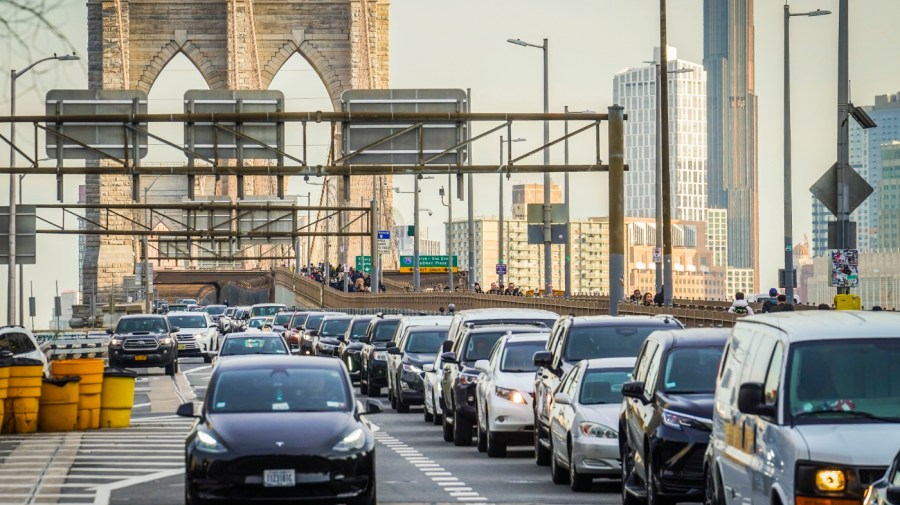
On Jan. 5, 2025, New York made a big bet. After decades of hard-fought grassroots advocacy, the city implemented the nation’s first-ever traffic congestion pricing program. It was a bold, long-awaited response to generations of worsening gridlock, increasing pollution and an aging transit system in a city we proudly call the greatest in the world.
Now, after a year of faster commutes and cleaner air, the bet has indisputably paid off. The congestion relief program demonstrates that thoughtful and deliberate policy decisions can improve people’s daily lives while reducing climate and dangerous air pollution and securing concrete progress toward a more sustainable and affordable society.
For years, critics from all corners of the political spectrum claimed congestion relief would backfire. Even Gov. Kathy Hochul (D) herself — who has emerged as the program’s fiercest champion — expressed doubt at the program’s potential benefits. Critics wanted us to believe there would be hollowed out business districts, harm to suburban commuters and worse traffic and air quality outside of the congestion relief zone.
But just over a year later, all of those claims have been disproven. The results are transformative and undeniable. Time and again, in the face of opposition, the courts have reaffirmed that congestion pricing is the law and cannot be tampered with.
Just this week, a federal judge rejected the Trump administration’s attempt to dismantle the program, ruling that it does not have the authority to shut congestion pricing down — reinforcing that this landmark policy is here to stay and deliver for New Yorkers.
In just one year, 27 million fewer vehicles entered the Congestion Relief Zone, resulting in 25 percent fewer traffic delays within the zone and 9 percent fewer regionwide. Bus speeds are up as much as 2.3 percent, Holland Tunnel trips are 51 percent faster and school buses are getting kids to class on time more often. Traffic injuries are down nearly 10 percent, with pedestrian fatalities at historic lows.
Early signs show that the program has also helped secure incredible environmental progress. Fine particle pollution, which causes heart and lung disease, has declined 22 percent in portions of Manhattan in just the first six months. Other areas of the city and suburbs are also benefiting from declines in this insidious form of air pollution.
In places like the South Bronx, early fears that traffic diversions would drive up truck traffic and further harm an environmentally disadvantaged community have not come to pass. To the contrary, today, truck traffic is down in the South Bronx, and money generated by the congestion relief program has been dedicated to addressing legacy environmental and health challenges experienced by local residents.
Congestion relief funding is expanding the Bronx Asthma Initiative, renovating green spaces and installing air filtration units in schools near highways. This is what climate policy looks like when it is designed with community benefit at heart.
And while traffic and pollution are down, business is up. A recent report by the New York City Economic Development Corporation confirmed that foot traffic inside the zone is up 5 percent year-over-year compared to just 1 percent in other parts of the city. Meanwhile, from May 20, 2024, to May 25, 2025, Broadway had its highest-grossing season ever. Taxi, limo and rideshare trips have increased, too.
These improvements alone would mark the congestion relief program as a historic success. But the most transformative impact will be what comes next. The program has already generated more than $550 million in dedicated revenue to rebuild, modernize and expand the transit system that millions of people rely on every day.
Safe, reliable, modern transit remains the lifeblood of the region’s economy. With the Congestion Relief Program on track to raise $15 billion for capital investment, funding is already flowing toward a host of projects that will improve accessibility for families, seniors and people with disabilities. These investments also make our transit system better equipped to withstand extreme heat, flooding and climate shocks in the years to come.
When policy is designed around clear goals and real-world outcomes that improve people’s lives, public trust will follow. Public favorability for the congestion relief program was low just before its implementation but surged in the months that followed. Today, the congestion relief program is simply part of everyday life in New York.
That lesson matters far beyond New York. Cities across the country are struggling with worsening traffic, rising climate pollution and crumbling infrastructure. Addressing the climate and affordability crisis requires deliberate, concerted action at all levels of government. Local leaders, all across the country, from San Francisco to Boston, can learn from the diverse coalition that persevered through policy, political and legal setbacks to secure meaningful change to make their communities healthier, safer, and more livable.
At a moment when climate progress can feel fragile, New York offers a reminder: Smart policy, grounded in evidence and fairness, can still cut through the noise. New York dared to imagine a city where people move faster, breathe easier and live well. One year in, the congestion relief program is doing exactly that.
Fred Krupp is president of the Environmental Defense Fund.
Copyright 2026 Nexstar Media, Inc. All rights reserved. This material may not be published, broadcast, rewritten, or redistributed.
For the latest news, weather, sports, and streaming video, head to The Hill.