
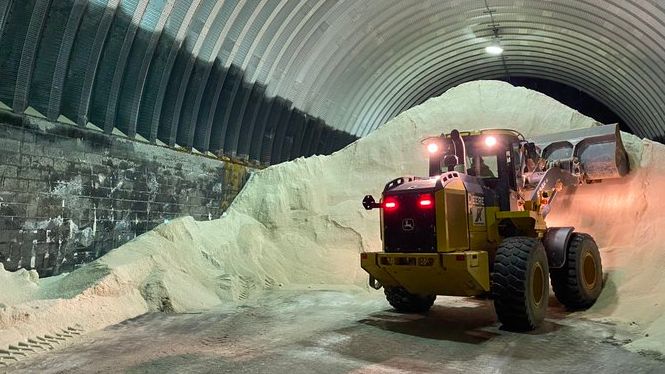
Salt is an important tool for maintaining New York’s roads in the winter. However, it can have an impact on water for drinking and wildlife.
To reduce salt usage and prevent salt from entering waterways, the state’s Department of Environmental Conservation has tips for individuals and businesses and is offering grants.
The department says a teaspoon of salt can pollute 5 gallons of water.
“As you get more nutrients in your water bodies, you’ll typically most likely have harmful algal blooms, which can release toxins that can be harmful to pets, and humans as well,” said Tim Schneider, a field manager with the Cayuga County Water and Soil Conservation District.
Over the years, Cayuga County Water and Soil has gotten water quality improvement grants from the DEC. A recent grant is funding ways to reduce road salt usage in the county. Some additions from the grant include temperature sensors, brine spreaders and a special type of plow blade.
“This new system in place has segmented blades that are on springs, compression springs. So, as the plows go down the road, they can adjust to the ground itself,” said Schneider.
By plowing closer to the road, they expect fewer passes over roads will be needed, and less salt.
“Technology is getting around the state, which is nice to see. And we just hope that expands just for all of New York State’s water quality because we have some of the best resources in the area. So, we’ve got to protect it as best we can,” said Schneider.
“Great practices to implement and it’s helping the environment, but also costing them less money,” said Julie Berlinski, research scientist, NYSDEC.
According to the Warren County DPW superintendent’s office, road salt use has been reduced by 30% with the plow blades. Reducing salt on roads can have ripple effects to the health of wildlife and people.
“Salt is related to hypertensive disorders. And so, people on sodium-restricted diets, if you have salt coming in your water, it’s not always accounted for. And you don’t know how much you’re consuming,” said Sujay Kaushal, a professor at the University of Maryland.
Kaushal has been researching the topic, and he says when salt enters drinking water sources, it can not only impact the water itself but be impacted by the metal pipes it travels through.
“The water coming from the treatment plant is different than the water that they get from their tap, because it has to go through a lot of different pipes where the water can react with the pipes and even their home plumbing,” said Kaushal. “And so, depending on what types of fixtures you have in your house or how old your house is, with like lead solders or other types of metals in those pipes, the salt can interact with it.”
While municipalities work to make plowing and salting more efficient, businesses and homes can make small changes as well.
“Just like we can all do our part recycling. We can all do our part to reduce salt in the environment,” said Lela Mitchell, environmental program specialist, NYSDEC.
“The environment is very delicate. So, any changes that we put onto the landscape itself can have a huge impact down the line,” said Schneider.
Berlinski said it could be years before we can see measurable results of these efforts in the environment. In December, the DEC rolled out a “Don’t Be Salty” campaign encouraging people to shovel before spreading salt; apply salt only when the temperature is above 15 degrees; and collect leftover salt after ice melts to lessen the impact on groundwater and surface water.
“Just 12 ounces will be enough for 250 square feet, which is about 10 sidewalk squares,” said Mitchell.
The DEC will start accepting applications for the next round of water quality improvement grants in May. In the most recent round of grants, $200 million was awarded to more than 130 projects statewide. Another DEC recommendation is making a salt brine with 3 1/2 cups of rock salt per gallon of hot water, and applying it with a garden sprayer, before a storm or after shoveling.