
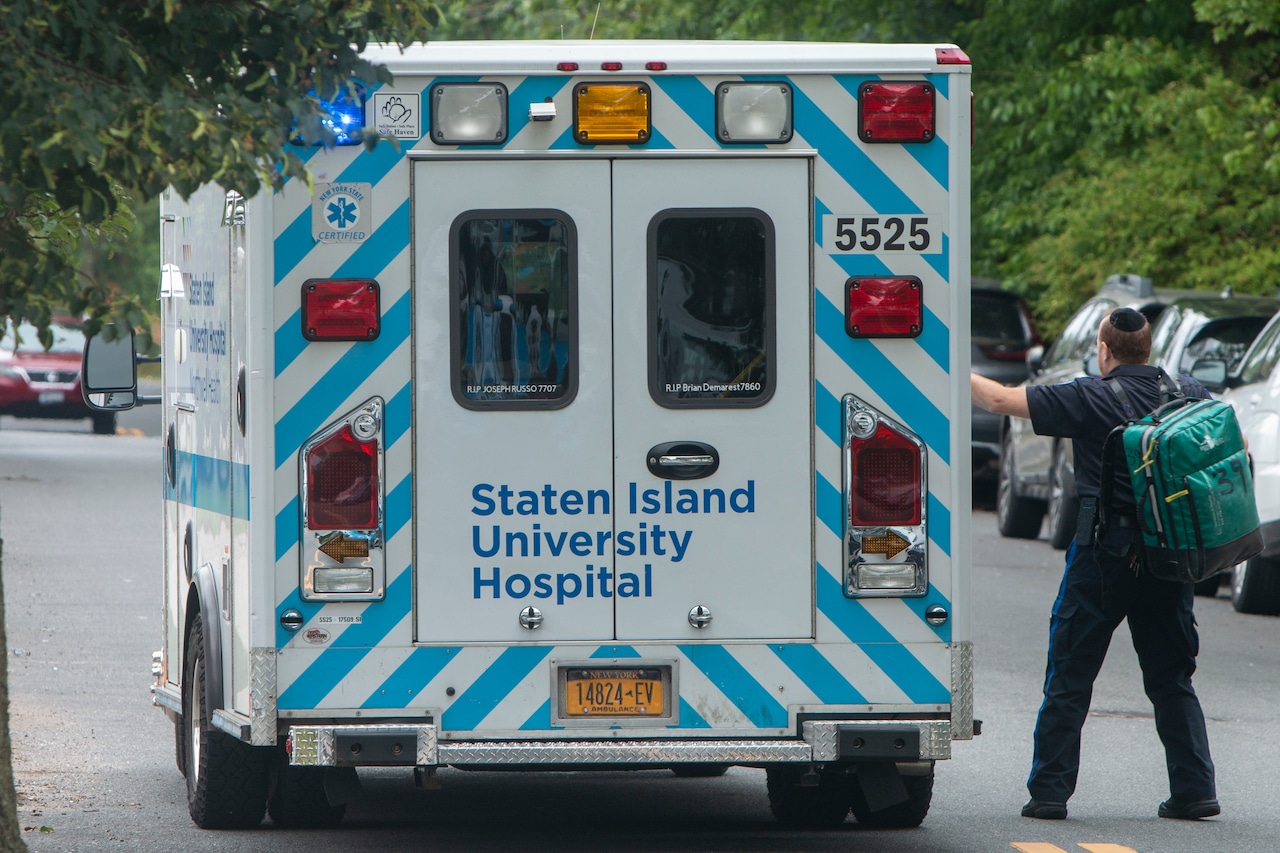
STATEN ISLAND, N.Y. — A Staten Island hospital recently shut down one of its overnight ambulance service units, marking the latest step in broader New York City trends.
Reductions in ambulance service around Staten Island include the recent end of an overnight unit at Richmond University Medical Center and a similar reduction in service from Staten Island University Hospital in 2023.
In total, Staten Island University Hospital operates four ambulances within the city’s 911 system compared to the five it operated 10 years ago. Richmond University Medical Center now operates six ambulances from 9 a.m. to 1 a.m., but five from 1 a.m. to 9 a.m. Previously, the West Brighton hospital operated six throughout the entire day.
Ambulance reductions have impacted hospitals and other services around the five boroughs, including among the FDNY.
Manhattan’s Lenox Hill Hospital, Northwell Health, the same network that includes Staten Island University Hospital, cut about a dozen paramedics in October, sparking concerns about growing ambulance response times, according to a CBS News report.
At an October City Council hearing, FDNY EMS Chief Paul Miano said EMS recruitment is a constant focus for the department.
“The FDNY tirelessly tries to recruit for EMS,” Miano said. “Throughout the country, EMS recruitment is going down.”
A decline in EMS personnel across the FDNY, private and volunteer sectors has been a contributing factor to slower ambulance response times around the city.
In November, Miano told the City Council that it loses about 10 in-service ambulance units daily due to insufficient staffing.
September’s Mayor’s Management Report, an annual report card about the performance of city agencies, found that in the last five years ambulance response times for life-threatening emergencies had increased by nearly two minutes. Modern ambulance response times for life-threatening emergencies trail those from a decade ago by two minutes and 12 seconds, according to the 2020 Mayor’s Management Report.
Government officials, union leaders and other advocates working to address the EMS personnel shortage mostly focus on one thing, pay parity.
Base salary for an FDNY EMT tops out around $59,000 after five years, while firefighters with the same years of service top out around $110,000.
“The city’s goal has always been to staff more tours with FDNY EMS, but until the pay changes, the retention rates and the ability to achieve this will be stifled,” former Councilmember Joseph Borelli, who chaired the Council’s Fire and Emergency Management Committee during his time in the city’s legislative body, said.
Mayor Zohran Mamdani’s appointment of Commissioner Lillian Bonsignore, an FDNY EMS veteran with over 30 years of service, was cause for optimism among past and present emergency medical service professionals about the possibility of pay parity.
“I was shocked when I heard her get appointed, very pleasantly shocked,” said Mark Peck, a former FDNY paramedic and Staten Islander who now lives in North Carolina. “This is the first opportunity for someone in that position to understand and actually try and deal with the things that are not right in the department.”
Peck and others who have followed the history of New York City’s municipal EMS service think it might be time for the service to get out from under the FDNY umbrella.
Since 1997, New York City’s municipal EMS has been under that umbrella after decades spent as part of the city’s public hospital system.
A City Council bill, sponsored by Councilmember Justin Brannan, creating a stand-alone Department of Emergency Medical Services failed to make it through the Council last year, but the 21 City Council co-sponsors for the bill show there is an appetite for such an agency among the city’s political class.
“Right now, morale is low. Headcount is down. Response times are up, and when good people leave because they can’t afford to stay, the whole city feels it, every neighborhood and every borough,” Brannan said during a Council hearing in November. “Emergency medicine deserves its own leadership, its own budget, its own respect, not as a bureau buried inside another agency, but as a department that is solely dedicated to saving lives.”