
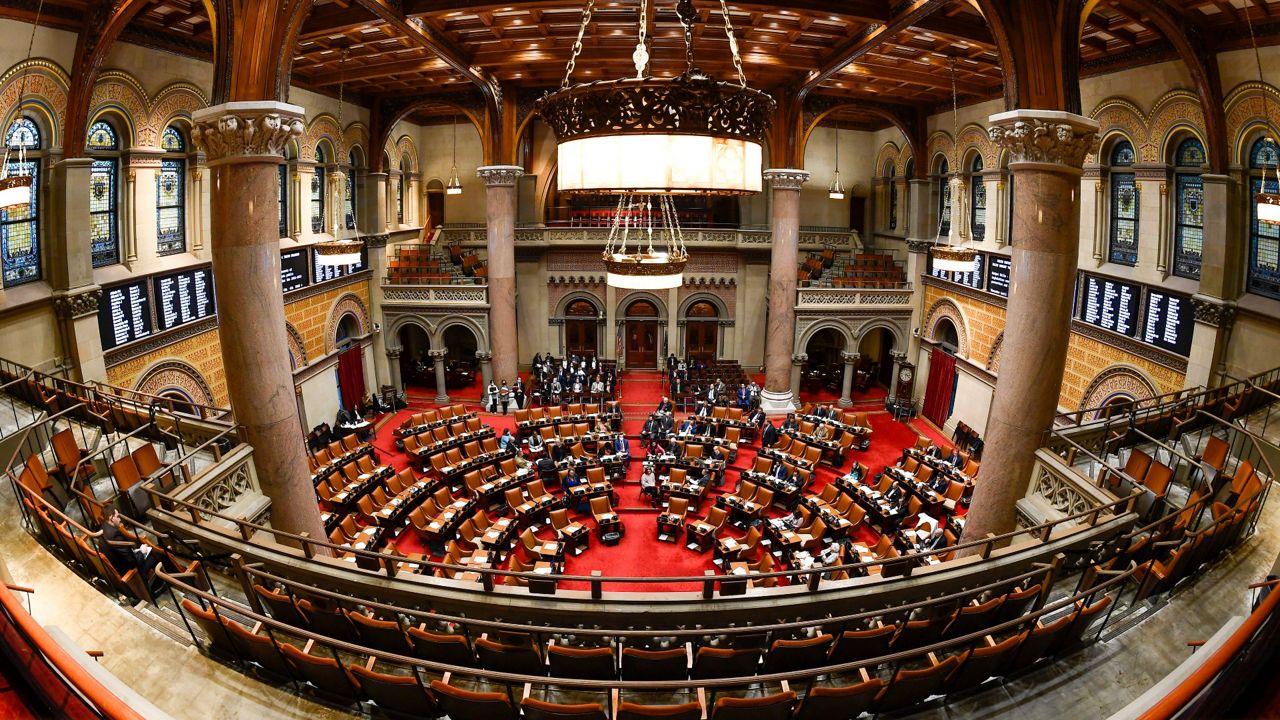
The New York state Assembly’s one-house budget proposal includes both tax increases and tax relief.
As expected, the lower house increased the personal income tax on New Yorkers earning more than $5 million a year – a hike that would impact 14,000 taxpayers, and raise $2.9 billion in Fiscal Year 2027-2028.
There is also a proposal to increase the corporate franchise tax as well as a new tax on cryptomining, which, together, would raise just under $2 billion.
On the other side of the ledger, rebate checks could be back if an Assembly proposal is adopted.
To assist residential ratepayers with high utility bills, the Assembly is proposing “POWER” rebate checks benefitting 5.4 million residential ratepayers. “POWER” is an acronym for “Protect our Wallets Energy Rebate Checks.” The Assembly proposal would cost $2.6 billion and would help 5.4 million residents with rising costs of utility bills. Households would receive $500 for incomes below $150,000 and $300 for incomes between $150,000 and $300,000.
The Assembly also proposes to provide a tax cut to low and middle-income New Yorkers earning below $323,200. The average tax cut is estimated to be $446. The cost to the state is estimated to be $2.1 billion in FY 26-27.
Under the Assembly proposal, the personal income tax would be eliminated entirely for certain low and moderate-income New Yorkers with dependents.
Additionally, the Assembly is proposing what it’s calling a “Small business subtraction modification” of between 15-25%, putting about $67 million back in the pockets of small businesses.
Utilities
While there won’t be any quick fixes to the state’s sky-high utility costs, the Assembly is proposing several mitigation measures, including a two-year moratorium on rate increases for electric and gas for the Public Service Commission and the Long Island Power Authority. The PSC and LIPA are the agencies responsible for approving such increases.
In addition to the rebates and the rate increase moratorium, the Assembly has proposed a Blue-Ribbon Commission that would look at residential affordability. The chamber also wants to create a new Office of the Utility Consumer Advocate.
It should be noted that Gov. Kathy Hochul vetoed legislation last year that would have created an independent State Office of the Utility Consumer Advocate, saying it was duplicative of functions performed by the Office of Consumer Services.
Municipalities
Last year’s enacted budget included Temporary Municipal Assistance (TMA) for all cities, towns and villages that receive Aid and Incentives to Municipalities, or AIM Aid. Cities including Buffalo, Rochester, Syracuse and Yonkers received $5 million each.
This year’s executive budget proposal includes $27.3 billion to New York City, as well as $715 million in AIM Aid for the rest of New York state, and an additional $50 million in TMA to distressed cities. The city of Albany would also receive $20 million in municipal assistance for the third year in a row.
In the Assembly’s proposed one-house budget, New York City would receive $1 billion over three years, while other distressed cities in the state would receive $452.7 million, also over three years.
The Assembly also proposes that fiscally distressed towns and villages receive AIM aid of $47.3 million over three years.
Other highlights include:
Education
$39.4 billion in school aid, $2.1 billion over SY 2025-2026
$27.8 billion in Foundation aid, $1.4 billion over SY 2025-2026
Include in foundation aid – homelessness, foster students and English Language Learners (ELL)
$20.9 million to increase three-year-old pre-kindergarten to a minimum of $10,000 per pupil
Higher Education
Tuition Assistance Program (TAP) – $285 million to expand income eligibility thresholds (8,000 students), and increase the income eligibility for the minimum & maximum award (249,000 students)
Increase income eligibility for the Excelsior Scholarship to $150,000, cost of $37.1 million (6,300 students)
Graduate Tuition Assistance Program (TAP) – $160 million to implement TAP for graduate students (65,000 students)
Create student loan program private loan program in partnership between the State, private lenders and higher education institutions
Increased funding for Opportunity Programs
Housing
Housing Access Voucher Program (HAVP) – $250 million
Mitchell-Lama and NYCHA maintenance $100 million
Mitchell-Lama capital $750 million
NYCHA capital $750 million
$225 million capital Public Housing Authorities outside of NYC
$50 million for down payment assistance
Child care
Agree with Executive proposal to fund $3.6 billion for childcare with eligibility modifications
Afterschool programs – $100 million for additional 40,000 students
NYC specific funding
$1.5 billion from General Business Corporate Tax
Financial 9% to 10.8%
Non-Financial 8.85% to 10.6%
$700 million from reducing PTET credit from 100% to 70%
$321 million from Mansion Tax, greater than $5 million 1%; supplemental 0.25% to 1.25%
$250 million from Unincorporated Business Tax 4% to 4.4% on incomes $1.25 million
Other
$1 billion over three years – Temporary Municipal Assistance (AIM)
$152.6 million to eliminate NYC 15% local share of TANF and EAF benefits
Additional $100 million in Raise the Age funding (allowing NYC to participate)
$100 million in Adult Shelter reimbursement, for a total of $170 million
$72.5 million in capital for Clean Water
$26.5 million in capital for highways and roads (CHIPs)
$15 million for fare-free buses (one in each borough)