
Amy FeiereiselAs momentum grows for workforce housing, $3.5 million bridges North Country gaps
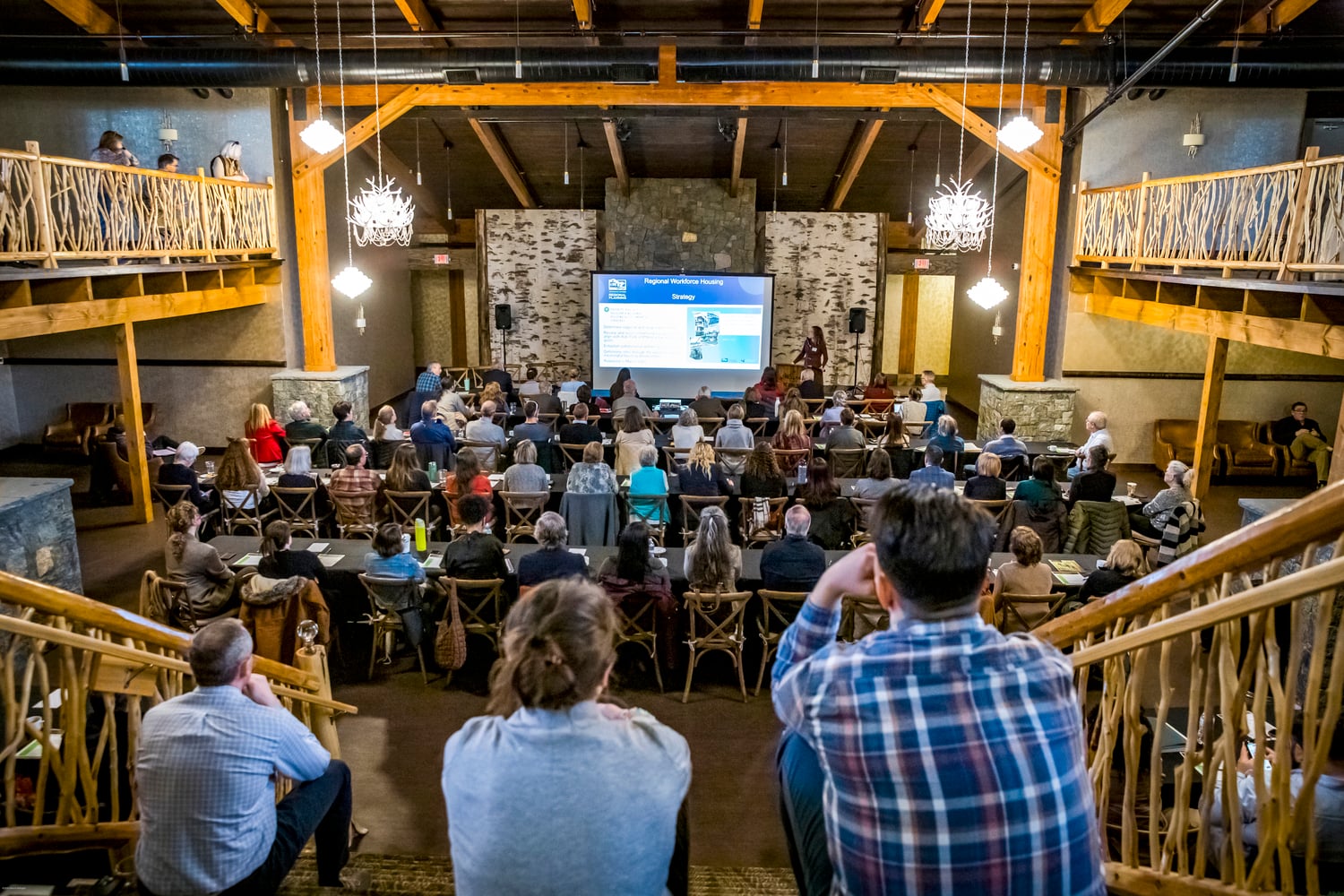
Attendees at the Adirondack Community Foundation’s Workforce Housing Forum. March 5, 2026. Photo: Nancie Battaglia for the ACF.
Northern New York has a workforce housing problem, and that’s been true for a long time. Affordable starter homes for year-round residents are scarce and got even scarcer in recent years.
But a lot of local and regional organizations are working to change that. Those efforts are starting to reach a fever pitch, and two new housing initiatives announced last week could add some needed gas to the fire.
Accelerate Workforce Housing
Last Thursday, around 100 people interested in local workforce housing gathered in Schroon Lake for a housing forum hosted by the Adirondack Community Foundation.
It was a wide-ranging group of people that included non-profit leaders, county and town supervisors, other local officials, environmentalists, and even developers. What that group shares is a recognition of housing needs in this region, said Steve Hunt, from New York’s Empire State Development.
“We all know the North Country seen a surge in interest since the pandemic from second home buyers to short-term rentals,” said Hunt. “And while that growth is exciting, it squeezed our year-round workforce. Our teachers, healthcare aids, and non-profit workers are being priced out of the very community they serve.”
Hunt was in Schroon Lake to announce a $3.5 million state and philanthropic housing initiative, called Accelerate Workforce Housing.
He said the initiative’s goal is to help “ensure that the people who keep the North Country running can actually afford to live here year-round.”

Steve Hunt, representing Empire State Development. Photo: Nancie Battaglia for the ACF.
Revolving Loan Fund: a new tool for the region
The first part is a $3 million ‘Revolving Loan Fund,’ funded by state dollars. It’s meant to fill in a missing piece of housing development funding in Northern New York.
“I’m really excited about this. It hasn’t existed in the past,” said Michelle Capone of DANC, the Development Authority of the North Country, which will be administering the program.
“Typically, developers will come to the table, and they have a primary funding source, they bring a little bit of their own cash to the project, but they really need a little bit more help to get over that finish line.”
The loan fund will provide that ‘little bit more’ through low-interest loans for developers building affordable workforce housing.
Loans will be prioritized for developers building projects that are permanent (no short term rentals allowed) and affordable to people making between 120 and 200% of area median income. Jobs that pay in that range include teachers, healthcare professionals like nurses, town and county government employees, and many hospitality workers.
Capone says while $3 million might not sound like much, as loans are repaid, the principal and interest will go back into the fund, therefore making more loans possible.
“As long as loans are paid back in full and the interest is received, we will have these funds ongoing into the future,” said Capone. “If we can show success with these programs – when we do – we can go back to the state and look ‘recapitalize’ that [loan fund] and bring more money into it.”

Michelle Capone of DANC, the Development Authority of the North Country, which will be administering the $3 million Revolving Loan Fund. Photo: Nancie Battaglia for the ACF.
The broad area that the loan fund covers is one of the most exciting things for Capone.
For forty years, the Development Authority of the North Country has been administering state housing programs in St. Lawrence, Jefferson, and Lewis counties, specifically for the growth of the Fort Drum military base.
This loan fund goes far beyond that, also including Franklin, Essex, Hamilton, and Clinton counties, as well as any town in the Adirondack Park with a population of less than 10,000.
“This is a a resource that has been lacking. So having this flexibility locally really allows you to see some of these projects through to the end,” said Capone.
Local philanthropy to fuel pre-development and technical assistance
The second piece of the Accelerate Workforce Housing initiative in philanthropic.
In addition to the $3 million state dollars, the Adirondack Community Foundation gathered $500,000 from private donors to fund pre-development and technical help for workforce housing projects. That includes things like easements, surveying, wastewater systems, and environmental reviews.
“So all of the work that goes into housing before houses are actually built,” said Kim Trombly, who serves as Director of Community Impact at the Foundation.
Trombly says the half million dollars in philanthropic funding will complement public dollars, “to kind of bridge the gaps where public funding can’t be used, as sometimes public funding can be a little restrictive.”
The Adirondack Community Foundation tracks housing projects across the region and has been helping convene the non-profits doing the work. Trombly says more than ever before, they’re seeing organizations work together, and progress being made.
“The increased sector coordination that we’ve been having has really started to move us all forward in the same direction,” said Trombly, “and I think it has really moved the needle in a way that individual efforts haven’t done before.”

Kim Trombly, Director of Community Impact at the Adirondack Community Foundation.
A regionwide push in the same direction
That optimism about the current housing landscape was shared by Beth Gilles, the Executive Director of the Lake Champlain Lake George Regional Planning Board, which will be administering the $500,000 philanthropic fund.
The planning board also recently received $5.75 million in federal funding for similar work in predevelopment. She said between recent investments and local commitment, it feels like the region is on the cusp of real change with
“It’s a huge deal. And it’s really going to get us to that next step,” said Gilles.

Beth Gilles, Executive Director of the Lake Champlain Lake George Regional Planning Board. Photo: Nancie Battaglia for the ACF.
She says the longtime puzzle of development in the region has been attracting developers. The funding will help them package up pieces of property to make them nearly shovel-ready for a developer.
“We spend the money and the time that developers usually spend, which in the Adirondacks can be a year to two years, just to make the property developable,” said Gilles. “So then we can say, “Here’s a piece of property. The community’s on board with development. We’ll give it to you, but you have to build what we want you to.'”
What they want is year-round housing for workers and families. Gilles said they’re thinking much larger than 5 or 10 units in a single place; more on the order of dozens or even hundreds of homes in communities across the entire region.

The Adirondack Community Foundation’s Workforce Housing Forum. March 5, 2026. Photo: Nancie Battaglia for the ACF.