

Listen to this article
Estimated 5 minutes
The audio version of this article is generated by AI-based technology. Mispronunciations can occur. We are working with our partners to continually review and improve the results.
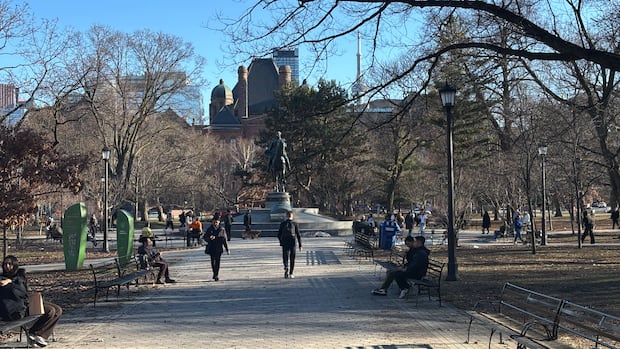
One of the first municipal parks in Canada, Toronto’s Queen’s Park North, could soon be the recipient of a multi-million dollar revitalization project, courtesy of the Weston Family Foundation.
The park just north of Ontario’s legislature opened in 1860 and the city was able to make some recent improvements to it in 2019, but stopped short of doing more due to budget constraints. The Weston family wants to give the city up to $50 million to revitalize the park, along with ongoing annual funding to keep it in good condition.
The mayor’s executive committee will vote on the proposed donation Tuesday, which would mean sending it to city council for final approval.
“In a perfect world, we would have tax revenue to be able to look after public spaces and public assets to a high standard ourselves. That’s not the world we live in,” said Coun. Dianne Saxe. “[The donation] is incredibly generous of the Weston family.”
But given the source of the donation, Saxe also wants to ensure the space continues to serve its intended, public purpose.
“How do we make sure that there isn’t excessive influence by the donor?” she said. “They don’t just hand over $50 million and say ‘have a nice day.'”
CBC Toronto has reached out to the Weston Family Foundation for comment on Saxe’s concerns.
WATCH | Last summer, Toronto opened its largest new park in a generation: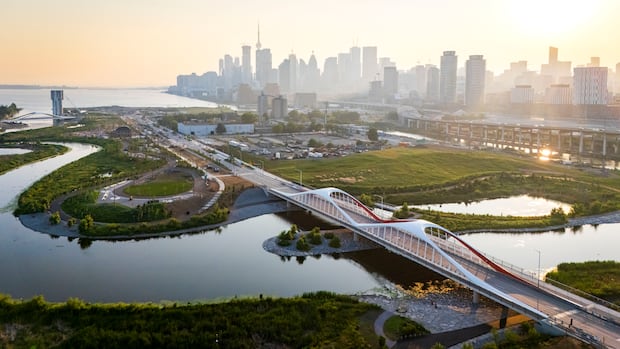
Take a walk around the new Port Lands park
Toronto’s waterfront is home to a new park, now situated at the mouth of the Don River. Haydn Watters spoke to a longtime advocate who has been working to revitalize the Port Lands for 30 years.
According to the report, the donor will have to approve of the final design. There may also be donor recognition in the form of a commemoration to Hilary M. Weston, Lieutenant-Governor of Ontario from 1997 to 2002.
The donor recognition would have to be approved by the city’s general manager of parks and would be in line with “typical donor recognition within parks and recreation spaces,” the report says.
Councillors will have the chance to ask staff about the potential donation at the meeting Tuesday.
Park could host more programming
The city hopes to settle on a “design direction” for the park by the spring, according to the report before the executive committee. Phased construction would begin late in the summer.
City staff say revitalizing the park is especially important because of the high demand for green space in densifying downtown wards.
Part of the goal for the redevelopment of the park is to create a better experience for the people who use it, with amenities such as new washrooms and potentially a café.
Other changes floated during consultations so far, according to the report, include improvements to the running track, a commemorative garden and a shelter structure being called a “workshop” for local community programming.
Henry Wiercinski, chair of the planning and development committee with the Annex Residents’ Association, said his group is thrilled about the prospect of new money coming to the park. He said the park has been neglected, but he worries about some parts of the plans.
“It’s putting too much programming into a delicate space,” he said, adding there is a desire to preserve the area as an urban forest.
A summary of some public consultation in the report said several people supported small-scale, community-led activities but expressed concern about programming that would draw large crowds.
The city has also been engaging with Indigenous communities about the revitalization plans, with discussions including things like storytelling posts to explain Indigenous history and the use of Indigenous languages to name some of the park’s features. The report explains that when members of the community come to Queen’s Park to speak with provincial representatives, they use the park to lay down tobacco and send prayers beneath its tallest trees.
Local councillor concerned about mature trees
One of the key pillars for the revitalization, according to the report, is protecting those trees. The park is described as “a natural oasis” known for its large trees, which became more isolated from its urban surroundings as the streets around it were widened for cars in the 20th century.
“This is the only grove of mature trees like this that we have in central Toronto,” said Saxe.
Saxe says the trees are already being disturbed by people walking on the roots covered by thin soil, as well as the subway running underneath the park. If the process moves ahead to add a café and washrooms to the park, she wants to ensure construction is done in a way that avoids damaging the roots.
WATCH | This iconic Toronto tree is dying — but is it the end of the line?: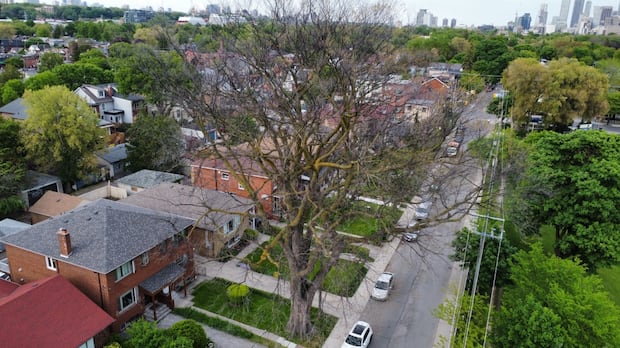
This iconic Toronto tree is dying — but is it the end of the line?
A giant elm at Christie Pits is “nearly dead.” But as CBC’s Michelle Song explains, its genetics may be preserved.
“[The report] had a lot of nice language that they’re going to be careful with the trees, but I think it needs to be clearer and stronger,” she said.
The report says there will be enhanced maintenance practices and public education to help the trees thrive.
“Care will be taken before, during, and after construction to ensure the significant urban tree canopy continues to define the character of the park for generations to come,” it says.