
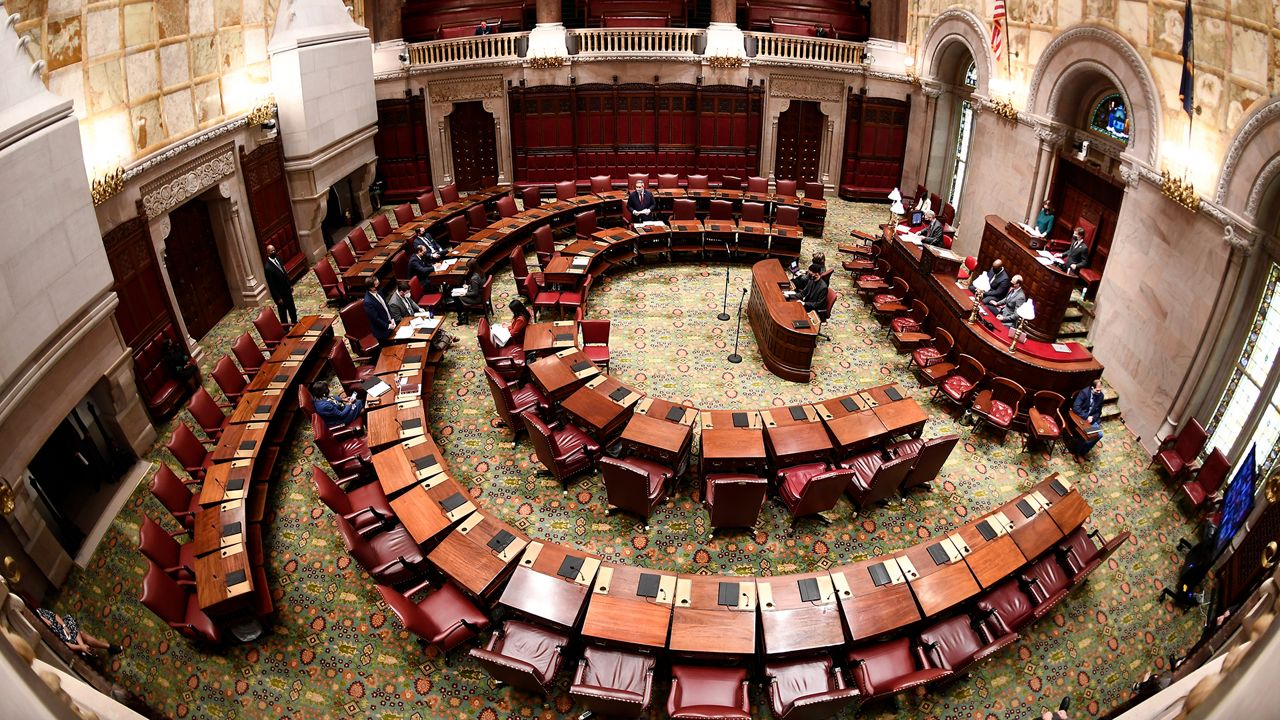
Both the New York state Senate and the Assembly’s one-house proposals increase taxes on the wealthy.
The Senate’s $269.8 billion dollar proposal (the governor’s proposal is $262.7 billion) includes a 0.5% income tax surcharge on the top two income brackets in the state, which currently stand at 10.9% for income over $25 million and 10.3% for income between $5 million and $25 million.
That increase is expected to raise over $1 billion.
The Senate is also proposing an increase in the statewide corporate tax rate from 7.25% to 9% for those with business income over $5 million. There is an additional proposal to adjust the pass-through entity tax credit to 90%, bringing in an estimated $1.8 billion. The Senate proposal also ends sales tax exemptions on some luxury goods, including luxury boats valued over $230,000.
These taxes combined will add an estimated $6.2 billion to the state’s coffers.
A few other revenue changes include new taxes on non-essential helicopter rides in New York City, a doubling of the credit for installing solar energy systems from $5,000 to $10,000 and making that credit refundable for low-income taxpayers and increasing the volunteer firefighter and ambulance worker credit from $200 to $600.
Municipalities
The state Senate’s one-house budget adds $604 million in Aid and Incentives for Municipalities (AIM) funding over the next two years for cities across the state, including New York City.
Breaking that down, the budget adds $302 million to AIM for the next two years. Additionally, it adds $125 million in general assistance for the cities of Rochester, Yonkers, Syracuse and Albany, as well as $40 million in “Miscellaneous Financial Assistance” (MFA) for the cities of Rochester and Yonkers; $30 million in MFA for the city of Syracuse; and $15 million in MFA for the City of Albany.
The Senate’s one-house also provides the state’s largest municipality with over $5 billion in new revenue, including authorization to increase the New York City corporate tax for the financial sector from 9% to 10.8%.
For some non-finance sector companies, the tax would be increased from 8.85% to 10.62%, adding $1.5 billion to New York City’s revenues.
Utilities
The Senate’s one-house proposal expands on Gov. Kathy Hochul’s executive budget, which would require utility companies to return excess revenues to ratepayers.
The Senate also adds $200 million for the Energy Affordability Program (EAP). National Grid and other utilities’ ratepayers are automatically enrolled in EAP when a Home Energy Assistance Program (HEAP) grant is added to an account.
Childcare, education and afterschool
Adding $285.3 million in additional Foundation Aid for a total of $27.4 billion, which ensures all schools receive at a due minimum of at least 2%.
Adding $34 million in additional support for child care pilot programs for children aged 0-3 in cities with a population of less than 1 million, for a total of $100 million.
$500 million total to support the child care workforce through the Child Care Worker Retention Grant Program
Increasing the Foundation Aid pupil needs index weighting for English Language Learners to .60, and adds a weight of .12 in the pupil needs index for students experiencing homelessness or in foster care.
Adding in $30 million in additional support for the Learning and Enrichment Afterschool Program Supports (LEAPS), for a total of $146.1 million with language to ensure that this additional support funds programs in districts that do not currently have a LEAPS program.
Environment and Energy
Advances a range of policy actions that can facilitate the Climate Leadership and Community Protection Act (CLCPA) compliance in its budget, including the ASAP Act, increased incentives for zero emissions vehicles and heat pumps, increased funding for weatherization and electrification, and advances a number of proposals outside the budget that could also assist the state in meeting its goals
Increases the Environmental Protection Fund (EPF) to a total of $500 million and the Clean Water Infrastructure Act (CWIA) to a total of $888.3 million
Earmarks $100 million of the CWIA increase to support lead service line replacement
Restores the $1 billion Sustainable Futures Fund and specifically earmarks $300 million for Decarbonization of Schools, $250 million for Renewable Energy Projects, $200 million for Thermal Energy Network Projects, $150 million for EmPower+ and $100 million for Electric School Bus Charging Infrastructure
Modifies the executive’s proposal to reform the State Environmental Quality Review Act (SEQRA) in line with legislation passed in last year’s session
Other items
Tier 6: The Senate continues to support reforming Tier 6 to provide improved benefits to Tier 6 members and address recruitment and retention challenges in public service
Increases funding for CHIPS, STOA, EWR, and Bridge NY
Adds $500 million for financially distressed hospitals, $405 million for a total of $560 million for hospital investments in rate increases and quality incentive programs, and adds $50 million for a total of $80 million for FQHCs and Non-FQHC Clinics
4% for TII, with 1.3% dedicated to workers
Both houses restore IOLA funding to $102.5 million, and the Senate proposal includes an additional $50 million investment in civil legal services, bringing the total proposed funding to $152.5 million