
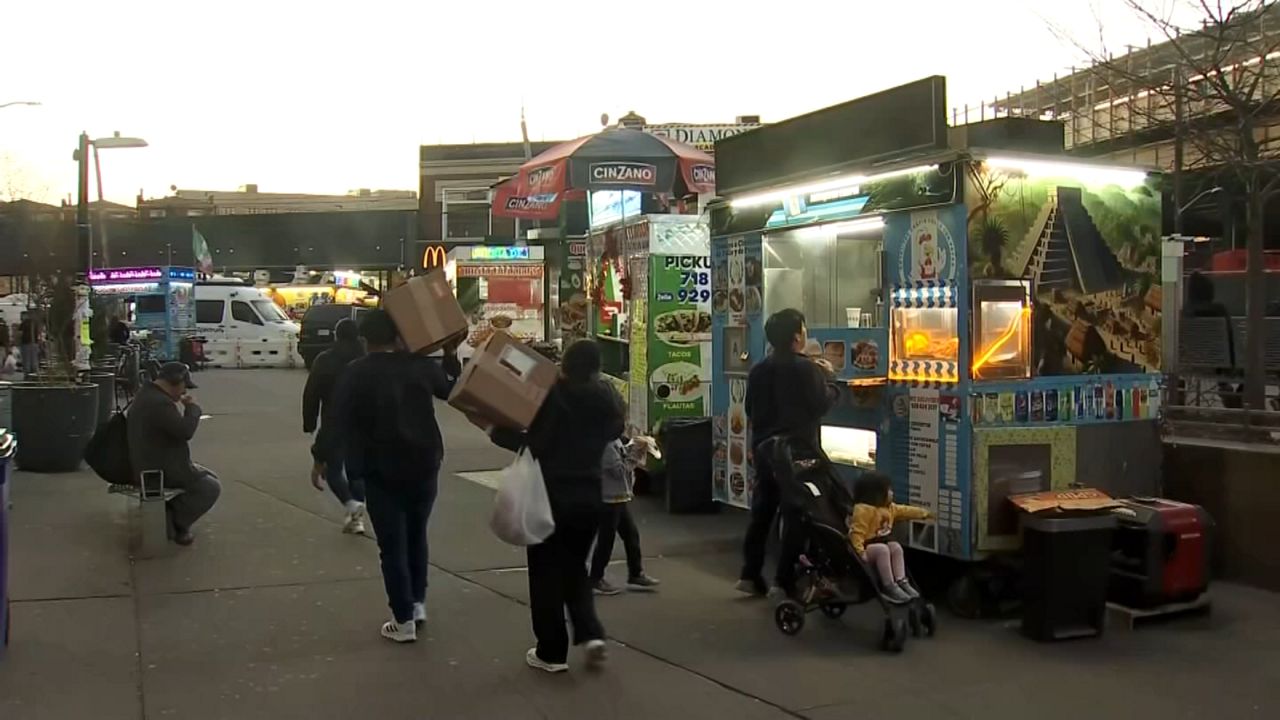
Street vendors will no longer face possible jail time for minor violations.
What You Need To Know
Vendors, activists and local elected officials gathered on the steps of City Hall on Monday, celebrating the first bill from the Street Vendor Reform Package going into effect
According to the Street Vendor Project, there are 23,000 vendors across the five boroughs
Last year alone, the NYPD issued more than 3,600 vending-related criminal summonses
“I’m not a criminal. I was just doing my job, trying to provide for my family. I’m just [making] an honest living,” Mahmoud Zaed, who has been a street vendor for 18 years, said.
He expanded his business to four locations across the city, with three in Manhattan and one in Queens.
Zaed said he’s received several summonses over the years.
“They can give you a criminal ticket for any reason. Let’s say if you’re not hanging your license, let’s say you’re one foot more close to the crosswalk. We’re supposed to be 10 feet. Let’s say I’m nine feet. If a cop stops by and says, ‘You’re nine feet,’ and he gives you a criminal ticket,” he said.
On Monday, vendors, activists and local elected officials gathered on the steps of City Hall celebrating the first bill from the Street Vendor Reform Package going into effect.
Local Law 122 ensures vendor-related violations will no longer result in jail time, probation or fines.
Advocates this will protect an industry that is overwhelmingly made up of immigrants.
“It’s a huge step toward equity and justice for immigrants in New York City who now no longer have to fear going to criminal court for something as simple as serving tamales to provide for their families,” Carina Kaufman-Gutierrez, the co-director of the Street Vendor Project, said.
According to the Street Vendor Project, there are 23,000 vendors across the five boroughs. Last year alone, the NYPD issued more than 3,600 vending-related criminal summonses.
“If you are in immigration proceedings, that’s also something that will show up on your record any time a judge is reviewing your case — be it an asylum case, be it applying for citizenship. It will always show up, even if the ticket is dismissed,” Kaufman-Gutierrez said. “[There are] still penalties, there’s still enforcement if you do break any violation, but it becomes a civil penalty rather than a criminal penalty.”
Zaed said he can go to work every day without fear, knowing he and his fellow vendors are being treated like any other small business owner.
“It feels great, especially if the cops stop by me, I’ll just pay the violation. You’re not gonna treat me like a criminal person, you’re not gonna give me a criminal ticket. It feels better, you know? When you feel respected, it makes you feel better,” he said.
By 2027, the city will also increase the number of permits and licenses available to vendors, which has been capped for decades.