
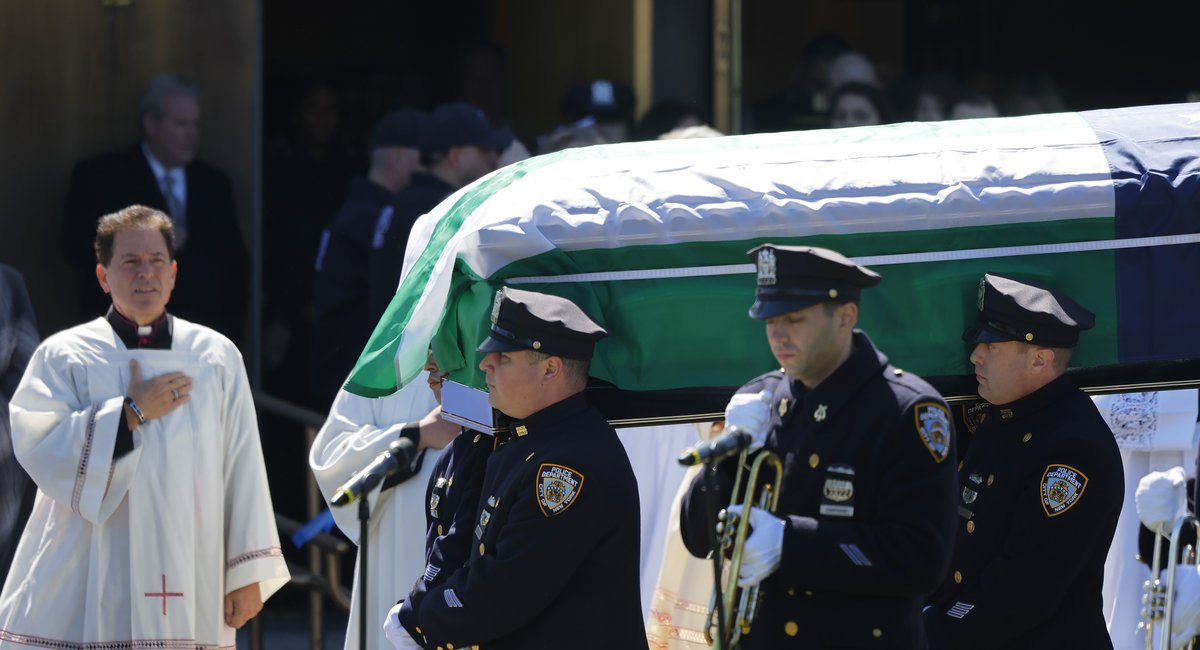
On a mild day almost exactly two years ago, several NYPD officers approached two men sitting in a car in Far Rockaway because, they later said, they suspected one of them was carrying a handgun.
Within seconds, one of the officers, Jonathan Diller, had been fatally shot.
Diller’s accused killer, Guy Rivera, is on trial in Queens this week. And the details of exactly what unfolded in the seconds between when the officers approached the car and when Diller was shot could determine whether Rivera spends the rest of his life in prison.
For prosecutors, the case is cut and dried: Rivera pulled out his handgun while sitting in that car and intentionally fired at Diller, striking the 31-year-old police officer with a fatal shot.
“He chose violence,” Assistant District Attorney Kenneth Zawistowski told jurors in his opening statement Tuesday morning.
But Rivera’s defense team maintains that the shooting was unintentional. Legal Aid attorney Erin Darcy told jurors in her opening statement that Rivera’s gun went off accidentally when he was struggling with another officer at the scene, Sgt. Sasha Rosen. She said video evidence that will be introduced at trial will prove her point.
The shooting
The two attorneys laid out their dueling theories of the case to a courtroom packed with NYPD officers and members of Diller’s family, including his wife Stephanie, who at times used a tissue to wipe tears from her eyes.
The judge overseeing the trial, Justice Michael Aloise, occasionally paced back and forth on the bench and stood up behind his chair as he listened to testimony and arguments from the attorneys.
Zawistowski began his opening statement with a dramatic reference to the NYPD motto, Fidelis ad Mortem, a Latin phrase that means “faithful unto death.”
For Diller, Zawistowski said, “it was more than just a phrase. It was more than just a motto. It was a sacred promise.” He noted that the day he was killed, Diller was working on his scheduled day off.
Zawistowski then cut to a description of the shooting, telling jurors that while Rivera was sitting in the car’s passenger seat, he refused several of Diller’s commands to lower his window and step out of the vehicle.
Zawistowski said Rivera then made a calculated decision to pull his gun, fire at Diller and then point it at Rosen in an attempt to escape. A third officer at the scene, Veckash Khedna, returned fire, hitting Rivera twice.
“He intended what he meant to do,” Zawistowski told jurors of Rivera.
He added that two guns were later recovered from the car, including the one Rivera was carrying and a second in the glove box.
A different story
Darcy, Rivera’s defense attorney, said none of that is true.
“What they just told you … that’s completely false,” she said. “There were critical facts that weren’t told to you, important details that weren’t shared with you.”
She said the evidence will show that Rosen and Rivera were locked in a chaotic struggle, leading to an “unintentional discharge” that fatally struck Diller. Rivera is charged with first-degree murder, which requires prosecutors to prove he intended to kill Diller. He faces life in prison without the possibility of parole if he is convicted on that count.
Darcy added that she expects Rosen to testify that’ he didn’t begin to struggle with Rivera until the first shot was already fired – but she said video evidence will undercut that narrative. Rosen is expected to testify on Wednesday.
“A trial can’t rest on sympathy,” Darcy told jurors. “Tragic outcomes do not always follow intent or hatred or evil.”