
A 200-square-foot apartment in Brooklyn, New York. A budget of roughly $20,000. And a primary crew of three Northwestern alums.
Beginning in June 2024, Sam Jonas (Communication ’23) turned his studio apartment into a film set. With a prism lens, purchased for about $40, a single light and sets built by Jonas himself, he and his team shot his first feature film, “The Rabbit Hole.”
The self-proclaimed “broke artist” independently created the film, which is about a neurotic tree-hugger who builds a supercomputer to save the natural world.
Jonas said he hopes audiences are left feeling entertained, intrigued by fungus and “flabbergasted” that it was filmed in a roughly 200-square-foot apartment with a minimal budget.
The first draft
Though no one in his family had ever been involved with filmmaking, Jonas grew up watching movies. Every Thanksgiving and Christmas, the family watched a few specific films: “Planes, Trains and Automobiles,” “Elf” and “Die Hard.” They also had regular Friday movie nights.
“There always felt like there was this kind of sacredness around bringing people together,” Jonas said.
But when Jonas first came to Northwestern, he had no idea the University had a film program, he said.
Though he was initially a Medill student, he eventually jumped into the film program as an underclassman.
“I just like never really looked back,” Jonas said.
Jonas quickly established a reputation as a “prolific” filmmaker, according to Xanthe Moon Brown (Communication ’23). Brown was the colorist for “The Rabbit Hole,” and she said Jonas was constantly making films on his own and shooting outside of class.
The film’s producer, Nick Schoenbrodt (Communication ’23), had a similar first impression of Jonas. He said that once Jonas joined the Radio/Television/Film program, he started hearing about Jonas and his projects all over campus.
Jonas took advantage of NU’s film program, having made 15 amateur short films and a couple larger-scale short films by the time he graduated, he said.
“It felt like a sandbox for me to play with my voice, play with my style and really, honestly, get to know people to help me with my films,” Jonas said.
He knew he wanted to make a film soon after graduating. Jonas thought he would move to Chicago following his graduation, he said, so in December 2022 he wrote a draft for a film based in the city.
However, he ultimately moved to Brooklyn, New York and spent about two months rewriting his script, which he called his “vomit draft.”
Jonas said he doesn’t begin writing until he has a concept that feels like something only he can write. Then, after the first draft, the script becomes a “living document.”
Moving beyond student film sets
After graduating alongside Jonas, Schoenbrodt moved back home to New Jersey and found himself sitting alone at home, working and writing.
“I was really bored because I’m from the suburbs and there’s not much to do in the Jersey suburbs when you’re in your 20s,” he said.
So, he posted on his Instagram story, saying he was interested in producing something in New York.
He originally expected someone to respond with a short film or music video project, so when Jonas responded with an idea for a feature film, his first reaction was, “What have I gotten myself into?”
Schoenbrodt had never produced something as the sole producer before, since he said he is a writer first and foremost. Still, he decided to give it a try.
“I think it’s fun to branch out and explore all the parts of filmmaking and film production,” Schoenbrodt said.
It didn’t take long until Schoenbrodt was fully on board since Jonas’ project seemed very doable, he said. He already knew Jonas from their time together at NU, and he knew that there would be creative freedom and clever innovation with “The Rabbit Hole.”
Other NU alums were also brought onto the project, including sound recordist Nick Kapp (Communication ’25). Together with Jonas and Schoenbrodt, the three made up the feature’s primary crew.
“Sam and I have a pretty storied creative relationship,” Kapp said.
The two first worked together on Jonas’ 2023 short “Domestikated,” which Kapp described as one of the most difficult things he’d ever done. He added that Jonas asked him to come back for another film during Jonas’ senior year, which Kapp agreed to.
Jonas said he called Kapp about a year in advance to ask him to be the sound recordist for “The Rabbit Hole.”
“I sort of became his de facto sound mixer,” Kapp said. “I was his first call for a lot of this stuff.”
Brown and Ian Mahanpour (Bienen ’22) had also worked on “Domestikated.” Jonas asked the two to be a part of “The Rabbit Hole” as colorist and composer, respectively.
Mahanpour recalled that “Domestikated” was both the first Jonas film he worked on and also his favorite film experience at NU.
“He’s one of the best collaborators I’ve worked with,” Mahanpour said. “He’s so open to new ideas, yet at the same time, he has a clear vision for his film.”
Blending team members, lessons from NU
The crew of “The Rabbit Hole” carried lessons from NU with them as they worked on the project.
Jonas said the most valuable thing the University gave him was the people he worked with. Every crew member, excluding the actors, was an NU alum, he said. Most of the post-production members were as well.
Kapp was on about 30 student film sets before “The Rabbit Hole,” and he said he used a culmination of all of the skills he learned for the project. His role as sound recordist involved a lot of “tap dancing,” he said, as he tried to smoothen all of the sound elements.
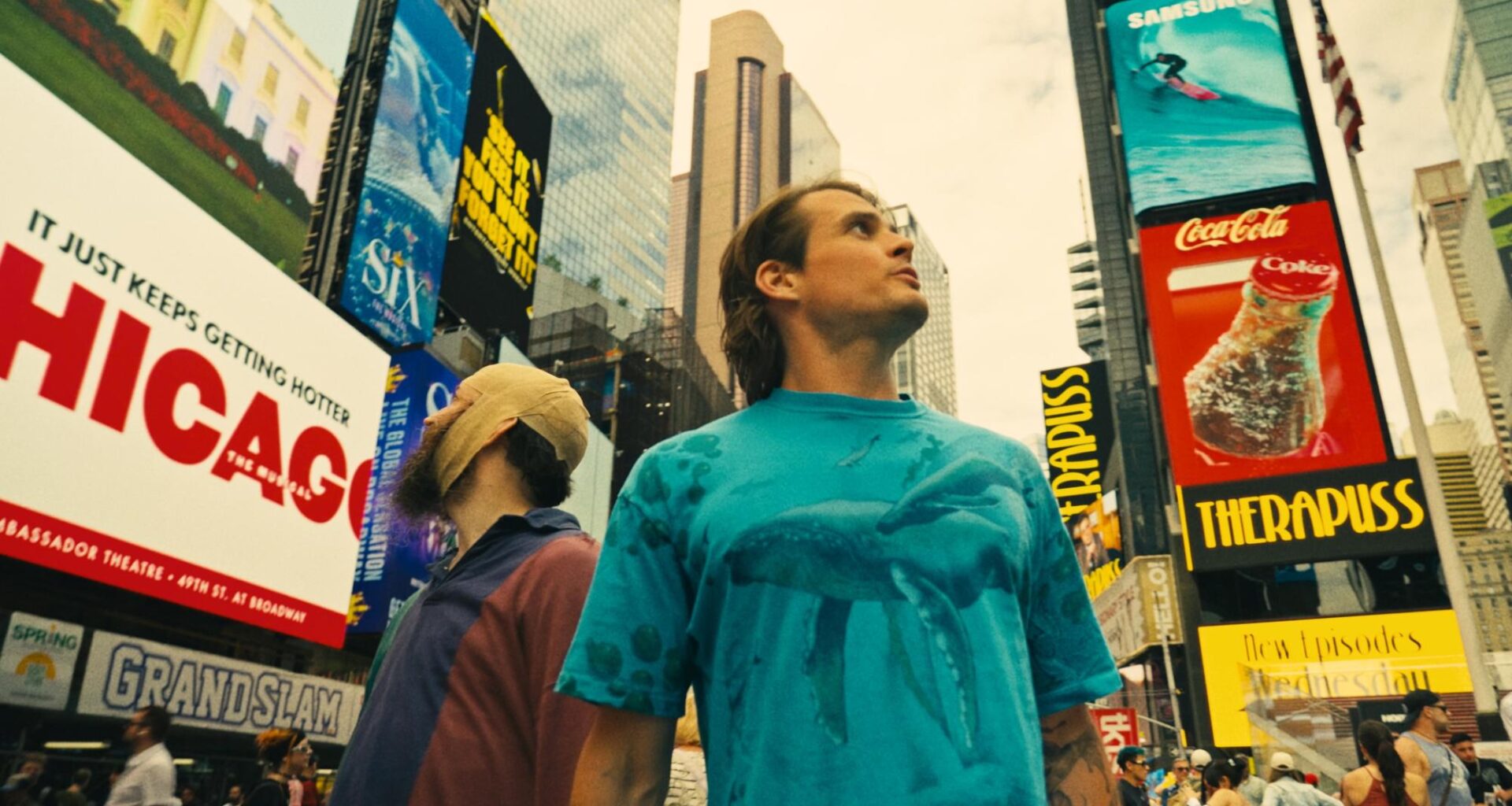
He recalled a scene shot in Times Square, standing in the middle of roughly a hundred people. He had his audio equipment in his backpack and no way to control all of the background noise. Later, he had to carefully edit everything together to make it sound like one continuous conversation.
Thanks to NU student film sets, where Kapp was thrown into the independent filmmaking process and quickly learned how to manage with what is given, he was able to do it.
“Northwestern will get you into scenarios where you can learn. It will get you onto sets where you will meet people who know way more than you do and know way more than your professors do,” he said.
Similar to Kapp, Brown said she was lucky to volunteer herself for every possible opportunity while at NU. She said she messed up a lot along the way, but the University gave her a safe environment to fail in.
While working on music for “The Rabbit Hole,” Mahanpour also pulled from his experiences and skills gained at NU.
Although he wasn’t an RTVF major like his counterparts on “The Rabbit Hole,” Mahanpour said he also worked on many films during his time at NU.
“All the film stuff I do know, I wouldn’t have been able to do without the Northwestern film and sound community,” he said.
The driving force behind the final product
Lessons and experiences from NU may have served “The Rabbit Hole” well, but Jonas was ultimately “the driving force in every way,” according to Schoenbrodt.
As producer, Schoenbrodt said he mostly filled in gaps and picked up slack where Jonas needed it. The two had a very collaborative relationship throughout the process, with regular meetings where Schoenbrodt said Jonas would bring a set of problems for the two to solve together.
For Brown, she said she chose to work on this project because she knew it would be high quality. She was motivated because she believes in Jonas’ artistic brand, she said.
Once shooting wrapped, Jonas was left with hours upon hours of editing.
“Making a film this way gets very lonely,” Jonas said. “You become your own feedback loop. You get lost in the sauce, real hard, especially when you edit it.”
He described editing as “eating my own throw up” and called it a “gruesome, vicious” process. However, he did seek out feedback from Schoenbrodt throughout the process.
Once he was finally finished with the film, however, he said it felt good. In fact, he said his favorite part of filmmaking is moving on.
“I like to be done,” Jonas said. “Done, in this world, in this industry, is a superpower.”
On the big screen
Once complete, “The Rabbit Hole” premiered with a screening in New York City at Anthology Film Archives.
The audience was made up of friends, family and even a few stragglers, Schoenbrodt said. It was his first time seeing the film as a finished product.
“Seeing this thing that feels so handmade and personal and that we were in the room for, and then seeing it take that huge position is a really cool feeling, where any of those doubts are just obliterated and it completely stops mattering because you made a movie,” Schoenbrodt said.
“The Rabbit Hole” was also featured at the Brooklyn Film Festival in June 2025.
Jonas said the festival experience was different than he expected and certainly a little overwhelming. He was one of the youngest filmmakers there, and he had never been to a film festival before.
Now, “The Rabbit Hole” is available to view on YouTube.
Jonas said he’s proud he was able to pull off his vision and create a film that was “about as independent as it gets.”
“I’m proud of the amount of work I put in,” he said. “I’m proud that I said I was gonna do something, and I put my mind to it and I went out and I did it.”
Others involved with the project also commended Jonas for his work. Brown said she’s impressed with Jonas’ dedication and commitment to his craft.
“It’s only a matter of time before people start catching up and really falling in love with what he’s doing,” Schoenbrodt said.