
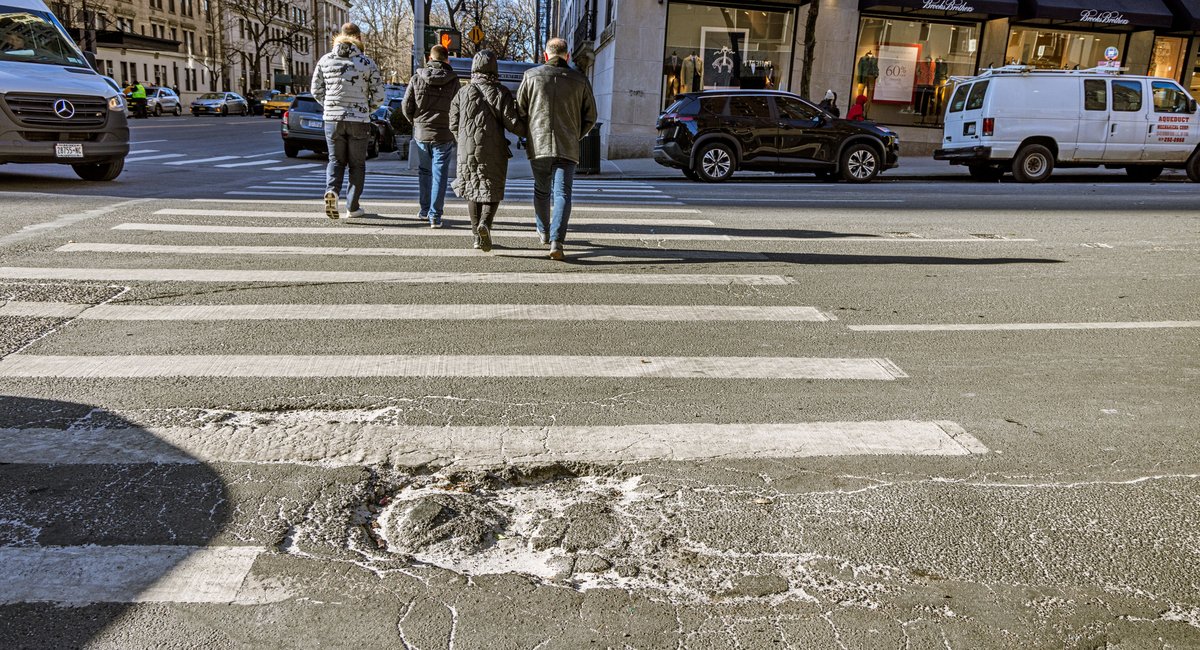
It’s pothole season.
And if it seems particularly brutal this time around, you can blame this winter’s record snowfall and below-freezing temperatures.
City streets are accustomed to taking a beating from the constant flow of hot rubber and tire chains on asphalt. The near-constant freeze-thaw cycles and water infiltration in the colder months exacerbate any imperfections. This wear and tear means that more drivers will spend more time avoiding these depressions in the roadways — also known as potholes — after the winter season.
On average, it takes the city, which is one of the few in the country that operates its own asphalt plant, about two days to fill a pothole after it’s reported to 311. The city transportation department said it fills an average of more than 170,000 potholes annually and paves more than 1,150 lane miles.
“After this historic winter, we’re ramping up repairs citywide to make sure every borough’s streets are safe and smooth,” DOT spokesperson Mona Bruno said.
And the department’s work may be cut out for it.
Nearly 13,000 pothole complaints have been received so far this year as of Tuesday, a 36% increase from the same time period last year, according to ananalysis of 311 data. More than 6,000 of those were made in Queens, followed by Brooklyn, Staten Island, Manhattan and the Bronx.
Urban policy experts said drivers should be especially careful as the city thaws out this spring.
“The damage to the streets and roads and highways from a bad winter often don’t become fully apparent until the snow starts to melt and spring starts to arrive — that’s when we’ll see the worst of the damage,” said Owen Gutfreund, a professor of urban policy and planning at Hunter College.
Gutfreund – who heads the college’s urban studies program — said the damage could even be worse because there’s still a chance of below-freezing temperatures, and perhaps even additional snowfall, in the coming months.
“The material that gets used for properly filling potholes and repairing damaged surfaces requires warmer weather. It can’t be done in subfreezing temperature, or in near-freezing temperature,” he said. “So the patches, if any, that get done now are really not very effective. So there will be this point when we can see how bad the streets are, but it’s gonna get worse before it gets better.”
‘We build infrastructure without an eye for the maintenance’
Improvements to infrastructure are particularly pressing as the city faces an ongoing affordability crisis, with more people relying on public transit — or biking and walking — to get around.
“The cracks in the asphalt can also occur in our sidewalks, and that can also create cracked, uneven and even broken sidewalks that just naturally create tripping hazards that are similar to potholes,” said Michelle Deme, the digital communications coordinator at Transportation Alternatives, a nonprofit advocating for pedestrians.
The nonprofit released a comprehensive agenda of public policy priorities for the Mamdani administration, including greater street improvements.
Gutfreund said he thinks DOT does “a great job” dealing with the city’s potholes — but added that the agency is overmatched.
“We don’t have a political will to spend as much money on maintenance as we do on building shiny new things,” he said. “And so we build infrastructure without an eye for the maintenance process and the maintenance costs, and then we underfund maintenance.”
Gutfreund proposes a constant inspection and repair process on all of the city’s streets and roadways – rather than merely deploying a crew to fix a pothole when it’s reported. But doing so, he said, is incredibly labor-intensive and expensive.
The state invested $3.6 billion into improving its transit infrastructure last year, according to Gov. Kathy Hochul’s office, which also announced that the state filled 1.3 million potholes that year.