
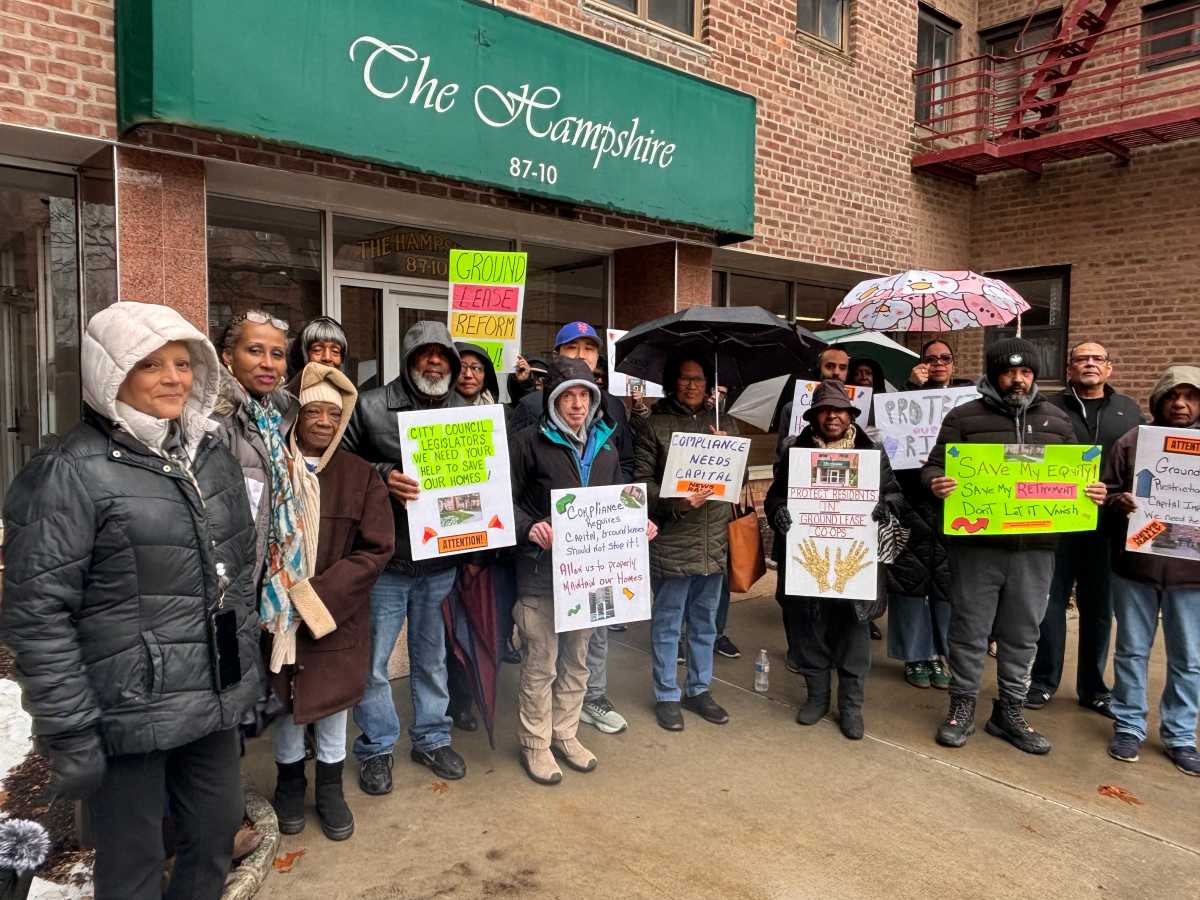
Dozens of Queens residents rallied in support of standard housing protections for more than 25,000 New Yorkers living in ground lease co-ops, gathering outside Hilltop Village Co-op in Hollis on March 3 to urge the New York State Legislature to pass the Ground Lease Co-op Bill.
Courtesy Ground Lease Co-op Coalition
Dozens of Queens residents rallied outside Hilltop Village Co-op in Hollis on March 3, urging the state Legislature to pass standard housing protections for more than 25,000 New Yorkers living in ground lease co-ops.
With decades-old ground leases beginning to expire, a news release from the Ground Lease Co-op Coalition said, residents in all co-op buildings are at risk of losing their homes and equity to rising maintenance costs.
The Ground Lease Co-op Bill (S2433A/A2619), sponsored by state Sen. Liz Krueger and Assemblymember Linda Rosenthal, is intended to stabilize conditions for existing co-op owners and new buyers seeking loans.
The bill would grant basic tenant protections, such as the right to borrow for required repairs and capital improvements, the right of first refusal, and tenant protections upon deconversion including rental leases for existing residents.
“Many of the residents of Hilltop Village Co-op, Murray Hill Co-op and dozens of others across the city never could have imagined when they moved into their homes decades ago that they would eventually be forced out because of an egregious rent reset,” said Rosenthal, chair of the Assembly Committee on Housing. “We cannot allow the greed of property owners to bring foreclosures and homelessness to thousands of New Yorkers.”
The GLCC — a non-partisan coalition of co-op owners representing more than 25,000 New Yorkers — said because ground lease co-op residents own their homes but rent the land beneath it from landowners, they are uniquely vulnerable to dramatic rent hikes because landowners hold unilateral power over lease renewals.
This power imbalance poses issues for co-op residents when seeking loans from banks for necessary repairs and upgrades, the coalition noted, while potential new buyers struggle to obtain mortgages due to widespread concerns about co-ops dissolving upon lease expiration.
Under these conditions, the GLCC said aging co-ops have few options beyond deferring critical maintenance fixes, which prevents them from complying with citywide local laws and other legally-mandated building codes, on top of triggering severe fines.
According to the GLCC, New York houses nearly 12,000 ground lease co-op apartments across the state, with more than a third of these units located in Queens. The majority of these co-ops are concentrated in middle-class neighborhoods across the outer boroughs, where most residents earn just above the citywide median of $76,000.
Pamella Harris, vice president of the Hilltop Village Cooperative Board of Directors and member of the GLCC, said since 1954, Hilltop Village has given thousands of middle-class New Yorkers the chance to own a home in the tight-knit community.
Decades later, however, Harris said nearly 2,000 co-op residents are at risk of losing their homes as they approach our rent reset.
“Thanks to a lack of housing protections, our families are facing an impossible choice: drain our life savings to cover skyrocketing rent and repair costs or face displacement and heavy fines under the city’s local laws,” Harris said. “Without this bill, Hilltop and our fellow Queens co-ops simply won’t survive. We are urging our state legislature to step in and save New York’s ground lease co-ops before it’s too late.”
Murray Hill Co-op has been home to Derek Chen, a member of the Murray Hill co-op board and the GLCC, along with generations of Queens residents. He explained that it’s a modern-day village where people build their lives and plan for retirement.
Today, he said ground lease resets are threatening that stability with “astronomical” increases to land lease rates.
Chen, who serves on two co-op boards representing over 350 residents, said they are proud, responsible people who paid off mortgages and saved for retirement — but now, they face the risk of losing their homes.
“Queens co-op communities are especially vulnerable having a large number of residents at or near retirement age who are living on fixed income,” he said. “We are not asking for special treatment — we are asking for fair rules and stability so no one has to fear losing their home late in life.”
The news release said if passed, the Ground Lease Co-op Bill would secure reasonable first rents for ground lease co-op residents in the event of deconversion, aligning tenant protections with current rent stabilization laws.
It said the bill would also prevent landowners from unilaterally blocking co-ops’ ability to borrow for necessary loans and repairs without providing sufficient justification.
By solidifying tenant protections upon deconversion and easing lease restrictions on borrowing, the GLCC said the bill would protect residents from unreasonable rent hikes, incentivize lending from banks and stave off displacement.
State Sen. Toby Ann Stavisky emphasized when residents buy into co-ops, they are investing their savings, stability and future in those communities. She said families in ground lease co-ops have played by the rules, built equity and maintained their buildings.
“They should not now face uncertainty because the landowner should not be able to unilaterally reset the terms of the renewal,” Stavisky said.
But, Stavisky continued, the Ground Lease Co-Op Bill would restore balance, ensuring the right to renew, the right of first refusal, and meaningful protections if a building is deconverted.
“That stability matters for homeowners, for lenders, and for the long-term health of our neighborhoods,” she said. “Co-op shareholders and landowners both deserve fairness.”