
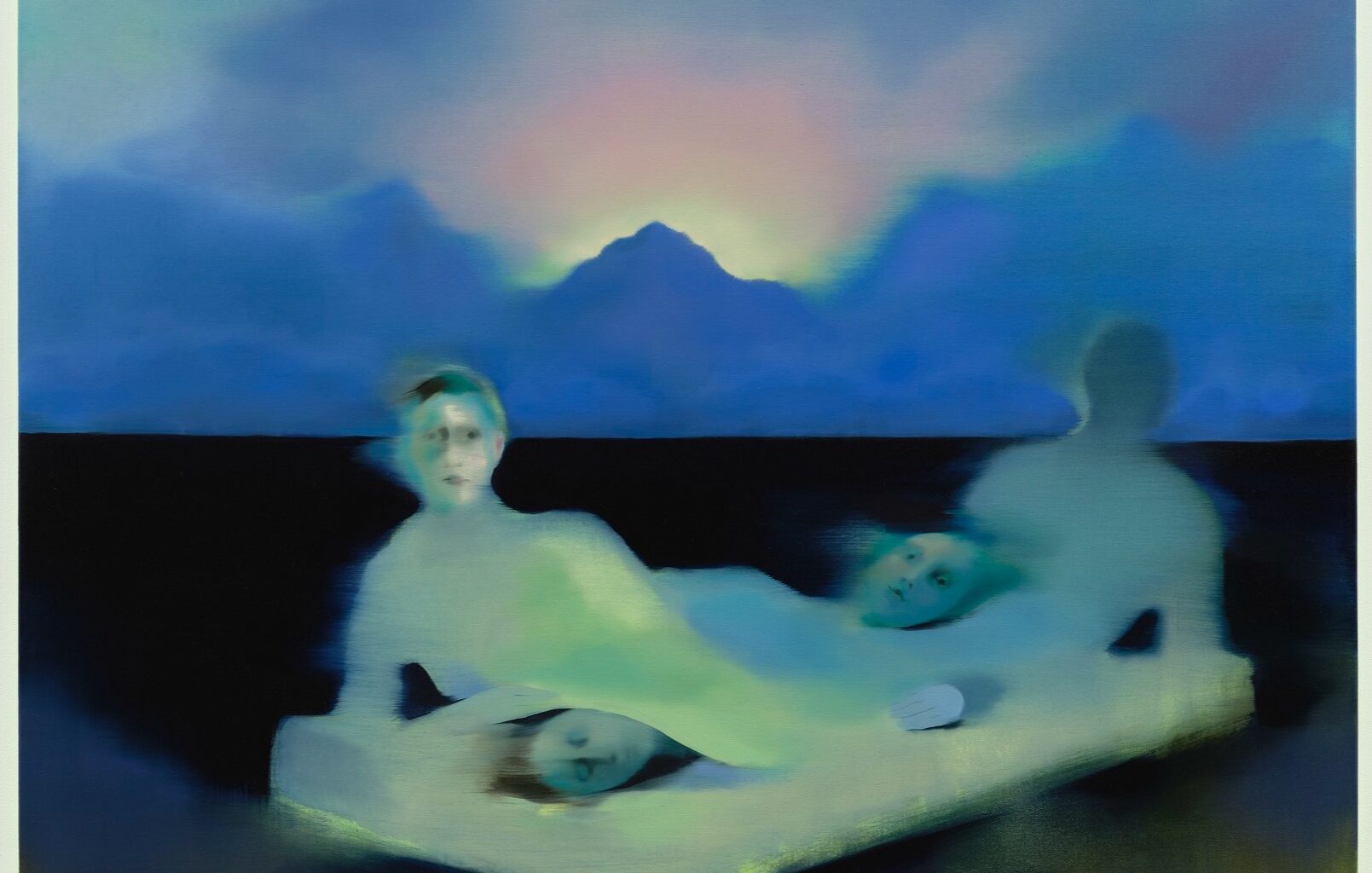
Cathleen Clarke: Episodes
Margot Samel
February 20–March 28, 2026
New York
The most disorienting darkness I’ve ever experienced occurred among Illinois farmland. Before dawn on a January morning, I was driving from my rural hometown to O’Hare International Airport for a flight back to New York. As I made my way through miles of frozen cornfields toward the interstate, my eyes struggled to adjust, no streetlamps, storefronts, or house lights to guide me.
Having grown up in Harvard, Illinois, forty miles north of my small town, artist Cathleen Clarke is no stranger to Midwestern murk. While many of her earlier works explicitly conjure memories of her rural Illinois girlhood, the paintings in her latest show Episodes at Margot Samel are peculiarly untethered to both time and place. With no farmhouses or prairie grasses in sight, these new canvases move beyond the iconography of a Midwestern childhood to instead give us its feel, one that leaves a haunting residue long after we’ve left for metropoles like Chicago or New York.
Bookending the exhibition are two small paintings featuring four female heads suspended in the liminal state between wakefulness and sleep. Gently grazed by translucent windblown curtains, or disappearing into the shadows of a gloomy forest, they are contiguous with the environment that holds them. Elsewhere, juxtaposition creates a sense of surrealism. In Ebb Tide (2025), four siblings are jumbled on a mattress adrift in a field, like a life raft lost at sea. Glimmers of light from rising suns and meteor showers peek through all of these paintings, reminding me of the stars and fireflies that dotted the smogless night skies of my childhood—or the flashlights my twin sister and I would nest under our chins while camping, mimicking moments we had seen in late-nineties media, like Nickelodeon’s Are You Afraid of the Dark?
Nearly thirty years later, my sister and I still circulate images of art that intrigue us. When I texted her snapshots from Episodes, she replied with a comparison worthy of a Letterboxd review: “Fruma-Sarah meets Loie Fuller.” Lacking context for the work, her response was more prescient than she knew. Clarke’s paintings evoke both the theatricalized dream states of plays like Fiddler on the Roof and the abstract “poetry of motion” associated with Fuller’s choreography. Given that Clarke has borrowed from vintage photographs of ballet dancers elsewhere in her work, I imagine that the Fuller connection might be deliberate. At the very least, it’s serendipitous: Fuller was also from our little corner of Illinois.
The Dance I and II (all works 2025) clarify the exhibition’s choreographic associations. Here, a barefoot woman manipulates a glowing fabric in what appears to be a black-box theater. As in a Fuller performance, the fabric flows over and around her, rendering her own body marginal to the scene. Yet the exhibition text, which takes the form of a series of fictional vignettes written by Alja Zoë Freier, reveals that this movement has context, that it is more than mere theater. In the first vignette, we learn that the woman is not dancing with fabric onstage, but hanging it up on a clothesline outdoors. High winds herald an oncoming storm, maybe a tornado. Recalling the opening scene in The Wizard of Oz, the disorientation of the weather transports the woman to a time in her childhood where she watched her mother dry clothes on that same line.