
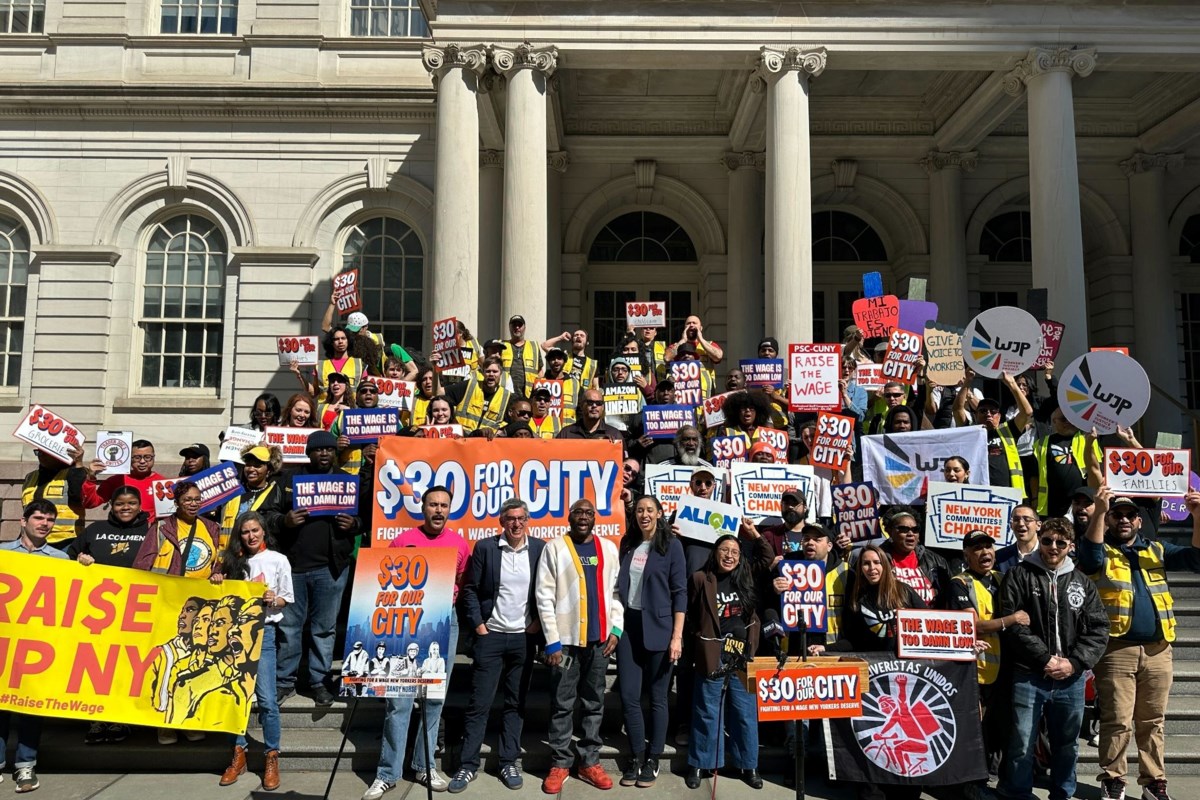
Workers’ rights advocates celebrated the introduction of the $30 for Our City Act, a new legislation from Brooklyn Council Member Sandy Nurse that looks to raise the minimum wage to $30 by 2030.
Workers’ rights advocates on Tuesday urged city officials to consider a new bill that would raise the minimum wage in New York City to $30 per hour.
Union leaders, workers, community groups, and businesses from the Raise Up NY coalition celebrated the introduction of the $30 for Our City Act, a new legislation from Brooklyn Council Member Sandy Nurse that looks to raise the wage floor for most New York City workers to $30 by 2030.
The proposed legislation establishes a phased minimum wage increase initially tied to employer size. Employers with more than 500 employees (including associated franchisees) would be required to pay workers $20 an hour in 2027, $23 in 2028, $26 in 2029, and $30 starting in 2030. Employers with 500 or fewer employees would have a more gradual phase-in: $19 in 2027, $21.50 in 2028, $24 in 2029, $27 in 2030, and $29 in 2031. Starting in 2032, the minimum wage for all employers, regardless of size, would be $30, plus a cost-of-living adjustment. After that, the minimum wage would continue to increase annually to keep pace with the cost of living.
“New York City’s minimum wage is a poverty wage, which at $17 an hour, leaves over 1 million workers barely surviving on $500 a week,” said Nurse. “NYC workers keep this city running. They deserve to thrive here, support their families, and enjoy the city they’ve built.”
Advocates said the city remains unaffordable for those making minium wage. One in every four New Yorkers is living in poverty, and 50% of working New Yorkers are struggling to cover their basic needs, advocates said. Recent polling shows that one in three New Yorkers plans to leave the state in the next five years, citing the high cost of living as the primary reason.
“Workers are tired of settling for crumbs and being forced to live paycheck-to-paycheck, work multiple jobs, or leave our city while wealthy corporations make record profits,” said ALIGN Executive Director Theodore A. Moore. “Every New Yorker deserves to thrive, and every worker deserves a fair wage. We need a $30 minimum wage that matches the high cost of rent, groceries, and life in NYC, so that our city can be a sustainable home for working families.”
Raising the minimum wage must be a part of any serious conversation about combating the affordability crisis, said Brooklyn Borough President Antonio Reynoso.
“Costs are skyrocketing, and the current minimum wage is simply not enough for New Yorkers to make ends meet,” he said.
The business community generally agrees that affordability is the biggest challenge facing New Yorkers, but the affordability agenda must extend to the small businesses in every neighborhood that help drive the economy, according to Five Borough Job Campaign Co-Chairs Tom Grech and Randy Peers
NYC already has one of the highest minimum wages in the country and will automatically be indexed to inflation starting in 2027, Grech and Peers argued.
“Small businesses are already feeling the burden of increased costs for everything from insurance to rent and utility rates,” they said in a statement. “Last year’s data shows that more small businesses closed than opened for the first time since COVID, and we fear this proposal will accelerate that trend. Let’s stick with the game plan of reducing costs for all New Yorkers, not continue to overburden our small business community by raising labor costs beyond their capacity to absorb such costs.”