
Every year, New York City Public Schools (NYCPS) would spend a week focused on lessons and activities around voting—educating students on its importance and registering those eligible to participate in the democratic process. But in 2019, the largest public school system in the country created the Civics for All initiative, vastly expanding their civics education. NYCPS offers various civics programs throughout the year and spends a Civics Week each March celebrating youth voices, civic empowerment, and the importance of registering to vote.
Civics for All is a multifaceted and scalable initiative that works in big and small schools and districts throughout New York City. And while NYCPS may be the largest public school system in the nation, Civics for All offers many free resources and a template for schools of any size around the country to teach a comprehensive K–12 civics program.
“Social studies education, generally, and civics education in particular, prepare students for life beyond school in so many important ways,” says Marc Lapointe, senior instructional and curriculum specialist with the NYC Schools Department of Social Studies and Civics and Civics for All. “It is important that the preparation that students can receive in civics education is real life learning.”
Through these school opportunities, students learn how to be empowered members of society, that they can use their voice to create change, and that ideas can turn into policies, he says. In addition, he adds, they discover that it is impossible to ignore the current political situation in the United States and the necessity of developing deep knowledge of American history.
“Civics education is necessary for the ongoing renewal of democracy and participatory governments,” says Lapointe.
Often school librarians are at the center of that learning.
While it depends on the school or district, NYC Schools director of library services Melissa Jacobs says, “In many cases, the librarians have been selected to be instrumental or point person at their school for Civics for All. It’s great, because there is a natural connection between the work around civics and the work in school libraries. That extends far beyond just getting the resources into the kids’ hands.”
Librarian Cheryl Rizzo, the civics teacher leader at PS/MS 232Q in Howard Beach, NY, has seen the impact of the program on her middle school students.
“Our civics work is what makes learning truly ‘real’ as we read, research, and inquire in order to take meaningful action,” Rizzo says. “The students are deeply invested in improving their communities and develop a strong sense of ownership. Through our connections with outside organizations, they have had the opportunity to get their op-eds published, deliver speeches on the radio, and create artwork to raise money for peace organizations.”
Some students have told Rizzo that Civics for All is the reason they come to school, she says. A key part of that motivation is that it’s learning with a clear purpose and often a real outcome.
“So many times students come to school and they have assignments that seem like the only purpose of the assignment is for the sake of doing the assignment,” she says. “The whole point of civics is that you take those skills and you’re putting them to use. You can take action. So, it becomes real.”
Initiative programs
The Civics for All initiative includes:
Student voter registration drive. This effort is concentrated each year in Civics Week in March. In New York City, 16- and 17-year-olds can pre-register and by the end of this Civics Week, Civics for All expects to have registered more than 100,000 students since Civics for All began.
Civics for All poster contest. K–12 students are invited each year during Civics Week to showcase their civic engagement and artistic talent by participating in the annual NYC Department of Education (NYCDOE) Civics for All Poster Contest. The annual poster contest asks kids to create a poster connected to the year’s Civics Week theme that amplifies why voting and civic participation are important. This year for Civics Week March 9-13, the theme was “America 250: Voices Then, Voices Now.”
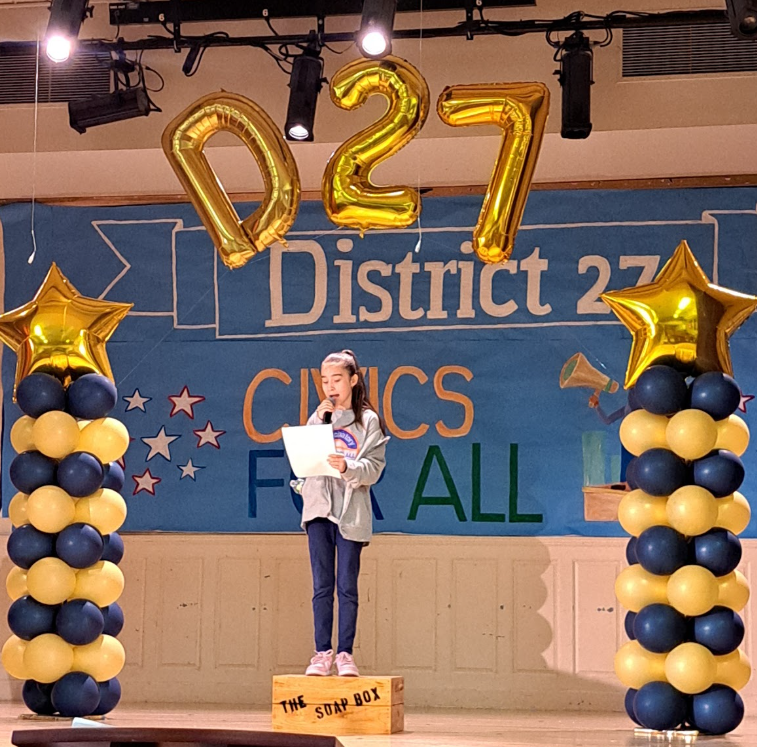
SoapboxNYC. This public speaking competition asks students to speak out about issues that affect them and their communities. They create and advocate for solutions to improve their schools, communities, and the lives of peers. Jacobs has listened to the speeches and heard students advocating for school libraries in the past.
“There were speeches that have to do with school library programs like, Why aren’t there school libraries in every school? Why doesn’t everybody have equitable access to these things?” she says. “The projects and activities around civics can all be connected directly to the work in libraries. But then the topic itself is a civic topic of developing strong school library programs and having equitable access in every single building.”
In another Soapbox speech, a librarian helped a student develop a speech about a little free library the student was building outside of school.
Participatory Budgeting (PB). This Civics for All initiative is a student-driven, democratic budgeting process where school community members decide how to spend part of a budget on something to improve the school community. Schools get approximately $2,500, depending on the number of schools participating.
“It’s been an enormous success,” says Lapointe. “Students and teachers alike both regularly talk about how important PB is in engaging [students]. Teachers often say it sparks something in students who usually are not very interested in topics related to social studies or anything that’s kind of dry and bland. There’s something about the direct participatory elements of it, and the money.”
 Students develop and propose projects that would help the school community. The student body votes on where to allocate the funds.
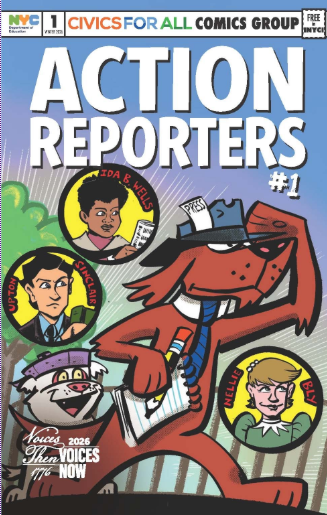
Civics for All Comics Group. The NYCDOE collaborates with comics creators to create nonfiction graphic texts. They have created more than 40 comic books on notable people in history, activism, voting, journalists and more, often focusing on the marginalized or previously untold stories. The comics are free for anyone to access. The website shows a targeted age for the individual comic and offers a free complementary resource guide.
The New York State Seal of Civic Readiness. In New York City, this seal can act as one of the requirements for graduation in place of an exam. Civics for All added this initiative in 2021.
Students participate in rigorous research on an issue related to their school or community and develop a policy proposal. It stresses experiential learning and shows students how to use their voice to create positive change. Started in 2021, NYC Schools has graduated more than 8,000 students with the seal so far.
Librarians assist students trying for the Seal, build lessons around databases connected directly to civics work, help students with Soapbox speeches, and are the point person helping drive the inquiry around participatory budgeting, Jacobs says.
A civic celebration
Rizzo’s school started small, implementing certain elements of the initiative, but have expanded into the entire Civics for All programming in the last three years.
With participatory budgeting money, students purchased games and equipment to make indoor recess more engaging. The principal was so impressed with the proposal, she matched the city funding, Rizzo says. Students have added an air hockey table, corn hole, pop-a-shot basketball, as well as dry erase boards for things like tic-tac-toe or drawing games.
Thanks to a survey, they learned they should add crafting supplies, as well. The students have excitedly added new items as they have arrived. Staff is reporting fewer behavior issues during lunch and recess and the entire atmosphere of the cafeteria has changed as kids are being productive and in community with each other, Rizzo says.
One student, who has struggled with attendance issues, shows up for student council events and activities and presented a Soapbox speech on extending recess. He did research and backed up his suggestions for change.
“He was proposing different things in the auditorium and then the cafeteria that would allow students to get that brain break and to also have that social connection with others,” Rizzo says.
The speech is now in the running to be read on the radio.
“It’s one of our true success stories,” says Rizzo.
For the first time, PS/MS 232 held a Civics Week gala this year. The PTA decorated the cafeteria, adding a red carpet and student council logo for taking pictures, then displaying student work in the space. Parents attended, along with local government representatives, and other faculty and staff from the city.
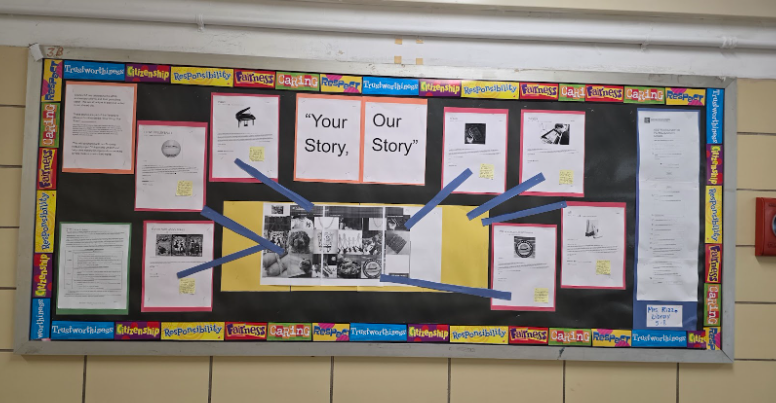
Rizzo says she is most proud of the Gallery of Voices. The NYCDOE civics department has a Hidden Voices curriculum that highlights people throughout history who have been marginalized. Using posters of those people as a guide, students created posters of themselves. They are the Voices of Now.
“The whole process of them seeing themselves as valued, that their voices really matter, that we’re listening to them, it just kind of changes their mindset and their approach, builds their confidence and allows them to feel like they can speak up more,” says Rizzo.
Start small
Just as Rizzo’s school grew its civics programming, the Civics for All initiative itself started small, supporting individual schools and has now grown to work with 32 of the 45 districts within New York City’s singular public school system, according to Lapointe. He says the central office encourages schools and districts taking on the Civics for All curriculum to “to start somewhere and to build from that.”
“There are so many different ways to connect students to civic learning experiences,” he says. “It’s a pretty simple instructional task—students are thinking about something that matters to them in their community, doing research on it, and then standing on a soapbox, literally, in many cases, to give a speech and to issue a call to action.
“That’s a very small moment that happens in a classroom or in a school auditorium, but the idea of a soapbox is kind of reflective of the idea of what we want civics’ role to be, which is to take that initial spark and scale from there.”
A speech in front of an audience of decision makers can materialize into something, Lapointe says
Civics for All creates an inclusive experience as it allows for customization and scalability within schools and districts.
“Civics for All takes on the character of the individual district where it’s taking place, for the individual school,” says Lapointe, who works directly with a district in East Harlem and uses the history of activism and social movements in the area such as the Young Lords, which was a Puerto Rican activists’ group in the 1960s and ’70s. “We have a comic book that features the story of the Young Lords. We’ve worked in collaboration with several of the men and women who were in the organization.”
The idea, says Lapointe, is that the district should “start from the basis of their shared history of this in developing what they think civics means at their school.”
Civics for All “looks different in brilliant ways every place that you go,” says Lapointe. “You can really note the individual flavor of a school, the culture that a student is bringing to it specifically. Civics for All is not an empty vessel, but it takes on the characteristics of the people who are engaged in doing it.”