
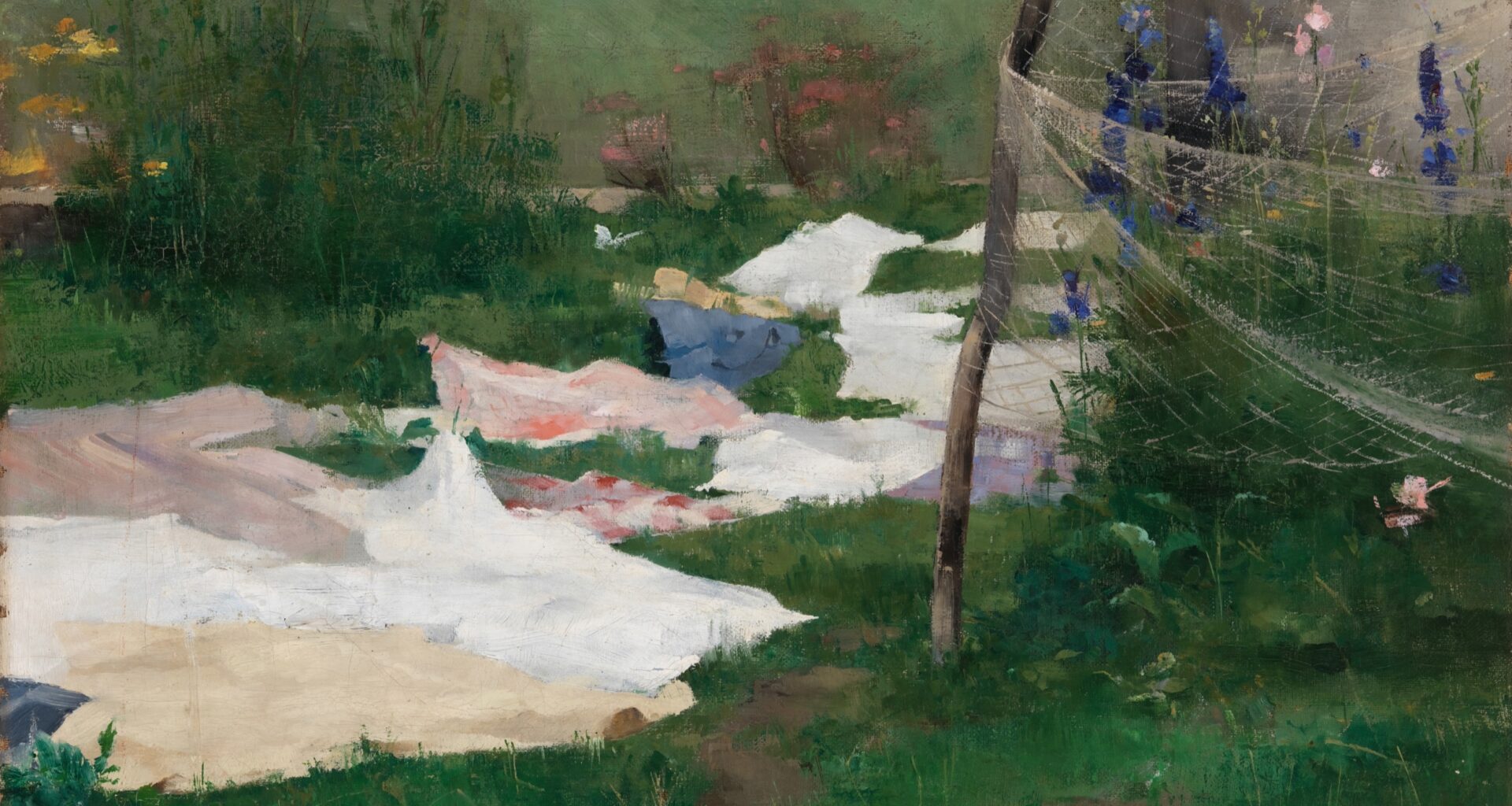
At the turn of the century, we see a shift in Schjerfbeck’s work towards a simplified, minimal, and abstract interpretation of the human form. The ideas permeating in Paris were central to artists in Helsinki. As she turned forty, Schjerfbeck abandoned her teaching position (her main source of income) at the Finnish Art Society’s Drawing School for health reasons and moved to Hyvinkää—a train ride away from the capital—lived with her mother, served as her caretaker, and painted. Her previous flickering brushstrokes changed to flattened-out blocks of color and form and scratches-away at the surface with a palette knife, taking away excess. The act of removing, for the essentials to suffice, is both a modernist principle and at the core of Finnish character. The silences of her compositions, the emptiness of the rooms, the simplicity of the clothes worn, the introspective poses, all contribute to the sense that silence is golden, silence is peace, silence is thought, silence is assertion of the self—affirmed during a turbulent time when Finland was resisting an intensified political attempt to Russify its people. Schjerfbeck didn’t overtly contribute to the large-scale heroic, narrative, historical, mythological, romantic, and symbolist paintings meant to build a visible national character different from its bordering neighbors as her peers did. Instead, her works arrive at Finnish identity in the subtle mood of her paintings and her own independent journey as an artist.
It is in this transition of painting alone, away from the city center and from travels abroad, fed by curiosity for modernism, that Schjerfbeck turned her eye to portraiture. Portraits of others, and of herself, became the main subject of her work. Maria (1909), as it is inscribed, is painted in thick layers of blue tones, melted like butter, forming the body of the subject as a mound of color, her face turned away with only neck and hands with fingers delineating a human presence. The inner glow of light is celestial or emanating from one’s intellect moved by reading. Blues are poignant and may allude to the magnificent blue light shimmering against snow, as in the Finnish winter, or perhaps the artist might be remembering her Italian travels and the blue of the Madonna. Fragment (1904) the artwork we could associate most closely with an Italian sense of humanism, holiness, and ruin. The subject’s hair is red-orange, the light purple and peach, scraped down and flattened like fresco. God-like, humble, holy, sensual—in another world.
The erosion by palette knife, which subtracts from top layers of paint, could provide a sense of freedom for Schjerfbeck. No longer tied to covering the whole of the surface, she scraped down, revealing lightness underneath, worn walls, and the ground of the substrate to balance the bare essentials. The 1920 portrait of Schjerfbeck’s landlady, the painting the Met has acquired, contains these minimal lines, suggestions of pattern, and a face with few strokes. It is probing: who is the modern woman? Did this lady, worthy of a portrait of her own, a landlady, represent such a new type of woman in a new Finland, one that had recently become independent?
The selection of still lifes in the exhibition show us the caking paint and palette knife at work, the pears and apples distinguished only by their vague shapes, alternating between thick and thin. How is it that in a faraway land like Finland, Schjerfbeck and her peers adopted modernism so whole-heartedly, without nostalgia? Perhaps the Finns’ readiness to explore modernist ideas was a way to also align their new art with the cultural center at the time—Paris—and to feel truly free to be themselves after fighting for a hard-won independence. It was a freedom to belong to a democratic future, rather than the monarchic past, and to build themselves up on their own terms.
Schjerfbeck’s bold and vulnerable self-portraits stand out and touch you deeply. It is these self-portraits and the haunting qualities they carry, this continuous probing of the self and the directness of her frontal contact, that make her stand out as an artist, perhaps more than her earlier, accomplished historical paintings, still lifes, and portraits of family and close friends. Aside from Rembrandt, Vincent van Gogh, Gauguin, Egon Schiele, and Pablo Picasso, few other artists made more than thirty self-portraits throughout their lifetimes that indicate a passage of time and the changing and morphing body and mind. The last room has a series of self-portraits where progressive changes are visible from early realist, Impressionist strokes to the modernist simplified lines and forms of a dignified woman, to a face sinking into the canvas, abstract and expressionist. Schjerfbeck’s later monotone self-portraits as an octogenarian, from 1944–45, are reduced to a skull and are telling self-revelations of aging amplified by the surrounding turmoil of World War II. The outline of a head, the deepening of the eye sockets, the gaping open mouth in a silent but violent howl: not too far from the angst in Edvard Munch’s The Scream (1895). Schjerfbeck left Finland to seek refuge in Sweden during one of Finland’s deciding wars, the Continuation War (1941–44), the outcome of which determined the future of its people and democratic independence. The anxiety of being away from one’s homeland, of aging, of loneliness, the unimaginable horrors of war, the uncertainty of time: these can all be felt in such unsettling self-portraits.
Schjerfbeck neither spoke nor understood Finnish well, but her determination to paint for her whole life despite the challenges and loneliness, to gain respect, and to pave her own path on the sidelines of nationalist movements, embodies what many Finns would refer to as the untranslatable Finnish word—sisu—an energy that pushes against all odds through impossible challenges with a will as strong as the enduring power of nature.