
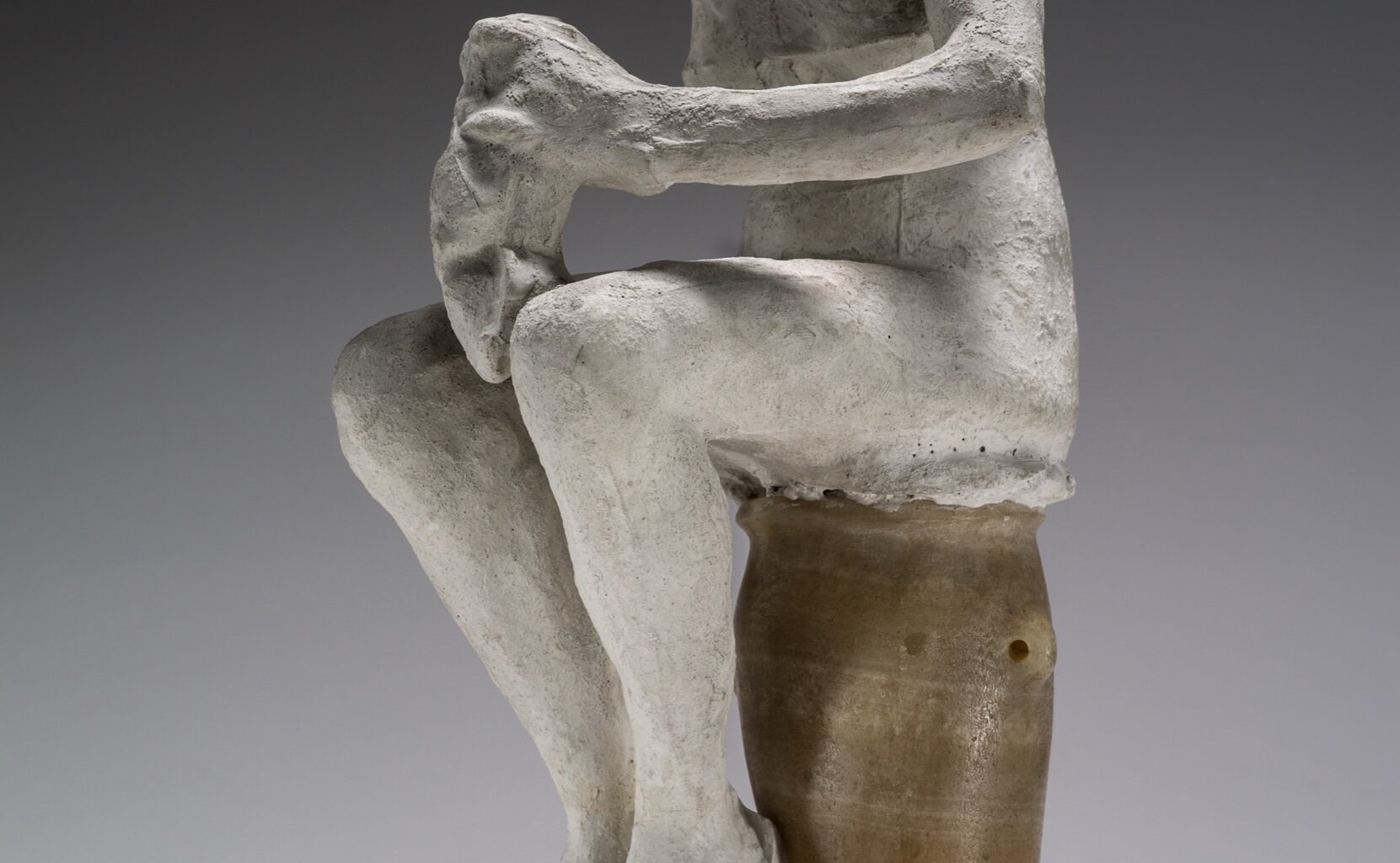
Rodin’s Egypt
Institute for the Study of the Ancient World
November 19, 2025–March 15, 2026
New York
Rodin’s Egypt introduces Auguste Rodin the collector. It may surprise you that he had accumulated thousands of Egyptian, Greek, Roman, Indian, Asian, and pre-Columbian artifacts, but then a hundred years of Rodin exhibition and scholarship had quite ignored all that. Meanwhile, we have learned to think of collectors as all but artists themselves. Rodin, who may seem to renew his contemporaneity every year, has caught up again handily.
Looking at some of his Egyptian antiquities (400-plus, in total) with a selection of his own works may tell us as much about Rodin as the business of the antiquities trade, as well as the Egypt of the nineteenth-century French imagination—which is half the exhibition’s intended story. One might wish it were a bit less. The historiography could be told without Rodin, whereas the exhibition is most interesting for getting personal. Scanning the antiquities as if inspecting one of his spontaneous terracottas, one can watch him think. To an almost tangible degree, these things he did not make are the guy. He wanted his hands on them, buying with the physical desire of a lover and the ambition of a thinker for whom holding was thinking. Rodin was a collector with sweaty hands.
He came late to collecting, in middle life with the celebrated major commissions—the Gates of Hell (1880–ca. 1890) and The Burghers of Calais (1884–95)—already behind him and his Bust of Victor Hugo (1883) and Monument to Balzac (1898) well underway. He was already Rodin. Before 1890, he may not have given a thought to collecting: he was working at a terrific pace, and he didn’t have any money. How did it start? We may not ever know just how, or with what item his accumulations began, but it is evident that he began without a design—item by item on sight, instinct, and enthusiasm, with the idea becoming evident by doing—just the method of all his work.
We have his correspondence with antiquarians and dealers; some, like Joseph and Imre Brummer, worked both sides of the Atlantic and the emerging market in modern art. By 1893, Rodin’s collecting harbored a private ambition: he had what would become the Musée Rodin on his mind. He had a staggering lot of stuff even for a sculptor, and given the encyclopedic nature of the Gates, it seemed to include all human experience. His collecting would give it the past as well.
Young Rodin should have been raised by the École des Beaux-Arts. Instead, he was rejected. Three times. Among the students, he would have been introduced to classical art as if in person—and he would have become one more official artist. But it was thought better that Rodin should attend the Petite École, a school for tradesmen. There, he saw the ancients over the shoulders of those who, in effect, owned the antique world.
In later life, Rodin published two short essays in his own words, and they are both on the ancients, the Venus de Milo and the Warren head (now at the MFA, Boston). He adored those pieces quite as if they were living women he knew personally, but the stones are a threshold to a manifesto and an indictment. This lover had a use for the ancients: he ascribes to them his own devotion to life observed and accuses the academy of inverting the natural precedence of life over style. He and the ancients have it right. I am one of them, and listen to me—the academy has wronged us both.