
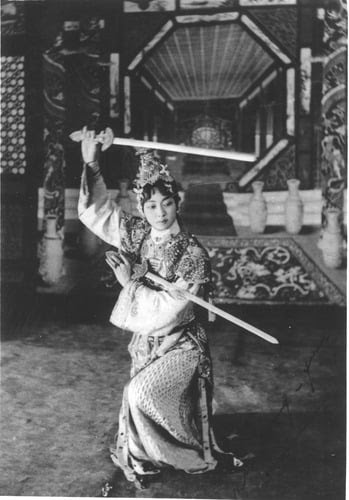
One of the most extraordinary talents to grace the stage will be celebrated in an upcoming exhibition at China Institute Gallery this spring. The groundbreaking artistry of Mei Lanfang (1894-1961), the 20th century’s greatest performer of Peking opera, best known for playing female roles, will be showcased in a new exhibition. The Dancing Goddess: Mei Lanfang will be on view from March 12 through July 19, 2026. A fully illustrated catalogue with guest essays by renowned experts on Peking opera and U.S.-China relations will accompany the exhibition.
Mei Lanfang’s 1930 North American tour, organized by the newly established China Institute of America, launched Peking opera on the world stage and made a significant impact on modern theater. With his completely original fusion of song, dance, and dramatic acting, Mei captivated American audiences and inspired artists from Broadway to Berlin.
“In the long history of illustrious Broadway shows, Mei Lanfang’s American debut was an unexpected smash hit that created unprecedented, wide-ranging diplomatic benefits,” notes Charles A. Riley II, Ph.D., Director, China Institute Gallery. “Mei Lanfang’s 1930 visit was a pivotal moment that enlarged American cultural imagination and ultimately inspired the creation of China Institute Gallery. Mei established a model for international artistic exchange that continues to shape cross-cultural dialogue today. The national spotlight on Mei put China Institute on the map as a private non-profit committed to fostering the world’s understanding of China.”
The Dancing Goddess: Mei Lanfang in America revisits a milestone of cultural exchange and features a spectacular array of Mei’s innovative stage costumes from his own collection, which were designed to allow dance movements that revitalized Peking opera, along with rare photographs, performance videos, original production props, and artwork. Most of the objects in the exhibition are on public view in the U.S. for the first time, on loan from the Chinese National Academy of Arts in Beijing, the world’s foremost archive of Mei Lanfang memorabilia.
Mei impacted theater and dance history on a global scale. He created strong feminine roles that offered a controversial re-imagining of a centuries-old art form. From its origins, Peking opera was dominated by male characters, and women were banned from the stage until 1912. One of the other key revelations is a new appreciation of the unsung contribution that the 1930 tour made to Western dance, theater and film, including the modernism of Bertolt Brecht, Ruth St. Denis, Thornton Wilder, Konstantin Stanislavski, and others.
The success of Mei’s tour laid the foundation for China Institute’s commitment to the arts, which blossomed into a wide range of initiatives including exhibitions, an art collectors’ club and committee, and finally the creation of the China Institute Gallery in 1966. The 2026 exhibition marks the 100th anniversary of China Institute of America and the 60th anniversary of China Institute Gallery. Mei was the first artist from China to be invited to the U.S. under the auspices of China Institute, which made a major contribution to U.S.-China relations with the tour.
Mei Lanfang’s U.S. Tour
In 1930, at the invitation of China Institute and American theatrical presenters, Mei Lanfang embarked on a groundbreaking six-city tour that introduced mainstream U.S. audiences to the dazzling artistry of Peking opera. On a coast-to-coast tour lasting seven months, Mei performed to sold-out houses in New York, Washington, D.C., Chicago, San Francisco, Los Angeles, and Honolulu—a whistlestop journey that drew unprecedented press attention and sparked a nationwide infatuation with Chinese culture.
Critics were enthralled. Audiences marveled at his mastery of dan (female) roles, elaborate costumes, spectacular electric lighting and stage sets, and refined movement vocabulary. The tour was a cultural sensation, with crowds packing theaters and clamoring for additional performances. The Broadway run had to be extended, and the production was moved into a larger theater.
Mei became an instant celebrity among American cultural figures and intellectuals. In Los Angeles, he was feted by Charlie Chaplin, Mary Pickford, and Douglas Fairbanks, whose fascination with his physical expressiveness underscored the tour’s influence on Western stage and screen artists. Mei’s work inspired renowned figures such as the poet Marianne Moore, actor Paul Robeson, and playwright Thornton Wilder.
Exhibition Highlights
The Dancing Goddess: Mei Lanfang traces the performer’s U.S. tour through immersive multimedia displays, spectacular costumes, props used in the performances and rarely seen archival materials. Exhibition highlights include the earliest surviving playbill from Mei’s first performances at the age of 14 (his grandfather was a famous opera star) as well as playbills and photographs from the U.S. tour; costumes from the 1920s and 1930s with elaborate embroidery and sequins; images of Mei’s New York performance by Broadway photographer Florence Vandamm; and rare footage of Mei performing scenes from his signature roles, including Farewell My Concubine.
The exhibition is organized by China Institute Gallery in collaboration with the Chinese National Academy of Arts. The curator of the exhibition is Catherine Yeh, professor of Chinese and Comparative Literature at Boston University and one of the world’s leading experts on Mei Lanfang’s life and legacy. The lenders include the Mei Lanfang Memorial Museum, Harvard University, and the New York Public Library.
The calendar of programs includes a full-day symposium convening leading scholars, a curator’s lecture, and a performance of Peking opera.
About China Institute of America
Founded in New York City in 1926 by American educators John Dewey, Paul Monroe, and Chinese scholars Hu Shi and Kuo Ping-Wen, China Institute of America is an internationally renowned U.S. nonprofit organization dedicated to deepening the world’s understanding of China through programs in art, business, cuisine, culture, and education. In 2026, China Institute of America celebrates its 100-year anniversary. This Centennial marks a historic achievement, and ushers in an exciting and ambitious era.
About China Institute Gallery
China Institute Gallery is renowned for its intimate, first-class thematic exhibitions, which are accompanied by in-depth scholarly catalogues. Since 1966, the Gallery has presented more than 120 exhibitions showcasing both historical and contemporary works across a wide range of media and art forms. Covering 5,000 years of Chinese history from the Neolithic period to present day, China Institute Gallery is the only non-commercial exhibition space solely dedicated to Chinese art in New York and the United States. The Gallery’s commitment to education through catalogues and art programming makes Chinese art available to audiences far beyond the Gallery’s doors.
China Institute Gallery celebrates its 60th anniversary in 2026, reaffirming the gallery’s leadership in landmark historical exhibitions while expanding the gallery’s commitment to the vibrant world of contemporary Chinese art.
China Institute of America is located at 100 Washington Street, New York, NY 10006. To learn more, please visit chinainstitute.org