
Brenda Goodman: The Sum of Its Parts
Sikkema Malloy Jenkins
February 12–March 21
New York
The painter Brenda Goodman, who over a six-decade career has slowly but surely become recognized for her psychologically visceral feats of painterly expression, has lately found great pleasure in the simple practice of drawing her living room. The exercise began, like many fruitful endeavors, out of boredom: while she recovered from a surgery on her dominant hand, she used her left one to sketch a nook crowded with photographs, figurines, sculptures, and artworks by herself, friends, and outsider artists. Goodman continued right-handedly once healed, spawning her “Treasures” series, an iterative meditation on domestic space. Four such works on paper hang in Goodman’s fourth solo show with Sikkema Malloy Jenkins, The Sum of Its Parts, comprising fourteen recent pictures and one from the early 1970s. The exhibition touches on several typologies within Goodman’s genre-defying oeuvre, but generally focuses on her ingenious use of space, both in the particular, as with the depictions of her home and studio, and the abstract. Compared with the immediacy of her images related to the body—such as her self-portraits, which critic John Yau once lauded as “one of the most powerful and disturbing achievements of portraiture in modern art,” and her biomorphic abstractions—the works in this exhibition transmit their psychic power more gradually, with space acting as the intermediary for Goodman’s expansive poetics of paint.
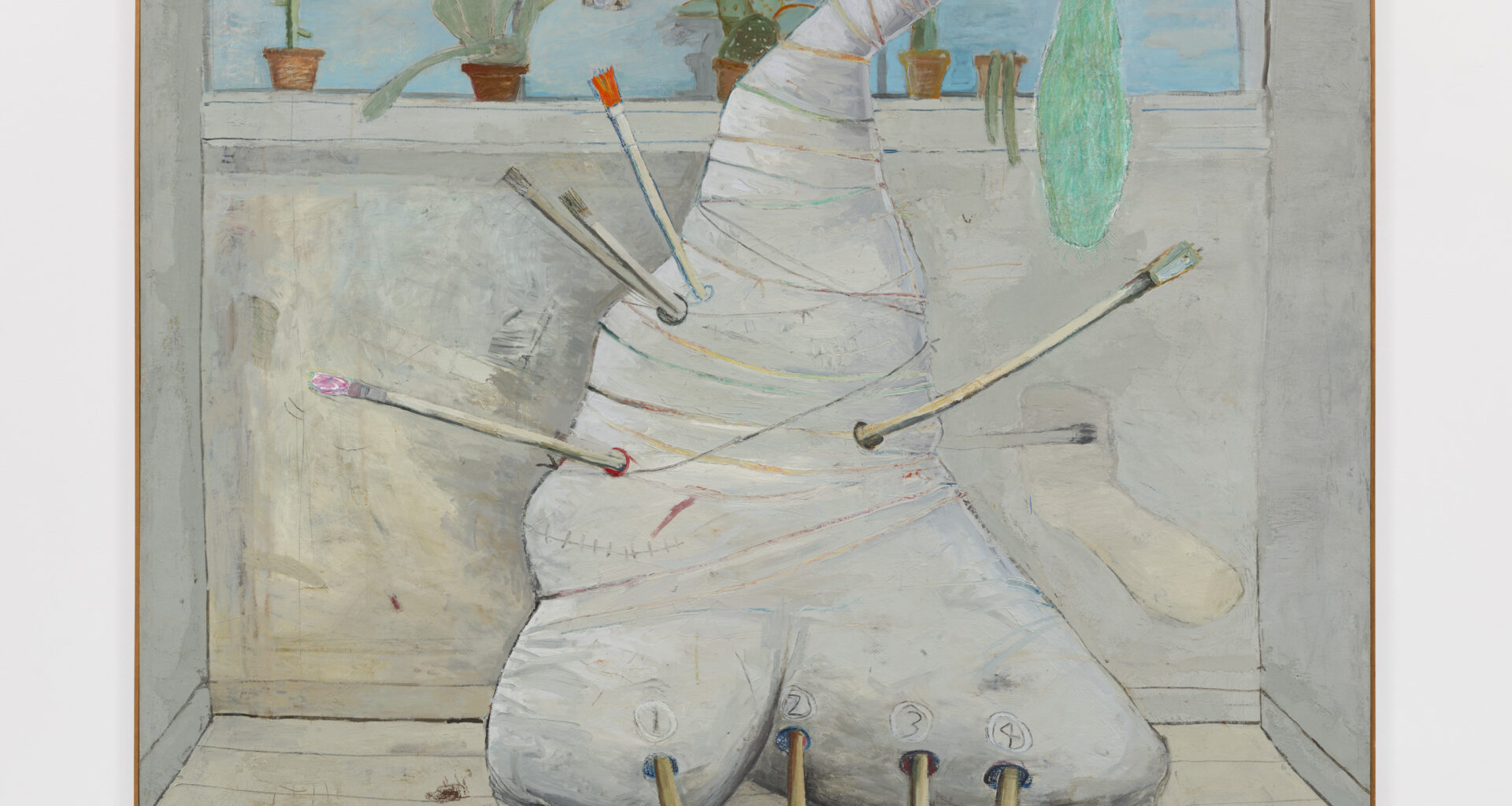
The largest piece, The Race (1973), predates all others on view by fifty years and anchors the show as a work of historical significance to Goodman’s journey as a painter. She made it a year after her mother’s death, per her artist statement, aiming to “express the depth of [her] grief while also experimenting with the communicative potential of paint,” and presented it at her debut solo exhibition in Detroit. In the monumental studio painting, we see Goodman beginning to employ a personal vocabulary of symbols: cocooned masses, insects, paints, brushes, and isolated body parts, such as the lone eye hovering midair. The central figure of The Race is a thickly impastoed pyramidal form wrapped in gauze, with small, numbered orifices inserted with paintbrushes—an incarnation of Goodman herself. The designated receptacles for her brushes suggest automation, as if she is going through the motions of creative work while shrouded in grief, blind and numb to the world around her. The form effortfully daubs gray, cyan, and orange on a white sheet laid in the foreground. From under this work-in-progress, a severed foot with red-polished toenails peeks out, resting atop the back of one of the many fat, reddish-brown roaches scuttling across the studio, like foul little tokens of death. Behind the form and a sill lined with succulents, a studio window opens to reveal a clear blue day; the outside world, it appears, is totally oblivious to the artist’s struggle. The tonal dissimilitude of the interior and exterior space reinforces how very lonely grief can be, how incommutable is the private pain of losing somebody. And yet, Goodman’s pictorial intelligence, nascently materializing in this breakthrough painting, makes confronting such weighty truths as these feel not only palatable, but completely enrapturing.
The Race mostly depends on the association of personal symbols to effect its narrative meaning, whereas the two other studio paintings, both from 2023, exemplify Goodman’s hybridization of abstract and figurative modes of expression. The space of Studio 2 is loosely defined by the slanted angles of a few recognizable things—a cruciform easel, a tabletop—which infect the picture’s otherwise non-representational aspects with objective possibility. Textural squares of pure paint thus assume the role of canvases and keepsakes that are leaned, stacked, and hung against a wall of drippy pastel hues. Only one painting within Studio 2 is quoted with any real detail: a scribbly all-red vertical, its central aperture circling the rosy outline of a sulking quadruped. Studio 3 depicts a similar environment, with two works (including the aforementioned Studio 2) leaning against the wall and, at center, an easel supporting a square painting of a scribbly all-red triangle. Particular items are secondary to these pictures; more to the point, Goodman uses her workspace and its contents as a framework for the evocative relations of color and form. Studio 2 and Studio 3 reflect the contentment and lively experimentation available to her in the studio, to be sure, but also bear a sense of foreboding. Amid otherwise buoyant colors, malignant black forms slink around her canvases, ambiguously betokening doom. As with the cockroaches and disembodied foot of The Race, these shadowy intruders signify death as an unavoidable fact of life, peripherally present even in her sanctuary.