
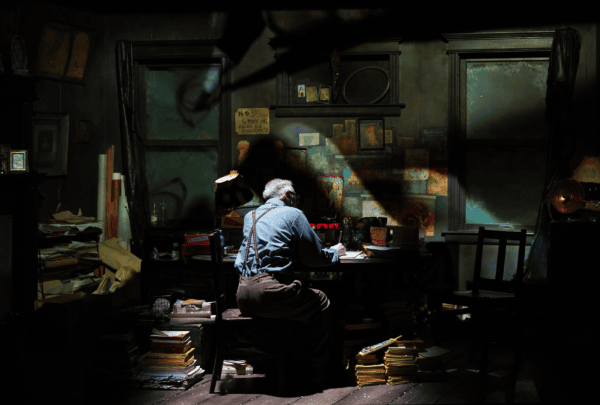
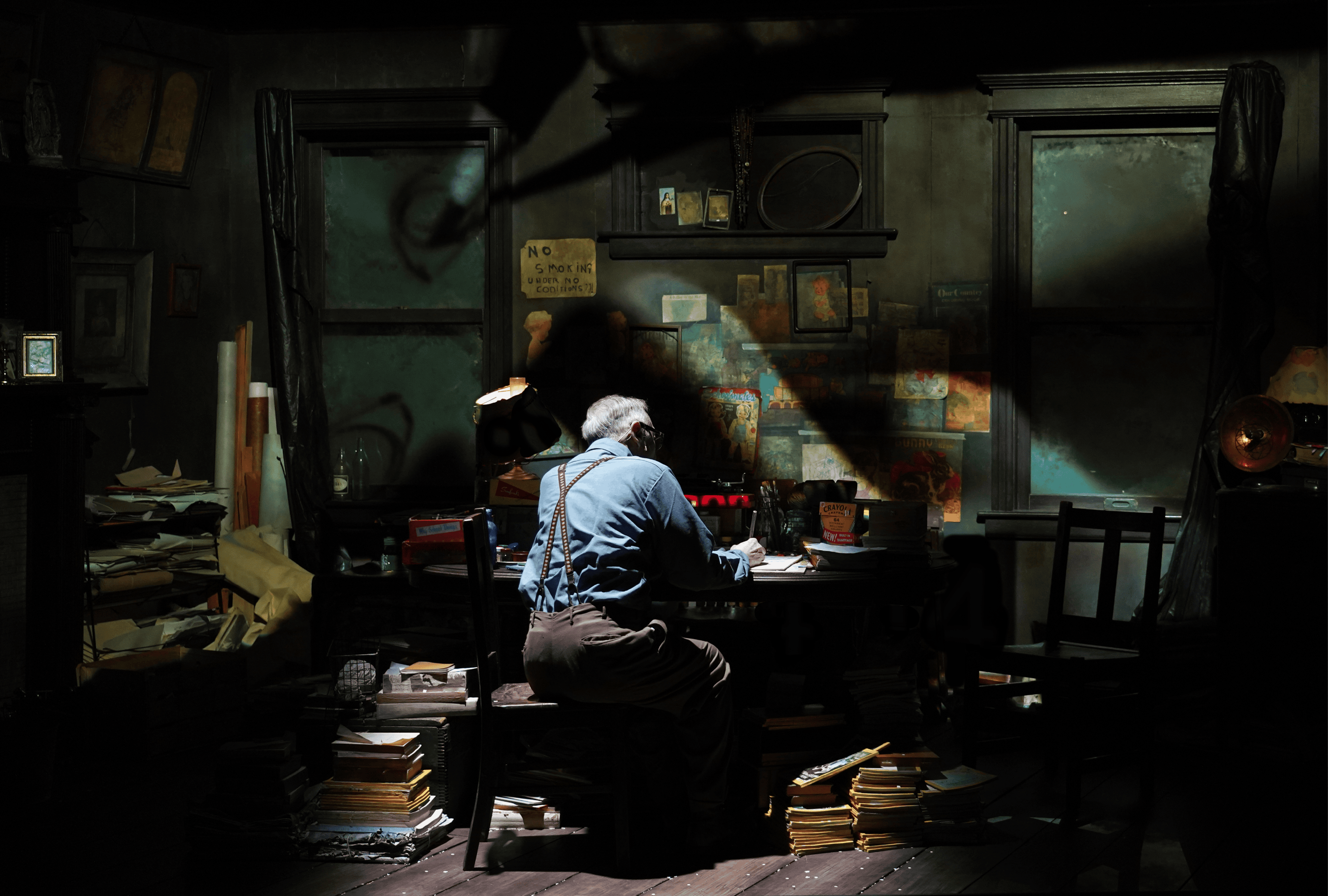
John Kelly in Bughouse. Photo: Carol Rosegg
Outsider artist Henry Darger was obsessive and incredibly prolific, producing tens of thousands of pages of writing and more than 350 watercolor paintings, most of it comprising an epic, and often disturbing, work about the Vivian Girls, a group of heroic warrior children. Darger’s life, on the other hand, was mundane, lonely, and sad—he lost his mother young, his father wasn’t able to care for him, he was institutionalized as a child, and as an adult, he lived alone in a small Chicago apartment and worked as a hospital janitor. Adapted from Darger’s extensive writings by Beth Henley and conceived and directed by Martha Clarke, Bughouse seems to be striving to find the roots of Darger’s art in his life in very literal ways. It’s unexpected from an artist like Clarke, whose work, as the artistic director’s program note says, dissolves the boundaries between movement, text, and visual storytelling. She’s perhaps best known for staging a Hieronymus Bosch painting—and yet with all this rich, strange material, and with performance and visual artist John Kelly playing Darger, somehow Bughouse still hews disappointingly (and sometimes bafflingly) close to a cookie-cutter autobiographical one-man show.
Which is not to say Bughouse is lacking in representations of Darger’s art. Projections by John Narun, often animated by Ruth Lingford, fill the space with it. First, the windows of the cramped parlor of Darger’s apartment (production design by Neal Patel) turn into screens that alternate between showing the weather outdoors and displaying either Darger animations or black-and-white stock films from the era of Darger’s childhood. Then figures begin to appear in the dresser mirror: Darger’s central character Annie Aronburg–whom we sometimes hear speak in a recorded voice–or a photograph of a little girl. Finally the whole room swarms with imagery: walls, ceiling, doors. The animation conveys both the sly charm and the creepiness of Darger’s work; it may look like old-fashioned cartoons, but there is also a lot of violence against children and drawings of nude little girls.
Bughouse’s use of technology feels more sophisticated and sharper than what you’d see in one of those “immersive Van Gogh” art exhibits. Alongside the projections, Arthur Solari’s sound design and Christopher Akerlund’s lighting effectively build a liminal world. But as a theater piece, it’s shockingly inert. Even at barely an hour long, it repeats itself, in a way that I imagine is meant to speak to Darger’s recurring preoccupations but instead feels like a heavy-handed way to zero in on his central traumas.
It feels like Henley and Clarke are trying to find motivations in Darger’s past for his work—the line “I do not remember the day my mother died” repeats three times in a show that’s barely an hour long. But that kind of one to one equation of traumatic input and artistic output feels facile, even more so when it’s so thinly sketched.
And while the show’s use of technology is overall a high point, even some of these choices don’t feel thought out: Why do they mix recorded and live presentations of Darger’s voice? Similarly, some of the other “characters” or voices are recorded and some are performer John Kelly putting on voices to dialogue with himself. The period stock films that alternate with the animations also feel rather generic; they don’t illuminate much about Darger or his world.
Performer John Kelly gives it his best shot, and you do get the sense of a person lost inside his own private universe, a person obsessively ruminating on his past. But what we don’t get a strong sense of is Darger creating: given his output, there must have been barely a day when he wasn’t feverishly writing or painting or collaging the scrapbooks that also made up a portion of his oeuvre. There are drawings and paintings pinned to the wall of the set, but we don’t see him making them. Instead we see him typing, fairly sedately, and we feel less his fervor for his work than the dutiful precision of the clerk.