
Real journalists wrote and edited this (not AI)—independent, community-driven journalism survives because you back it. Donate to sustain Prism’s mission and the humans behind it.
The New York City Council’s freshly minted Committee to Combat Hate held a hearing on Feb. 25 to introduce multiple controversial pieces of legislation seeking to institute “buffer zones” around houses of worship and educational institutions in reaction to pro-Palestine protests.
Two bills, dubbed the “Buffer Act,” initially aspired to apply buffer zones of “up to 100 feet” outside houses of worship and “up to 25 feet” outside educational facilities. Both bills were amended to remove explicit distances after the New York Police Department (NYPD) intervened, rendering both effectively redundant to existing NYPD procedure against blocking entrances and exits, according to testimony from NYPD Deputy Commission of Legal Matters Michael Gerber.
Gerber told the committee that the NYPD already creates “frozen zones”—also known as buffer zones—based on NYPD discretion.
Despite the bills’ adjustments, a coalition of organizations for abortion rights, Palestinian liberation, the New York Civil Liberties Union (NYCLU), and others spoke out against the proposals, which came as lawmakers introduced similar buffer bills on the state level. The groups have vowed to continue organizing against legislation they say intends to criminalize protest and institute censorship zones while employing laws that are meant to protect abortion clinics from harassment from anti-abortion extremists.
Besides actions from city and state lawmakers as well as the governor, protesters are also being targeted by the Department of Justice (DOJ), which has used the Freedom of Access to Clinic Entrances (FACE) Act of 1994—intended to protect abortion clinics—to crack down on pro-Palestine and other organizers.
“The people who are trying to put these laws into power … they’re against pro-Palestine protesters,” said Margot Varrat, an abortion rights activist with New York City for Abortion Rights who testified against the bills at City Hall. Varrat is using a pseudonym out of fear of right-wing retaliation. “So the people primarily speaking up against it are pro-Palestine groups.”
She added, “People need to keep in mind that if these laws get passed, whoever’s in power next could be targeting whatever they’re against. It could be LGBTQ+ demonstrations that could get targeted under different admin.”
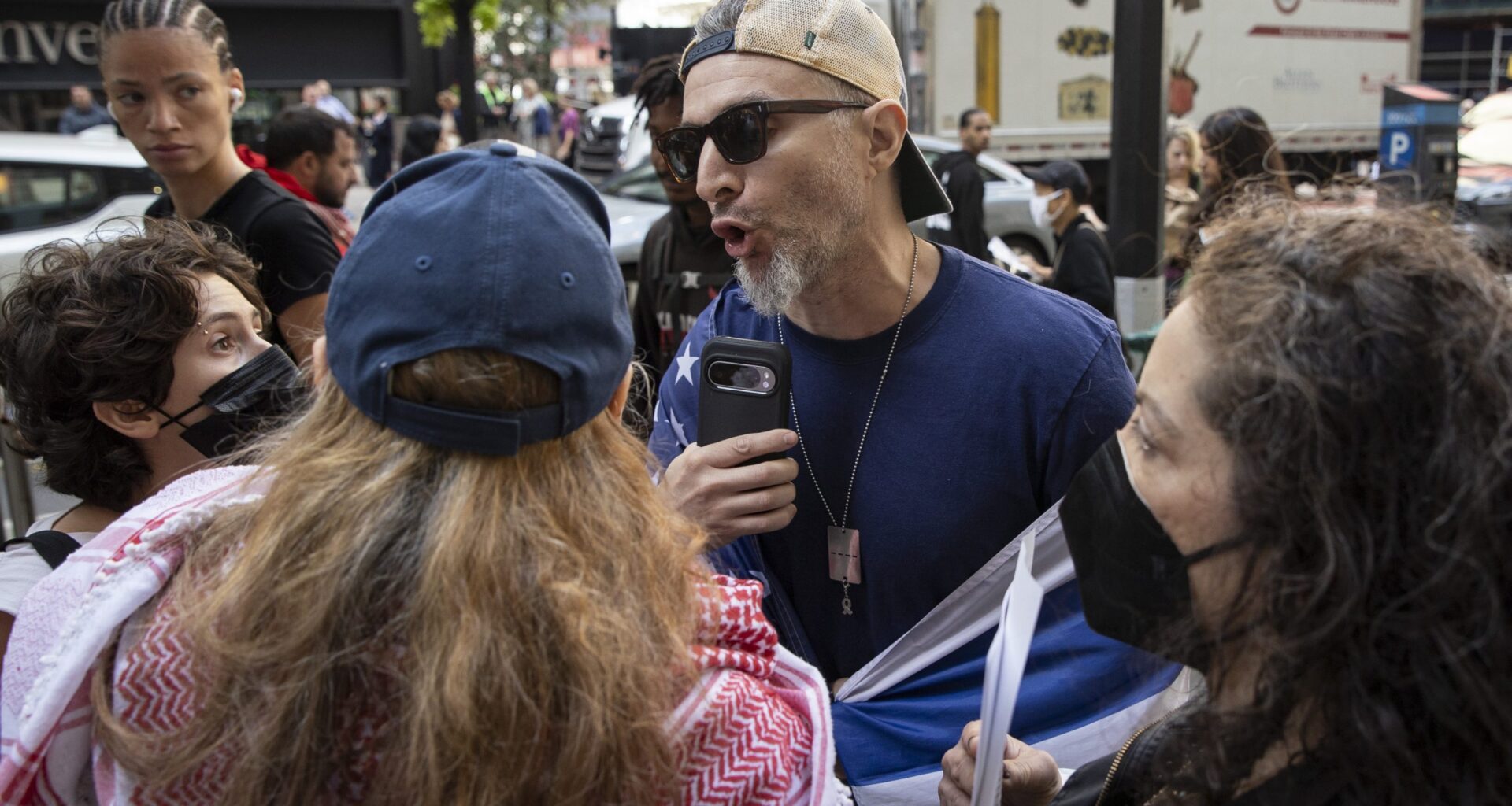
While Council Speaker Julie Menin initially claimed that her buffer legislation was intended to protect all New Yorkers, she later admitted during the hearing that a primary motivator behind the bills was a November protest against an Israeli land-sale event held at the Park East Synagogue. Israeli settlement program Nefesh B’Nefesh held the event in the closed school portion of the synagogue. During that demonstration, some protesters—who organizers told Prism were not part of their group—were heard chanting in support of Hamas. Later, far-right counterprotesters alleged that the entrance to the synagogue was blocked and that worshippers were prevented from praying. Prism was unable to verify this claim.
“That is one of the main reasons we’re here is to address what happened and to fix that so that never happens again,” Menin said during the hearing. “Any suggestion that the bills aren’t needed is just minimizing what the impact has been to the Jewish community.”
Harmeet Dhillon, DOJ assistant attorney general for civil rights, promised to investigate the protest and said on X at the time that the DOJ “has zero tolerance for violence/obstruction around any American house of worship.”
State-level crackdown
The protest outside the Park East Synagogue also sparked jointly introduced buffer bills in the New York State Assembly and state Senate. In January, New York Gov. Kathy Hochul announced intentions to pursue legislation establishing 25-foot buffer zones outside of places of worship and health care facilities, citing “venomous and hate-fueled demonstrations” to protect people who seek “to exercise their right to worship … in a manner that is safe and free from harassment.”.
In January, the state Senate introduced the Public Protection and General Government Executive Budget bill for fiscal year 2027, in coordination with Hochul’s legislative agenda, which the NYCLU described as unconstitutional. The budget’s initial draft sought to restrict protests outside houses of worship and abortion clinics with a buffer zone of 25 feet and defined a “house of worship” to include the public sidewalk “that touches such building or structure.” The executive bill from Hochul added language to criminalize the “intent to alarm and annoy.” On March 10, the Senate responded to Hochul’s budget bill by removing the explicit 25-foot buffer and all unique portions of Hochul’s legislation, leaving only the obstruction of entrances and exits a misdemeanor—legislation that already exists under FACE Act as a federal felony.
“Both of these proposals are solutions in search of problems,” civil rights lawyer Ron Kuby said in a text message. “The police already have full authority to maintain access to houses or worship and schools, while permitting demonstrators to be within sound and sight of the thing they are protesting. The proposals make no distinction between houses or worship being used for religious observation, and those being used for a secular purpose such as gun shows, job fairs, or real estate sales.”
Jen Goodman, director of rapid response for Hochul’s office, told Prism in an email statement, “The Governor looks forward to working with the legislature to pass a budget that makes New York safer and more affordable for working families.”
Assemblymember Micah Lasher and state Sens. Sam Sutton and Liz Krueger, who introduced the state bills, did not respond to requests for comment.
To date, no legislation has been introduced prohibiting houses of worship from hosting events that violate international law or that run afoul of federal anti-discrimination laws. In addition, no investigation or legislation has been introduced in response to counterprotesters at the Park East Synagogue who Prism observed carrying signs that read “Complete the genocide” and “80,000 wasn’t enough,” a reference to an estimated number of people Israel killed in Gaza, as well as an apparent nod to an antisemitic neo-Nazi slogan arguing that the Holocaust didn’t kill enough Jews.
Land-sale protests
While efforts to tamp down anti-apartheid protests are still underway and facing some headwinds in New York, similar legislation has made headway in Democratic-led Los Angeles. In August, LA City Council passed legislation instituting 8-foot “bubble zones” around the entrances and exits to hospitals, medical clinics, schools, and places of worship after a 2024 protest against an illegal land sale drew a mass of violent counterprotesters. The two sides devolved into numerous brawls, with the pro-Israel crowd later chasing and assaulting demonstrators as police stood by, according to on-the-ground coverage.
Land sale and settler recruitment events are hosted by Israeli real estate agencies and nonprofit groups. The real estate events market “Anglo,” or English-speaking, neighborhoods, with land or planned developments mixed between those in Israeli-controlled territory and Palestinian lands in the process of being ethnically cleansed. The real estate agencies and nonprofits involved, such as Home in Israel, Nefesh B’Nefesh, and Getter Group, gear their marketing toward English-speaking U.S. and Canadian Jews to make Aliyah, or emigrate to Israel.
PAL-Awda, a coalition that advocates for the Palestinian right of return and monitors for land-sale events, goes to great lengths to determine if an event organizer or a specific event sells stolen Palestinian land, according to civil rights attorney and PAL-Awda organizer Leena Widdi.
Widdi said the hosts of illegal land-sale events exclude access through practices such as requiring proof from a prospective attendee’s rabbi that they support Zionism. These tactics have been investigated for violating anti-discrimination laws. Widdi challenged allegations of antisemitism or intimidating houses of worship by pointing out that PAL-Awda calls its protests long before the group even knows the location, and has organized protests wherever illegal land-sale events are hosted, whether in a synagogue, a house, or at a hotel.
“They’re literally selling land in territory that’s deemed illegal under anyone’s definition of international law,” Widdi said. “They have cover and an opportunity to completely manipulate the narrative and say, ‘These people are protesting a synagogue.’”
Federal repression
On the federal level, a law initially intended to protect abortion clinics from extremist violence has quickly become one of the foremost ways—besides deadly violence—that the Trump administration is working to stifle protest activity on the left, according to Kuby, the civil rights lawyer, in an interview with Prism.
When the FACE Act was drafted, lawmakers added a provision for houses of worship in order to get conservative votes to help pass the legislation, Kuby said. That provision, Kuby said, was never acted on until now “for a variety of reasons that are going to become apparent as it is now being used by the government.”
Kuby is representing Tova Fry, a 76-year-old grandmother and daughter of Hungarian Jews who survived the Nazi occupation of Hungary. Fry is named as a defendant in a lawsuit filed by Trump’s DOJ in September. The suit accuses Fry of violating the FACE Act by serving a notice of impending legal action to a man who planned to host an event at his house allegedly to sell stolen Palestinian land. The DOJ argues that her actions constitute an attempt to intimidate a house of worship because the man she served allegedly has a prayer room in his home.
Since Fry’s indictment in September, the Trump DOJ has indicted journalists for documenting a disruption in a church in Minneapolis, opened an investigation into a protest against another illegal land-sale event in Brooklyn, and is investigating an activist-comedy group for disrupting a public event at a synagogue for Democratic New York Rep. Tom Suozzi wherein the self-identified goofballs offered him diapers and kneepads for voting to increase funding for Immigration and Customs Enforcement.
“The trouble with passing new laws as a solution is that eventually they’re going to be used against you, and indeed, that time has come,” Kuby said.
“This law is being weaponized against righteous causes,” said Varrat. She used to think the FACE Act existed only to protect clinics, but she has increasingly become concerned with its additional provisions about houses of worship and the murky definition of “health care facility.”
“It’s basically just a law that the government in power can interpret however they want,” Varrat said.
The fight continues
While the use of the FACE Act against leftist protest activity has gained prominence, it didn’t start under Donald Trump: The Biden administration’s DOJ indicted and later convicted abortion rights activist Gabriella Oropesa for spray-painting a number of “crisis pregnancy centers”––which pose as abortion clinics to mislead and coerce people seeking abortions into keeping their pregnancies––in the wake of the Supreme Court’s draft leak overturning Roe v. Wade.
“The Trump administration wants to completely snuff out dissent and shred our rights to free speech and to protest,” said NYCLU Senior Policy Counsel Justin Harrison in a post on the NYCLU website. “New York politicians should be racing to put out this fire, not adding fuel to it.”
NYCLU has indicated intent to challenge buffer bills that move forward in New York, warning that such bills “would broadly prevent First Amendment protected protest, and would increase policing of disfavored communities and messages.”
Widdi, meanwhile, said protests will continue so long as violations of international law do.
“If you don’t want to have protests at houses of worship, don’t organize sales of stolen Palestinian land, which are illegal, in houses of worship,” she said. “It’s that simple.”
Editorial Team:
Sahar Fatima, Lead Editor
Lara Witt, Top Editor
Rashmee Kumar, Copy Editor
Related