
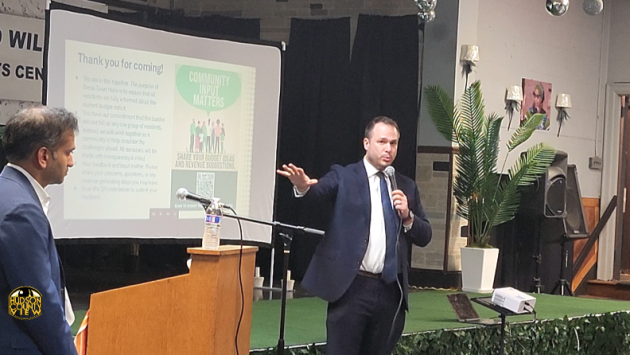
Jersey City Mayor James Solomon said at a Ward B Town Hall that “we will still have to increase property taxes somewhat in the first year” even if the New Jersey Department of Community Affairs approved a significant transitional aid application.
By Daniel Ulloa/Hudson County View
Deputy Mayor for Housing and Economic Development Keshav Poddar began the event at the Miller Branch Library by reiterating that the city has an over quarter billion dollar deficit, which is about 28 percent of the overall budget.
He said that it’s larger than the budgets of the police and fire departments combined.
“It’s unprecedented!” Poddar exclaimed, continuing that one-shot revenues and COVID-19 funds were use recklessly.
He added 36 percent of a resident’s tax bill comes from the city, with 17 percent from the county, and 43 percent goes to the board of education (BOE), adding that municipal funding to the BOE has increased.
“This is a challenging … topic that is a great concern to all of us. While I think we have huge challenges … we have the right people and the right approach,” noted Councilman at-Large Rolando Lavarro said.
Also attending the meeting were Ward B Councilman Joel Brooks and Councilman at-Large Michael Griffin.
“We want to make sure you keep receiving the services you need … We want to make sure people don’t get priced out of Jersey City,” expressed Brooks.
“We do want to make sure that we’re providing the services we need to provide. It’s important that we’re creative in ways to generate revenue,” added Griffin.
Solomon then explained he was in Trenton earlier for Gov. Mikie Sherrill’s (D) first budget address, a $60.7 billion spending plan that has a number of cuts expected.
“There’s no way we can get through this without the state’s support and help. If we were to lay off every single civilian employee … that wouldn’t even get us to half of this deficit,” the mayor declared.
For that reason, the city applied for roughly $150 million in transitional aid, which would come with a fiscal monitor from the state if their application is approved.
“We welcome that,” Solomon noted, continuing that the state has benefited more from the city’s prosperity than they have on the municipal level due to sales tax collections.
Solomon added that the city has not been submitting requests to the federal congressional delegation, which they are going to do going forward, also making it a priority to seek out more grants.
Communications Director Nathaniel Styer read questions from the YouTube livestream, including one about what the city could do about the BOE, highlighting that their budget is over one billion dollars.
“I have no authority to tell them what to do … We want them to understand the budget crisis and produce a responsible budget. I’m hopeful they’ll do that,” Solomon replied.
Additionally, Charlene Burke inquired about the city’s stance on developers who request for variances to construct large buildings where they are not typically zoned.
“I would like for you to make a moratorium on that. Maybe our parks and affordable housing could get money from these developers … The city has not benefited in any way,” she said to applause.
Solomon responded that he did not take any campaign donations from real estate developers during any of his bids for public office, concluding that there must be community givebacks from developers seeking a variance.
With that said, he did not feel that imposing the moratorium she suggested would be legal, also indicating he is still against the Albion Hotel proposal on the corner of Newark and Jersey Avenues since they are not offering any significant community givebacks.
Later, another woman in attendance asked what the total budget will be and how the deficit would impact municipal taxes.
Solomon said the city budget is about $800 million, and most of it is taken up by salaries, which he envisions being money well spent via improved city services, such as more recreational services, better trash pick-up, and regularly filling potholes.
He then addressed what many residents want to know: The bottom line for the tax increase.
“If we are getting the state support that we are hoping to get, there will still be difficult, tough choices. We will still have to increase property taxes somewhat in the first year and we will have to not fill vacancies that we have in the city,” the mayor said.
“Find ways to save money through efficiencies, ultimately we have to get city spending and city revenues even to each other.
He added that they’re compiled a list of ideas on addressing short-term and long-term budget issues, also mentioned shared services agreements with the county and state.
Another attendee asked if the city was ever audited during the prior administration, to which Solomon said yes, but it’s unclear if anyone ever truly went under the hood to see what was really going on.
He said after winning the December 2nd runoff, his team knew they had to clean house at the Finance Department and thought the deficit would be substantial at around $100 million, but it ended up being more than $250 million.
Solomon also said the city will be going after bad landlords by enforcing their rules on the books, which he feels will help the city’s finances in the long run.