
On 11 March, 2022, five ministers stood up one by one in the Northern Ireland assembly chamber, and spoke. With conviction, and in sombre tones, the ministers – one from each party in the NI executive – delivered a public apology to victims and survivors who, as children, had suffered physical, sexual and emotional abuse at the hands of institutions across the country, between 1922 and 1995.
It was a long-awaited and highly anticipated occasion – the Historical Institutional Abuse Inquiry, led by Sir Anthony Hart, had been set up in 2012. He reported in 2017 but survivors had to wait five years to hear the apology because the Northern Ireland assembly had been suspended.
Public apologies are auspicious events. “If done properly, they represent the first official state acknowledgement of harm,” says Prof Anne-Marie McAlinden, an expert on the topic at Queen’s University Belfast school of law. This acknowledgement is hugely significant for survivors. “It’s their number one priority,” she says. “It’s the first time they’re hearing, officially from the state: ‘We were to blame for what happened to you.’” Public apologies are also important from a societal point of view, functioning as a way to break the silence around abuses and harms, and helping the wider public come to terms with what happened in the past.
Crucially, says McAlinden, they also mark the beginning of the process of restitution. “They don’t necessarily represent justice in and of themselves … but are a gateway into the broader justice process.”
In Northern Ireland, the legacy of institutional harm towards children is profound. The inquiry found that thousands of children had been exposed to abuses in institutions such as care homes run by local authorities and the Catholic church, juvenile justice centres, and the charity Barnardo’s.
As well as suffering sexual abuse, they were harmed in a variety of other ways, such as being beaten at random, referred to by a number instead of their names, bathed in harsh cleaning fluid, chastised for bed-wetting, bullied, and deprived of any birthday presents, soft toys or comforts. The list of offences is harrowing, and many survivors interviewed for the inquiry spoke not only about the trauma they had suffered but how they felt invisible and unheard.
In 2020, Fiona Ryan was appointed as the first Northern Ireland commissioner for survivors of institutional childhood abuse, to represent survivors and amplify their voices. Ryan had spent a decade at the helm of the Sonas domestic violence charity, the largest provider of frontline support services to women and children experiencing domestic abuse in the Republic of Ireland.
She wanted to ensure that a public apology was done in the right way, so that it could adequately serve as a bridge towards restorative justice, symbolic repair and accountability. So she reached out to McAlinden, explaining what she wanted to do.
One issue she faced was that, although the Hart inquiry recommended that there should be an apology at a public place, it didn’t specify what it should contain. McAlinden was well-placed to advise as she had set out in previous research what the essential elements of a public apology should be. Importantly, her research has always been survivor-led, so she was able to convey what an apology that was centred on their perspectives might look like.
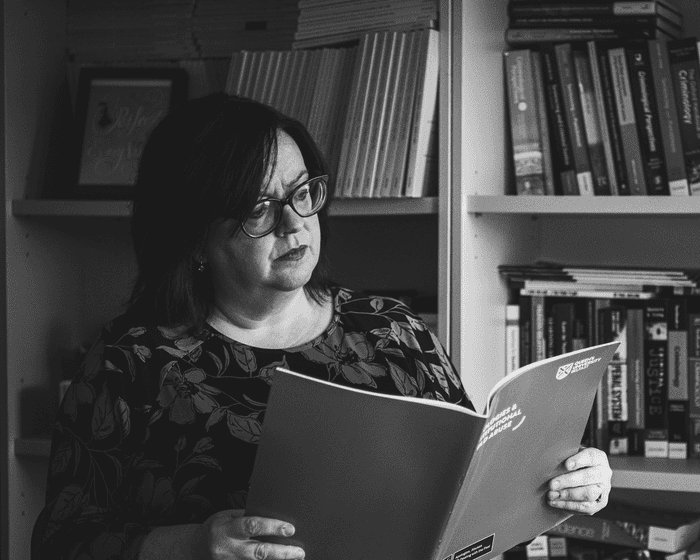
Fiona Ryan, when appointed as Northern Ireland commissioner for survivors of institutional childhood abuse, approached Prof McAlinden for recommendations. Composite: QUB/Stocksy United
According to McAlinden, a public apology should contain five distinct elements: acknowledgement of harm; acceptance of responsibility; expression of remorse; assurance of non‑repetition; and offer of repair or corrective action. So, when ministers stood up on that day in March 2022, did these elements come across? McAlinden says they did, and it felt genuine: “You could see the emotion, some of the speaker’s hands were quivering.”
Although the apology generally landed well with survivors, it did feel “downgraded”, McAlinden says. Instead of being delivered by one head of state, it was spoken by representatives of the five main parties due to the ongoing instability of the government. But it did go over more favourably with survivors, says McAlinden, than other apologies made by different institutions that did not contain the five elements and lacked real emotion.
At the end of the day, what is most important is what happens next. We live in a society where political figures and celebrities are constantly apologising, says McAlinden. So while it’s essential to get it right, the restitution and policy change that follows is key.
To that end, the partnership between Ryan and McAlinden served to create a bridge between academia and public service, informing the restitution process as well as the apology. A redress scheme involving financial compensation was made available, and an ongoing support service is offered. In February, a memorial was unveiled at Stormont, which Northern Ireland first minister Michelle O’Neill said would stand “as a permanent acknowledgement and reminder that children were failed by the state and by others who had a duty to protect them”.
Ryan pointed out that it was those who had been hurt who should continue to be held up for their bravery: “Victims and survivors have done us all a massive public service … their testimony, their courage has enabled us to understand what happened … to a whole generation of children in Northern Ireland.”
A force for change: discover more about the real-world impact of academic research at Queen’s University Belfast