
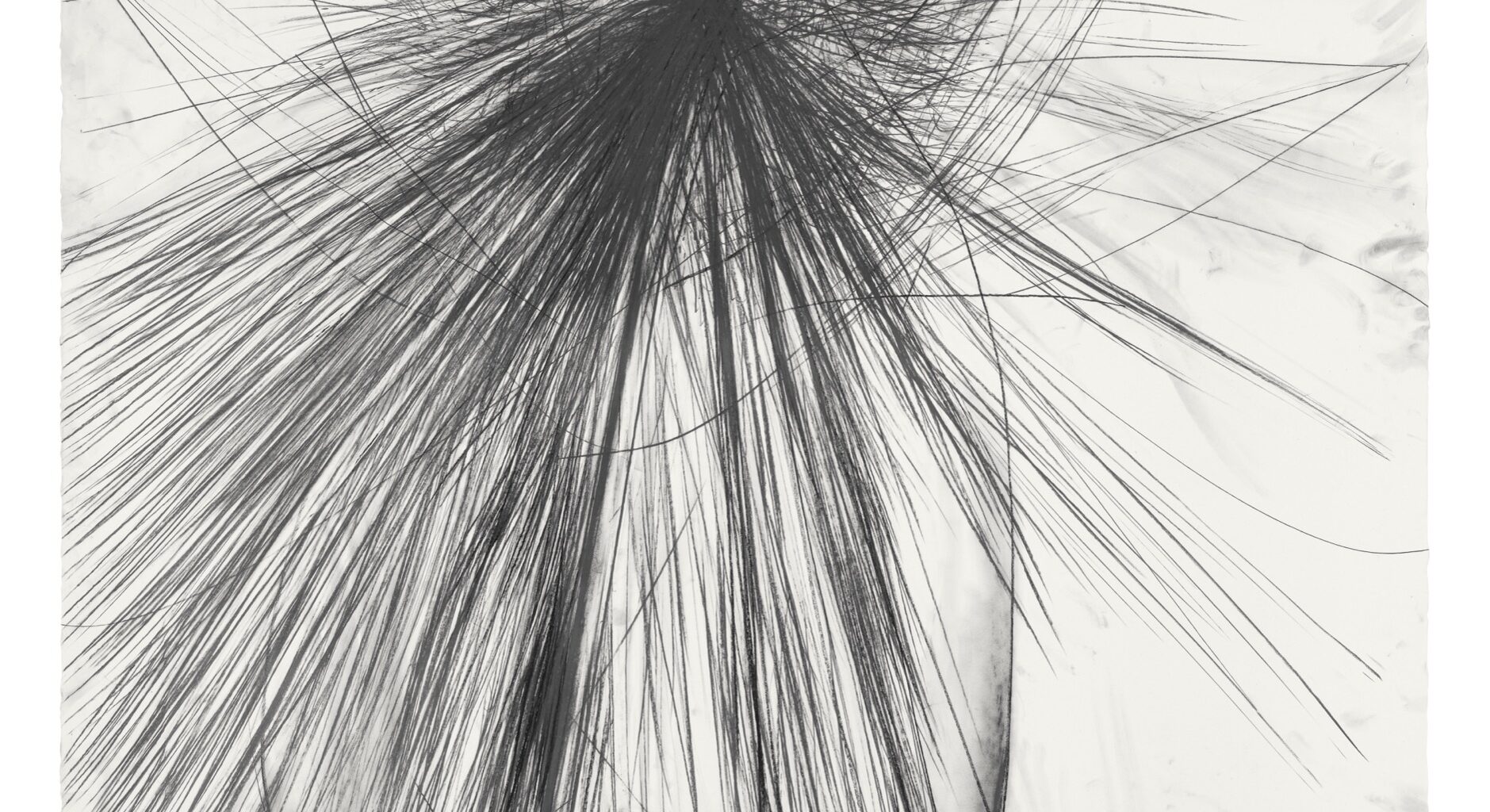
Sterling Ruby: Atropa
Sprüth Magers
January 30–March 28, 2026
New York
In June 2022, the first time I ever frollicked through the oversized installations of Art Basel’s Unlimited sector, I promised to always build a relationship with art before reading about it, thwarting my honor student aims to get it “right.”
I’ve since honored this approach, experiencing its pleasures and plentiful pitfalls. Recently, for instance, I braved a biting Upper East Side evening to catch the opening of Atropa at Sprüth Magers, the latest show by American artist Sterling Ruby, best known to me for his beguiling spray paintings, four of which made a little cathedral amid Miami’s Rubell Museum when I visited in December 2024.
The first works I encountered upon entering the gallery were Ruby’s looming new scrawls. “Blech,” I huffed. “He made merchandise.” Alas, that time, my trusty method revealed a muscle that had atrophied into cynicism. Desperate graphite streaks orbiting the explosion of MORNING GLORY (9098) (2025) caught my eye. I wondered whether I was the problem. Lingering, I noticed how floral forms arise from these frenzied, repeating gestures. The resulting shapes—especially on SCHIZANTHUS LITORALIS (9056) and OPHRYS (9092) (both 2025)—simultaneously evoke strange attractors, which map the habits of chaotic systems. With time, these drawings reminded me that all solid matter remains vibrating, that even wildflowers honor Fibonacci sequences. Order can devolve into madness, or shake out of it.
Several of Ruby’s notoriously disparate, diligently compartmentalized series converge in Atropa. The most imposing among them is a new sculptural series of metal armatures cradling delicate, decaying flowers. A separate nook, isolating them from their dance with Ruby’s drawings, displays several series of charming collages, mostly pairing watercolor flourishes with barren natural motifs. Brittleness permeates Atropa, consistent throughout the exhibition’s many mediums, underscoring Ruby’s renowned polymathic prowess.
A week later, I returned to see the full collection—a fitting term for this varied show, considering Ruby’s fashion endeavors—one more time before reading. I’d enjoyed contemplating the sculptures in the interim. Flowers, of course, mark the ultimate icon of gorgeous, unrelenting mortality. On a bitter, wintry opening night like that, in a bleak year like this, it had been easy to equate these reliquaries with America’s fragile democratic experiment, their armatures the sterile, unforgiving system that’s propped it up. That notion was by no means a reach. Ruby, born on a military base in 1972, made a career-defining splash with SUPERMAX, a 2008 Los Angeles museum show exploring the aesthetics of maximum security prisons, for starters. Savoring my chance to witness his new sculptures without crowds, I noticed one quiet detail: none of these blooms, tall or short, touch the ground. Instead, they hover above it, reduced to specimens, uprooted from the earth. When I finally laid eyes on a press release, the title of this series, “Bound Flower,” struck me, coloring my interpretation of “support.” The literature also confirmed my suspicions that Ruby had used real plants. Although the sculptures are entirely bronze, he employed the 6,500 year-old lost-wax method to cast actual flowers, immortalizing every spike and thorn in meticulous, devotional detail. The metal armatures are the actual sprues and gates used to incinerate each sacrificial cutting, in an artistic process historically likened to rebirth.