
“These projects outline a practical roadmap for a new era of public space in New York: streets can function as parks, transportation corridors can double as civic spaces, brownfields and forgotten infrastructure can be reclaimed for public life.”
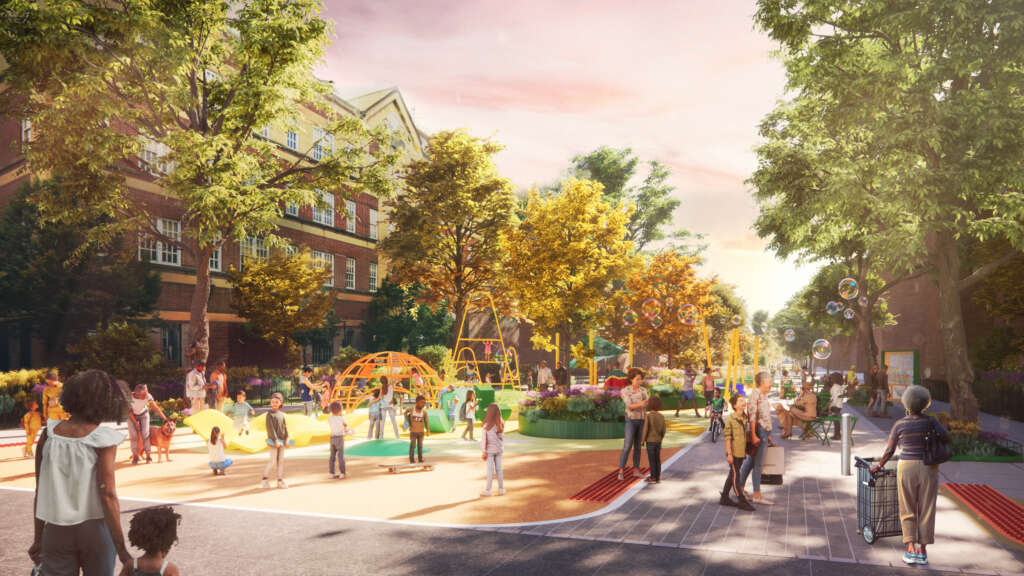 A rendering of the planned revitalization of of Paseo Park, a 26-block stretch in Jackson Heights, Queens that will be transformed into a promenade. (Courtesy WXY)

While New York City’s skyline gets the most fanfare, one of our city’s most valuable assets are its shared spaces, from humble stoops and bustling sidewalks to Central Park. These communal places make a dense and expensive city more livable, and are increasingly critical at a moment when affordability, public safety, and climate are all under threat.
During Mayor Zohran Mamdani’s first week in office, newly appointed Department of Transportation commissioner Mike Flynn spoke about making New York’s streets the “envy of the world.” If that promise is going to hold weight, the city will have to invest in public spaces that are greener, safer, and more democratic across all five boroughs.
The good news is the ingredients for many of the most promising approaches to doing so are already here. As public space practitioners, we’ve spent years working on innovative projects across the city and seen what actually works. The new administration doesn’t need to start from scratch, it needs to look at what’s already proving itself and commit to doing more of it, in step with local communities and especially in neighborhoods that have been overlooked for too long. Here’s where to start:
Turn more streets into public space
Launched at the peak of the pandemic in 2020, the Open Streets program showed how quickly New York could expand its public realm, transforming how we experience many of the streets around us. A prime example of the program’s impact can be seen in the forthcoming revitalization of Paseo Park, a 26-block stretch in Jackson Heights, Queens that will be transformed into a walkable, car-light promenade in one of the city’s most park-deprived neighborhoods.
A similar idea is taking shape in Manhattan through NYC DOT’s “Broadway Vision,” which is stitching together plazas, shared streets, and pedestrianized segments into a continuous north-south spine between Union Square and Columbus Circle.
In Williamsburg and the mayor’s own former neighborhood of Astoria, the city has created low-stress, people-first corridors where bikes, scooters, strollers, and pedestrians have priority and cut-through car traffic is discouraged. What makes this model powerful is its scalability. Nearly every neighborhood has a handful of residential streets that could become bike boulevards with modest capital investment, expanding the city’s network of car-free infrastructure.
These spaces show how a pandemic-era solution can become a permanent part of daily life, linking neighborhoods, enhancing communities, and making the city safer for pedestrians and cyclists. The big question is how they can be funded and maintained in less affluent parts of the city, where public-private partnerships are harder to pull off.
Revive infrastructure for the people
Public spaces aren’t just for leisure and lingering, they shape how we move through the city every day. The Edwin J. Grant Memorial Highway in the Bronx shows how transportation infrastructure itself can be reimagined as a public asset. Long a symbol of danger and disinvestment, the corridor is now being repurposed around bus rapid transit (BRT), better crossings, greener medians, and more public amenities.
Done well, BRT can deliver reliable, dignified mobility and public spaces to communities cut off by highways and underserved by subways. When stations are well designed and the priorities of a street are reframed, a transit corridor can become a linear civic space that reconnects neighborhoods instead of dividing them.
Reclaim Abandoned Spaces
Some of the most ambitious public-space projects take place on land that was written off for generations. Fresh Kills Park on Staten Island is a vast regional park taking shape on a site that was once the world’s largest landfill.
This is a major environmental success story, as well as a reminder that even the most damaged landscapes can be returned to public use if the city thinks in the long term. Wetlands, trails, renewable energy fields, and cultural spaces can eventually replace mountains of trash. In an era defined by the crisis of climate change, Fresh Kills offers a model for how remediation, ecology, and recreation can be braided into a new kind of urban commons.
The same spirit animates Gotham Park, a community-led effort to transform the forgotten space beneath the Brooklyn Bridge into a connected public asset. For decades, this area was a patchwork of defunct plazas, dead end streets, and fenced-off infrastructure. Now, through an incredible grassroots campaign led by Rosa Chang, it is slowly expanding into a network of plazas, skate parks, and play spaces that links Chinatown, Two Bridges, and the Financial District.
Reusing underpass spaces is one of New York’s great untapped opportunities. Below the viaducts of the BQE, Gowanus Expressway and other highways across the city, new public spaces await. These places already belong to the public; they just need design, programming, and maintenance to become welcoming rather than forbidding.
Taken together, these projects outline a practical roadmap for a new era of public space in New York: streets can function as parks, transportation corridors can double as civic spaces, brownfields and forgotten infrastructure can be reclaimed for public life. Mayor Mamdani does not need to invent this future, only commit to it at scale.
That means stable funding and staffing, clear rules, and the willingness to prioritize people above all else. It also means making sure these investments reach every borough—especially the places that have historically been underserved.
In a truly new era for public space, a child in the Bronx, a senior in Queens, and a family on Staten Island will all have access to safe, green, joyful places right outside their doors. We already have the ingredients. What we now need is the political will to learn from these success stories—to make New York, already the envy of the world in so many ways, somewhere you can walk, bike, and breathe in.
Rob Daurio is director of urban sustainability at WXY and an adjunct instructor at NYU, where his work focuses at the intersection of urban design, climate strategy, and equitable city building. John Surico is a journalist and researcher who focuses on cities and how they’re changing. He teaches cities-focused reporting at NYU’s Arthur L. Carter Journalism Institute, and chairs the 31st Ave Open Street Collective in Astoria, Queens, where he lives.